

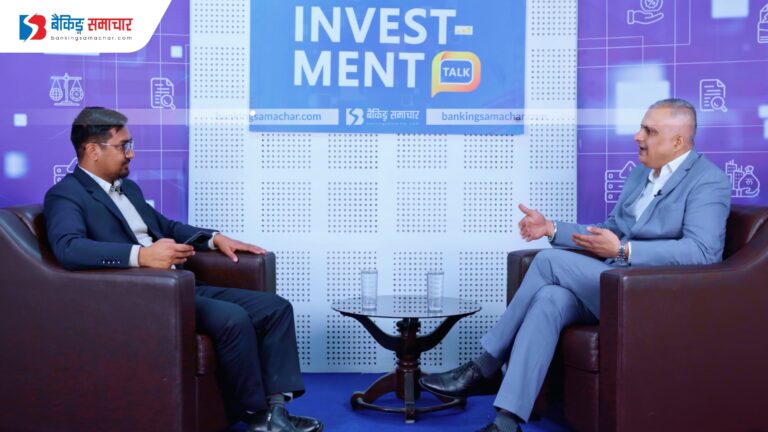
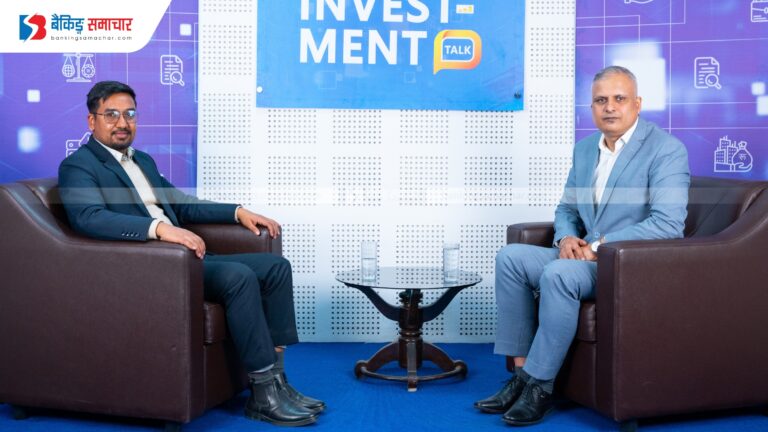
In this edition of Investment Talk Banking Samachar’s Nikesh Khatri explores the future of Ai in Nepal’s Banking Sector with Gaurav Arora, Regional Head of Kiya.ai. The discussion centers on moving Nepal beyond simple digital wallets toward an AI-driven banking revolution. Arora highlights how Generative AI avatars and advanced credit scoring can bring formal banking to rural, unbanked populations. The interview also addresses the critical need for Fraud Risk Management and cross-border remittance innovation. By blending Khatri’s local insights with Arora’s global fintech expertise, the session provides a strategic roadmap for Nepal’s digital and economic transformation.
You are here in Nepal for Fintech Expo 2026, organized by the Fintech Alliance of Nepal. What has surprised you most about Nepal’s fintech ecosystem during this visit?
Well, I won’t say it surprised me; it met my expectations. I was expecting to meet players from the entire ecosystem of Nepal fintech—starting from the regulators and policymakers to bankers and the local fintech players. It was a very good experience understanding their vision of taking this fintech to the next level, focusing more on policies and how they can utilize technology to bring a framework for providing better solutions to end customers.
After interacting with Nepali startups, banks, and regulators at the expo, do you see Nepal as a serious AI fintech market or is it still an early-stage opportunity?
I believe the fintech players and technology people are ready with the technology. It’s up to the regulators to provide approvals for the banks and insurance companies to look at the correct use cases that can help them bring back ROI. As of now, AI has been limited to reducing costs in contact centers and utilizing chatbots. However, AI can be utilized in many other functional aspects-whether for banks, insurance, or microfinance-to reduce operational costs and enhance customer experience.
Most banks mostly use their chatbot systems to reduce operating costs. Is that the maximum use of AI, or is that an early phase?
That’s a very initial phase. Earlier, we had conventional chatbots trained on word-specific searches; now we are moving into Generative AI. A bot is a very basic use case. There are multiple use cases, such as taking technology to unbanked people through Augmented Reality or creating Generative AI avatars that can help customers do banking in rural parts of the country without needing a physical brick-and-mortar branch.
If we compare to the Indian market, how far is the Nepali banking sector?
It’s in a very initial phase. In India, banks are adopting AI use cases and are in the pilot or PoC phase to increase banking reach to the “last mile” where there are challenges with branches and employees. These AI-trained avatars are helping rural unbanked customers.
Nepal’s fintech growth is visible but largely wallet-driven. Is Nepal ready to move toward AI-led and intelligent banking?
Actually, yes. Wallets help you understand customer behavior. If you utilize AI on the digital lending side, we can offer credit lines to unbanked people who don’t have a formal credit history or documentation. By using AI to analyze customer behavior patterns, you can create a credit score and offer loans through underwriting engines.
What immediate policy signal would convince global companies like Kiya.ai to invest deeper in Nepal?
I would like to see a better framework to reduce digital frauds (Fraud Risk Management) and a framework for additional banking so that everyone has access to a credit line. If the central bank and regulators are open, companies would prefer to come here and invest in technology and manpower.
Can solutions like or virtual banking realistically solve access problems in rural and mountainous regions?
Yes. We launched Generative AI-driven avatars at the Global Fintech Festival in Mumbai. These can help financial inclusion in rural areas. You don’t need a branch; you can set it up in a community center of any village and plug in any kind of banking activity.
How can AI-driven RegTech help Nepal strengthen trust as digital transactions grow?
As we move toward digital banking, fraud risks increase. We need a better framework for Fraud Risk Management. Kiya.ai has a real-time fraud prevention engine that prevents fraud across all channels. Proper security will help take care of financial fraud concerns.
Remittance remains central to Nepal’s economy. How close are we to real-time, low-cost cross-border payments?
That will require collaboration between the two central banks and getting into CBDC (Central Bank Digital Currency). Once that is in place, fintech providers can work together for real-time remittance.
India’s UPI is often discussed. What practical steps should Nepal take first?
We need to increase market penetration. While eSewa and PhonePe are doing a fantastic job, many shopkeepers still prefer cash. We need to look into how to incentivize merchants to accept QR payments or other online channels.
What can Nepali fintech companies learn from Indian fintech companies?
Once they have technology tried and tested in the Nepal ecosystem, they can take it to other countries. In India, the growing economy and startup culture help retain young talent. If Nepal has more startups and global customers, the youth will want to stay and work for the country.
Can you tell me about Kiya.ai? What is it and what does it do?
Kiya.ai is an India-based fintech company. We have been in business for 30 years and provide technology to BFSI (Banking, Financial Services, and Insurance) clients in 56 countries. We offer digital core banking, digital lending solutions, microfinance solutions, and our flagship anti-money laundering (AML) product, which is ranked number one globally. We also focus on Generative AI solutions like metaverse-driven avatars.
Compared to other nations, is Nepal easier or harder to run a business in?
Whomever I have met in Nepal has been very friendly and helpful. I believe I will be doing good business with them. I am still learning about the policies, but I see that banks are in the process of adopting better AML and fraud management policies.
Thank you for this important discussion with us.
Thank you. Thanks a lot. Namaste.

 About Us
Comment