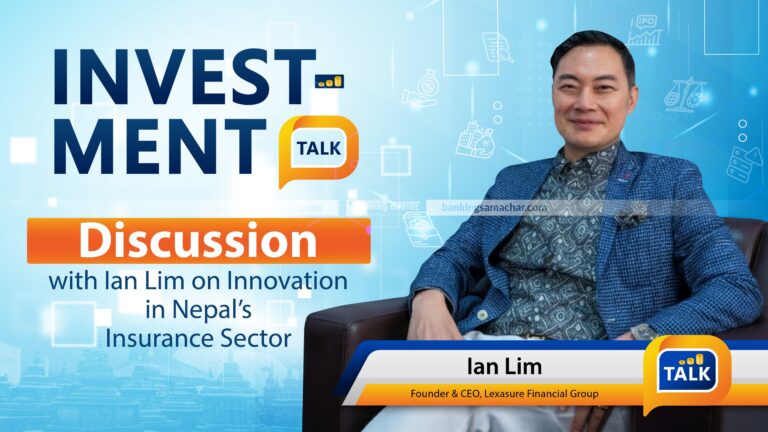

Nepal’s insurance and healthcare financing sector are gradually opening to global innovation, with growing interest in insurtech, preventive healthcare, and data-driven risk management. As policymakers and industry leaders debate how technology and international expertise can strengthen the country’s insurance ecosystem, questions remain over sustainability, affordability, and long-term impact.
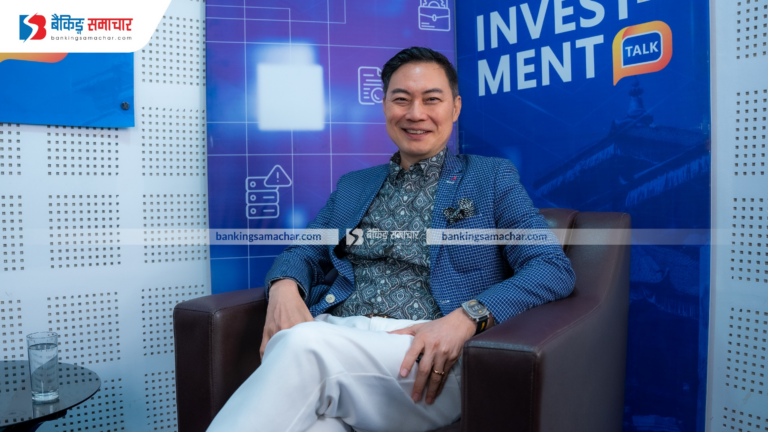
In this edition of Investment Talk, Banking News & News of Insurance’s News Chief Nikesh Khatri speaks with Ian Lim, Founder and CEO of Lexasure Financial Group, on the strategic expansion of insurtech and health-tech innovations into Nepal. Lim, a Singapore-trained lawyer with over 25 years of global experience, visited Nepal as a keynote speaker for the Third National Insurance Discourse 2026, held at the Hotel Yak & Yeti on 21st January.
The conversation focuses on AI-driven diagnostics, including platforms such as Nepal Insurance Market and DexaFit, and examines how global reinsurance expertise and preventive healthcare technologies could reshape Nepal’s insurance landscape and strengthen economic resilience.
Recently you attended the Third National Insurance Discourse 2026. How was your overall experience in that event?
I think it is very meaningful. I listened to different speakers, and there is a genuine interest in building the industry from the capacity side, both in life and non-life. I also looked at the space that we were discussing, which was about healthcare financing. Healthcare financing is always a challenge for economies. However, when you have good medical doctors and great hospital networks, I am sure a lot can be achieved.
Is it impactful or meaningful to you, because you are here to attend this event from Singapore?
Of course. Singapore is well developed, and we are at an advanced stage of the economy. That’s why it’s always exciting to come to a developing country, where insights can be shared and people can learn from different models across the region.
What do you find in Nepal about the insurance sector? Is it developing, is it growing, or what do you find?
Yes, I think when an economy grows, you always see two things happen. First, as people become wealthier, they start looking for more sustainable, long-term life insurance products that serve both as protection and as an investment. Second, there is growing demand on the asset side: covering properties, buildings, and goods in transit. Nepal has a very interesting economic structure. It remains largely agriculture-based, but at the same time, a significant number of people work overseas and send substantial foreign exchange back into the country.
Did this change your perspective about Nepal’s insurance industry?
No, I’ve always kept a close understanding of Nepal. What is really happening is that you are seeing the business expand. There are more reinsurers now, you have Nepal Re, you have Himalayan Re, so there are more players in the market. In general, companies are getting bigger, they are managing more assets, and people are becoming wealthier. You also see more hydropower dams coming up, which I think is a real source of strength for Nepal, rather than relying on energy sources like crude petroleum.
What do you see as the top priority of Nepal’s insurance industry right now?
In the insurance discourse, a lot of things were covered, but it is always about insurance penetration rate, clarity of policy, and affordability. How you can make insurance more inclusive and provide a better service. But you also have a new angle from the digital side some of the smartphone companies and remittance companies are also getting into this space.
Now, I want to focus on your business which is operating in Singapore. You are operating the business across the United States also and Central Europe also, and it is based in Singapore. You are controlling from Singapore, right? And you are a founder and CEO of Lexasure Financial Group Singapore also. At first, what is Lexasure Financial Group and in which sector is it investing?
All right, thanks for the question, Nikesh. So, to understand Lexasure Financial Group is how I have been growing the business. I am like the majority owner of this group. In the space of Lexasure Financial Group, we do insurance, we do services like brokering, we do agency, we do reinsurance underwriting for life and non-life, and we have just added healthcare into the business. Healthcare because of my own personal interest that I think is going to be a very interesting sector. So not just from the health underwriting, life underwriting, but the treatment and therapy space which is also innovating at the same time. So, insurance and health, if you are buying health, you can match the two together.
What are the key focused areas of your company or group?
The key focus area is to bring capital to the group from public markets to our brokerage business. From the life region space, we are looking to find partners in the US and build our intensive life reinsurance further. Then, like I mentioned, we have Dexafit, which has about 100 locations in the US. It does diagnostics for body composition, VO2 Max, and resting metabolic rate. I see the value where that can be translated into an insurance use case.
How many countries are you operating or running your business in?
I sit in an executive role, I have managers that look at different businesses simultaneously. I want to drive it from a strategy and shareholder point of view where I see the most value. For myself, I am looking a lot into the longevity space and how that translates to insurance.
Running these different types of business from Lexasure Financial Group, what are the key focused areas of your company or group?
The key focus area is to bring capital to the group. So, we are looking at bringing capital from public markets to our brokerage business. From the life region space, we’re looking to find partners to work with in the US, build our intensive life reinsurance further, work towards rating to support that. Then, like I mentioned, we also have Dexafit, which has about 100 locations in the US. What it does is diagnostics for body composition, VO2 Max (which is cardiorespiratory fitness), and we do rest metabolic rate which gives you a very good overall physical assessment of a person. I see the value of that where it can be translated into an insurance use case as well.
Right now, you are doing business in so many countries across the world. How many countries are you operating or running your business in?
Well, because I sit in a very executive role, I do have managers that look at different businesses simultaneously. But I want to drive it from a strategy point of view and from a shareholder point of view where I see the most value that we can maximize our time, effort, and returns. So, for myself, I am looking a lot into the longevity space and how that translates to insurance or life underwriting.
It means you can’t say how many countries you are running your business in?
I think if you need to remember count, Southeast Asia is almost every country in Southeast Asia. We do a bit here and there. We write US non-life reinsurance. I am looking at Central Europe as one of our growth areas for 2026. I also look to build more MGA or broking partnerships in the Middle East and Europe to expand a bit of the footprint for the traditional insurance and reinsurance business. Then for Dexafit, it is a growing business that looks to be placed more in Europe where there are a lot of DEXA machines and I think we have a lot of technology to help a lot of the European companies as well.
During this expanding journey, which country is your focused area or focused market to promote your business?
Generally, it is still the US because that’s the biggest market for insurance and it’s also the biggest market for healthcare. So, there is a lot of time and spend and assets that we hold in the US. Nonetheless, we go to different countries and we can see whether we can add value to different economies. We do take a very niche approach towards our business; we should do things where we are good at.
In near future, can we see your group in Nepal also doing business?
Yes, so we are looking at a few things here. Some of the larger risks we are looking to co-broker through our companies that have great relationships to Chinese companies. Then we are also looking at technology for underwriting for health and life, and the space of medevac and evacuation as an assistance business.
I want to know about one thing: what inspired you to be a businessperson and expand across the globe?
I do have a very unusual career. I did work for about 8 years in insurance and broking companies, you just climb up the career path. Then I did my first joint venture more than 20 years ago. I had that for about 3 years, then after that became fully independent. Looking at opportunities at that time was to build a more reinsurance wholesale type of business. Then 5 years ago we bought a reinsurance company in the Cayman Islands to look at US business. At the same time, we also took an interest into health and healthcare.
How do you get the idea to start your own business?
I think there is always a natural progression. Either you take a very corporate career or you could take a very entrepreneurial career. You cannot quite wear two hats at one time because there will be a conflict of interest, but the entrepreneurial road is a career by itself.
If you must compare Nepal and the US market, what are the differences to do business in policy, government, or political parties?
In the US, the legislation for healthcare is very clear. Here we must work with hospital groups that already have the medical license. We are looking at a radiology type of machine for body composition and getting results for ‘structural resilience’ of the body. Nepal is a new market; it is always exciting to see how this market develops. You must look at Nepal through the interest people have in health and sports fitness.
Can you find out key things which are adopted from Europe and US by Nepal?
What we want to do is work with partners here. Key things we want to look at are bringing Dexafit technologies for life and health underwriting, and using it for wellness and preventive care like stem cell therapies, longevity, and regenerative medicine.
Does that mean we have to improve our policy to make it stable?
Of course. There are a lot of tourists who come here with certain insurance policies and they may want to claim against those. That is where services like medevac and evacuation support can help.
Now I want to focus on Dexafit. Can you introduce what is Dexafit?
Dexafit has been a business in the US for about 10 years. They built an AI that is unique because it uses a client database for predictive analytics for cardiovascular risk and Type 2 diabetes using a DEXA scan. It is a software tech service. The hardware is already in the hospitals; we provide the diagnostic service. It looks at ‘structural resilience’ which is different from just looking at chronological age or blood tests.
So, Is it like a ‘super app’ of healthcare?
It is a diagnostic. We look at visceral fat and adipose tissue. We can tell a person if they are ‘thin on the outside, fat on the inside.’ It tells users what to do to be fit and reduce illness.
If I want to use this app, what do I need to do?
My role is to tie up with hospitals that have the machine. You can’t use it directly; it’s medical grade. You would go to a hospital or Dexafit center.
At the last, what message would you like to share with the viewers?
I think we all must work to advance our economies. I hope the upcoming general election goes smoothly and that Nepal gets a government that genuinely takes care of its people. The government’s role is to protect and support the citizens, keep them healthy, and help them live long lives like in Singapore, where they talk about the ‘Blue Zone.’ After all, happiness comes from being able to live a long, healthy life.

 About Us
Comment