
Kathmandu, March 1: Historical data from the Nepal Stock Exchange (NEPSE) shows that the country’s stock market has generally responded positively to elections since 2008, with the exception of the 2017 general election.
An analysis of four elections held since 2013 indicates that the stock market has shown an upward trend in three of them, suggesting that investors tend to view elections as a positive signal for economic stability.
During the Constituent Assembly elections held in 2008 and 2013, NEPSE recorded gains. Similarly, the stock market rose before and after the 2022 House of Representatives election. However, the market declined during the 2017 election period, which analysts attribute partly to the political and structural transition following the promulgation of Nepal’s Constitution in 2015.
The stock market has also shown upward momentum ahead of the upcoming early elections. The NEPSE index has increased continuously for four trading days, gaining about 40 points, with total transactions exceeding Rs 20 billion during the period.
Market observers say elections often boost investor confidence because of expectations of political and economic stability. While the market typically rises moderately before elections, historical data suggest that gains tend to accelerate after the formation of a new government.
Election-related economic activities, including campaign spending and increased domestic demand, also contribute to economic movement, which in turn influences the stock market. Increased imports during election periods further stimulate economic activity.
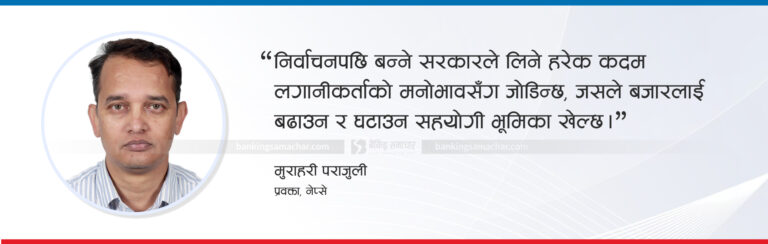
NEPSE spokesperson Murahari Parajuli said government policies formed after elections significantly influence market sentiment.
“Every step taken by the government formed after elections is linked to investor confidence, which plays a role in both market growth and decline,” Parajuli told Banking News.
Share investor Chhotelal Rauniyar said investors usually expect political stability and market-friendly policies from a stable government after elections, which contributes to market growth.
According to him, the stock market reacts strongly during election periods because policy direction, taxation policies, and public statements by political leaders influence investor sentiment.

With more than seven million direct and indirect investors involved in Nepal’s stock market, Rauniyar said it is natural for elections to have a noticeable impact on market performance. However, he warned that less-informed investors could face losses during election periods.
Maoist Majority and Record Market Growth
Nepal’s first Constituent Assembly election was held on April 10, 2008. Prior to the election, the NEPSE index stood at 739 points in March and rose to 747 points shortly before voting.
Within one month after the election, the index climbed to 775 points and reached a record high of 1,132 points by late 2008.
The surge came after the Maoists entered mainstream politics and formed a government led by Prime Minister Pushpa Kamal Dahal, with Baburam Bhattarai serving as Finance Minister. Investors expected Bhattarai to introduce market-friendly policies, which contributed to the bullish trend.
At the time, Nepal Telecom was the largest listed company, accounting for about 19 percent of total market capitalization. Growth in the company’s share price also helped push the overall index higher. Monetary policy introduced before the Maoist-led government was also considered market-friendly.
However, later policy changes, including an increase in capital gains tax to 10 percent and remarks labeling the stock market as a “gambling house,” led to a sharp decline. The NEPSE index fell from around 1,176 points to nearly 290 points.
Market Rise After Congress Majority
The 2013 Constituent Assembly election also saw strong market performance. The NEPSE index hovered around 433 points in early October and climbed to about 600 points by the final trading day before the election.
Within one month after the election, the index crossed 800 points.
The Nepali Congress, led by Sushil Koirala, secured a majority in the election. Investors increased their market participation in anticipation that the new government would deliver a constitution and bring political stability.
Although the constitution was promulgated in 2015 with support from major political parties, political instability has persisted. The next election, originally scheduled for 2027, is now set to be held earlier this year.
2017 Election: Exception to the Trend
Following the promulgation of the constitution in 2015, the first parliamentary election was held in 2017. Unlike previous elections, the stock market declined during this period.
At the time, the CPN-UML and CPN (Maoist Centre) formed a strong alliance that later became the Nepal Communist Party (NCP). While the alliance received strong public support, investors remained cautious.
The NEPSE index stood at 1,560 points one month before the election and fell to 1,529 points just before voting. By January, the index declined further to 1,421 points and dropped to around 1,200 points by April.
2022 Election Shows Mixed Results but Rising Market
The 2022 parliamentary election produced mixed results, with the Nepali Congress emerging as the largest party and CPN-UML in second place. Investors reacted positively to the outcome.
The NEPSE index stood at 1,855 points one month before the election and rose to 1,927 points shortly before voting. Although the index temporarily declined to 1,866 points after the election, it climbed to 2,211 points by late December.
Historical trends suggest that Nepal’s stock market tends to react positively to elections, reflecting investor expectations of policy stability and economic growth. The recent market movement indicates that this pattern may continue in the upcoming election period.

 About Us
Comment