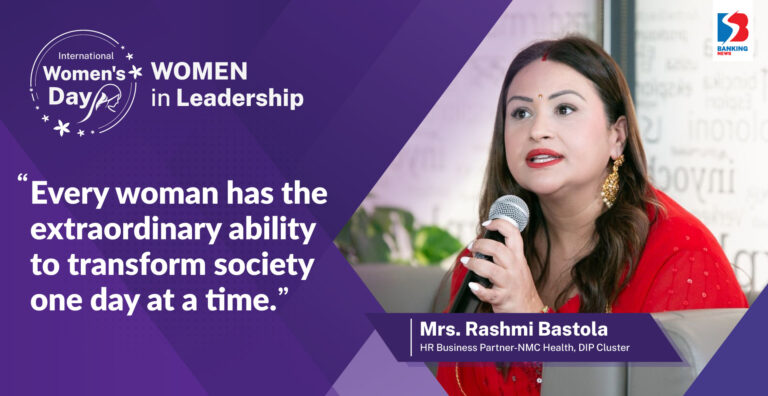

Kathmandu– While many people prefer to follow a safe and comfortable path in life, some individuals choose a different route one filled with challenges and uncertainty. The life journey of Rashmi Bastola reflects courage, self-confidence, and a constant search for growth beyond comfort zones.
Born in Dharan, Bastola had a distinct personality from an early age. She wanted to shape her own future rather than follow the traditional expectations often placed on daughters in society. For many women, the typical path after higher education was marriage and settling abroad. However, Bastola chose a different direction.
Early Struggles in Kathmandu
At just 17 years old, Bastola moved to Kathmandu to pursue higher education. Life in the capital was demanding. She worked at night in a call center serving clients in the United States while attending college during the day.
According to her, the decision was not driven by financial necessity alone but by a desire to experience life differently.
“There are two types of struggles in life,” she says. “When people have nothing, they fight with the world. But when they have enough, they fight with their own mind. The second struggle is often more difficult.”
Bastola chose that second struggle pushing herself beyond her comfort zone and personal limits.
Moving to the UAE
After gaining work experience in Nepal and India, Bastola completed her MBA in Human Resource Management from the Indian School of Business Management.
In 2012, she moved to the United Arab Emirates in search of international exposure and new opportunities. However, the transition was far from easy.
Despite her professional experience in Nepal, she had to restart her career from an entry-level HR position in the UAE. The experience taught her that starting over is not a weakness but an opportunity to learn.
During her first six months, she spent much of her time in company warehouses to understand operational processes, observe working conditions, and identify potential risks faced by employees.
Working in industrial sectors in the UAE posed its own challenges. Temperatures often reached 45 degrees Celsius, working environments were demanding, and many laborers were uneducated. Bastola was often the only woman on site and also faced language barriers.
Despite this, workers respected and trusted her.
“They understood that I was there to listen to them and improve their working conditions,” she says. “That experience taught me the real meaning of leadership.”
From First Nepali Female HR Leader to Global Recognition
Her career began to take a significant turn in 2016 when she was appointed Senior HR Manager at a healthcare group in the UAE. Over the next eight years, she played a key role in the organization’s expansion from three clinics to thirteen.
During this period, Bastola recruited more than 300 employees, developed HR policies, implemented performance management systems, and managed government relations.
Her professional achievements soon gained international recognition. In 2021, she received the “Rising Star in HR” award from the World Medical Council, becoming the first Nepali to receive the honor.
Later, in 2024, the global HR organization Society for Human Resource Management invited her to participate in its annual HR conference in Florida.
Today, Bastola works as a Senior HR Business Partner at NMC Healthcare one of the leading healthcare providers in the UAE, which operates more than 45 hospitals and clinics.
“I will always try to make a difference wherever I am,” she says, “as a Nepali and as a woman who dared to step beyond her comfort zone.”
Leadership and Women’s Empowerment
Bastola says working as a female leader in the UAE has been an empowering experience. She credits the country’s diverse and professional work culture for providing equal opportunities.
“In the workplace, women should not be treated as ‘special’ but as ‘equal,’” she explains. “What matters in leadership is capability, contribution, and the value one brings to an organization not gender.”
In many organizations she has worked with, Bastola has often been the only Nepali at the leadership level. Rather than viewing this as just an achievement, she considers it a responsibility.
“If my journey inspires other Nepali professionals to step onto the global stage, that will be my greatest accomplishment,” she says.
Message to Women
Bastola believes women possess immense potential whether in entrepreneurship, corporate leadership, or public service.
“Women should never accept less than their true potential,” she says. “Whether running businesses from home, leading corporate institutions, or contributing to public service, women have extraordinary abilities to offer society.”
She also emphasizes that women possess unique strengths love, patience, and courage that enable them to contribute continuously to their families and communities.
Looking ahead, Bastola remains open to the future. While grateful to the UAE for the opportunities it has provided, she says she would gladly return to Nepal if the right opportunity arises.
“Wherever I am, I will keep trying to make a difference as a Nepali and as a woman who dared to walk beyond her comfort zone,” she says.

 About Us
Comment