
Banking News – Minister for Communications and Information Technology Dr. Bikram Timsina has said that the government is prioritizing policy, legal, and practical reforms to integrate the knowledge, skills, technology, and capital of Non-Resident Nepalis (NRNs) into Nepal’s development.
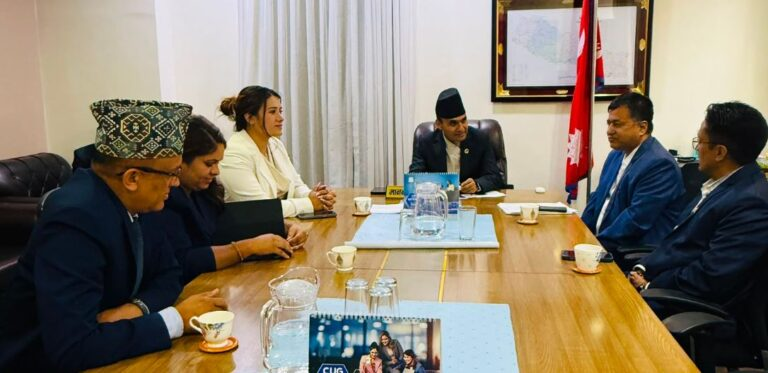
Speaking during a meeting with officials of the Non-Resident Nepali Association (NRNA) at the Ministry of Communications and Information Technology, Dr. Timsina said the government is committed to utilizing the experience and investment of Nepalis living abroad for nation-building. He highlighted that Nepal is ready for investment in information technology, artificial intelligence (AI), data centers, and digital infrastructure.
The discussion was attended by NRNA Vice President Rozina Pradhan Rai, Vice President Gyanendra Regmi, Deputy General Secretary Krishna Pokharel, and other representatives.
During the meeting, NRNA officials briefed the minister on preparations for the 4th NRNA Global Knowledge Convention 2027, scheduled to be held in Kathmandu in January 2027. According to the association, the convention aims to connect the knowledge, expertise, innovation, and experience of Nepalis worldwide with Nepal’s development.
Minister Dr. Timsina stated that the government is moving forward with the construction of modern data centers in different parts of the country and emphasized the need for both domestic and foreign investment in these projects. He noted that Nepal has become an attractive destination for investment in AI, data centers, digital infrastructure, and information technology, while reaffirming the government’s commitment to creating a more investment-friendly environment.
He also acknowledged that Nepalis living abroad have a deep emotional connection with their homeland and a strong desire to contribute to its development. According to him, this potential should be harnessed through appropriate policies to encourage greater inflows of skills, technology, and capital.
Highlighting the government’s priorities, Dr. Timsina said that good governance and improved public service delivery remain at the center of its agenda. While acknowledging the challenges in implementing reforms, he stressed that the government remains committed to delivering results-oriented governance rather than merely following procedural approaches.
“Every sector requires reform. There are challenges everywhere, and the focus should now be on how to implement solutions effectively rather than simply identifying problems,” he said.
The minister added that the government is working to improve policy implementation, budget execution, digital governance, and transparency to ensure better services for citizens.
For their part, NRNA representatives expressed their readiness to collaborate with the government in implementing programs related to digital transformation, e-governance, artificial intelligence, good governance, and digitalization. They said the organization has already been contributing to Nepal through knowledge transfer, investment, innovation, tourism, agriculture, information technology, and other productive sectors.
NRNA Vice President Rozina Pradhan Rai welcomed the government’s decision to grant citizenship with specific rights to Non-Resident Nepalis and urged the swift implementation of the policy. She also called for the early passage of the proposed amendment to the Non-Resident Nepali Act, highlighting practical difficulties NRNs face in buying and selling property, obtaining driver’s licenses, and dealing with visa-related issues when visiting Nepal.
Referring to the slogan “Once a Nepali, Always a Nepali,” she said practical policies would encourage more investment, technology, and expertise to flow into Nepal.
Similarly, NRNA Vice President Gyanendra Regmi said Nepalis living abroad have high expectations from the current government. He stressed the need for effective implementation of the economic, social, and cultural rights guaranteed to NRNs under the Constitution, while noting that positive policy reforms should be translated into action without delay.
The NRNA also expressed its expectation of high-level participation from the Government of Nepal in its international conferences, saying such events provide an important platform to connect the global Nepali community of experts, researchers, entrepreneurs, and investors with Nepal’s economic, social, and technological development.

 About Us
Comment