
Banking News – Finance Minister Dr. Swarnim Wagle has emphasized that Nepal’s private sector is seeking not only incentives but also clear policies, regulatory stability, faster decision-making, and credible implementation to restore business confidence and accelerate economic growth.
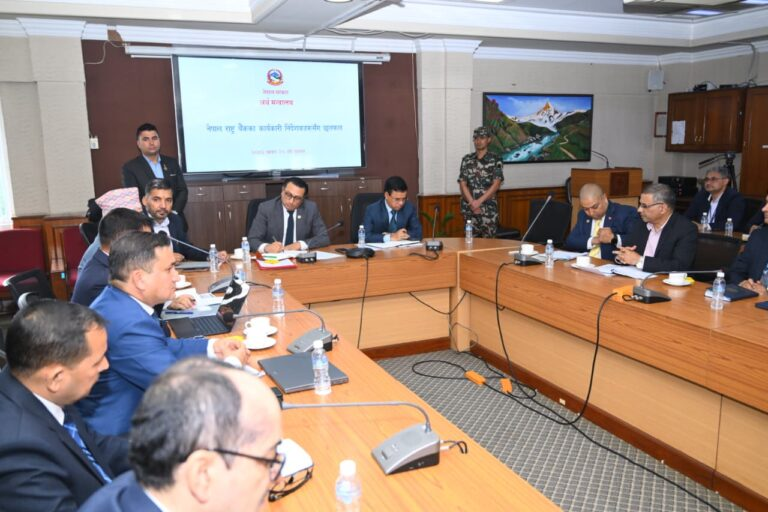
Addressing a meeting with Executive Directors of Nepal Rastra Bank (NRB), the Finance Minister said discussions held in recent days with industrialists, business leaders, and chief executive officers (CEOs) of commercial banks revealed that the private sector is looking for greater policy certainty alongside new investment opportunities.
“The private sector does not want concessions alone. It needs clear policies, stable regulations, timely decisions, and reliable implementation. Our thinking, priorities, and actions must move in the same direction,” Dr. Wagle said.
Reflecting on Nepal’s economic performance over the past decade, the Finance Minister questioned why many well-intended policy decisions failed to deliver the expected outcomes during implementation. He pointed to declining investor confidence, rising banking sector liquidity without corresponding credit expansion to productive industries, weakening links between the capital market and the real economy, and slower-than-expected growth in production and productivity.
According to Dr. Wagle, these issues are not merely matters for review but will shape Nepal’s economic policy direction over the coming decade.
He described the government’s latest national budget as more than an annual fiscal plan, calling it a roadmap for economic reform and structural transformation. He urged NRB to redefine its role in supporting this transformation through proactive monetary and regulatory policies.
The Finance Minister asked NRB officials to evaluate whether the central bank has sufficient policy clarity, institutional confidence, and responsiveness to address current economic challenges. He stressed that regulators should move beyond simply managing risks and instead focus on creating opportunities for productive economic activity.
During the meeting, Dr. Wagle invited suggestions on several key policy areas, including:
- Strengthening NRB’s role in implementing the government’s economic reform agenda.
- Expanding credit flow to productive sectors.
- Converting excess banking system liquidity into investment, industrial growth, and employment.
- Building healthier linkages between the capital market, real estate sector, banking system, and the real economy.
- Enhancing coordination between monetary and fiscal policies.
- Promoting digital finance, fintech, alternative financing, startup funding, and innovative financial instruments.
He also stressed that financial regulation should encourage innovation rather than hinder it, urging participants to adopt a solution-oriented mindset focused on enabling progress rather than identifying obstacles.
“Nepal currently needs policy confidence more than anything else,” he said, adding that if the government, Nepal Rastra Bank, the banking sector, and the private sector move forward with shared confidence and commitment, achieving higher economic growth would become a realistic objective.
Dr. Wagle reaffirmed the government’s commitment to accelerating legal reforms, institutional improvements, and policy implementation. He called on the central bank to match this momentum with clear and decisive monetary policies.
Describing NRB as not only a regulator but also a partner in Nepal’s economic transformation, the Finance Minister said the discussions would not remain limited to formal consultations. Instead, the issues raised would be translated into actionable plans, with the possibility of forming joint task forces, institutionalizing policy coordination, and streamlining decision-making processes.
Concluding his address, Dr. Wagle said Nepal currently has a rare opportunity for economic transformation, supported by political commitment to reforms, macroeconomic stability, and a private sector ready to invest. He expressed confidence that coordinated efforts between the government, NRB, the banking industry, and the private sector would help turn Nepal’s economic transformation from a vision into reality.

 About Us
Comment