
Banking News – The Non-Resident Nepali Association (NRNA) has urged the Nepal government to establish shelter houses in countries with large numbers of Nepali workers to provide emergency accommodation and support to workers facing difficulties abroad.
The demand was raised during a session on ‘Safe Foreign Employment and Reintegration’ held as part of the NRNA Asia-Pacific Regional Conference currently underway in Guangzhou, China. Participants said NRNA representatives often face difficulties when attempting to rescue and accommodate Nepali workers in distress because there are no designated safe facilities available.
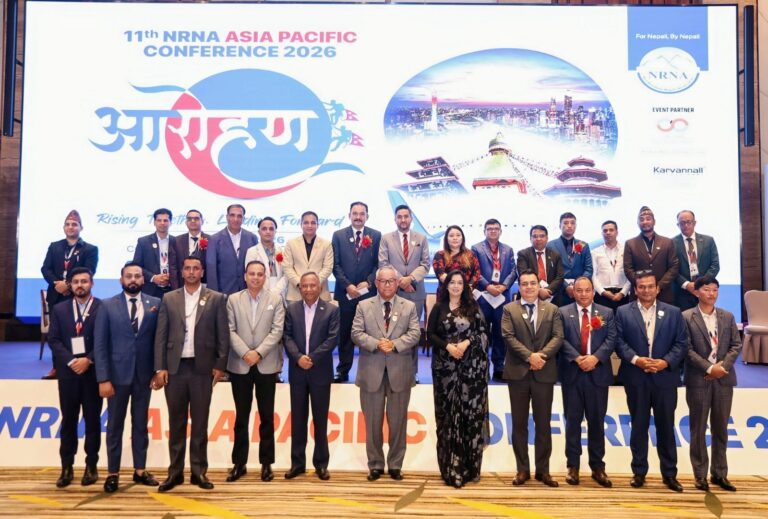
The conference discussed safe foreign employment, skilled manpower, problems faced by Nepali workers abroad, possible solutions and reintegration after returning to Nepal.
NRNA Vice President and session chair Khagendra Neupane said the government itself should establish shelter houses in countries where large numbers of Nepali workers are employed. He said NRNA representatives are often forced to arrange accommodation on their own when workers face problems and, in some cases, have even faced the risk of imprisonment while trying to assist them.
Neupane also stressed the need to ensure that Nepalis receive proper skills training before leaving for foreign employment. He proposed establishing skill academies and skill-testing centers through cooperation between the government and NRNA.
He further urged the government to formally recognize NRNA representatives as honorary, unpaid labour envoys, saying they frequently provide immediate assistance to Nepalis facing difficulties abroad but encounter problems due to the lack of formal legal recognition.
Jagdish Kharel, a member of the House of Representatives and former Minister for Communications, praised the role of NRNA representatives, saying Nepalis abroad often rely on them to resolve problems in a manner similar to diplomatic representatives.
Kharel said the position of an honorary envoy may appear modest, but it could play an important role in addressing the problems faced by Nepali workers. He pledged to raise the issue with the government where necessary.
Similarly, House of Representatives member Ain Mahar stressed the need to make foreign employment more organized, safe and dignified. He said Nepal must move beyond its image as a country that primarily sends unskilled workers abroad and should focus more strongly on skill development.
Krishu Chhetri, Deputy Head of the Diaspora Coordination Division at the Ministry of Foreign Affairs, said Nepalis abroad often turn to NRNA after contacting Nepal’s embassies and diplomatic missions. He praised NRNA representatives for effectively performing the role of labour envoys despite not receiving formal government recognition.
NRNA President Dr. Hemraj Sharma said more work needs to be done in the foreign employment sector and called for broader discussion. He announced that NRNA plans to organize a separate comprehensive conference on foreign employment in Nepal within the next few months.
NRNA Vice President Junu Gurung shared information about ongoing initiatives concerning the mental health of Nepali migrant workers and programs planned for the future. She emphasized the need for additional initiatives to identify and address mental health challenges faced by workers during foreign employment.
The conference also called on the government to establish training and skill-testing centers to produce and send skilled workers abroad instead of relying primarily on unskilled labour. Participants stressed the need for cooperation among the government, private sector and NRNA to develop and promote skilled manpower.
NRNA representatives from various countries said they have been providing emergency rescue, legal assistance and other support to Nepalis in distress, but the lack of formal legal authority creates difficulties. Although NRNA has previously urged the Nepal government to recognize its representatives as honorary labour envoys, the proposal has yet to be implemented, prompting participants to renew the demand during the conference.
The program also featured presentations on the conditions, challenges and possible solutions for Nepali workers in various countries. Dipak Pun presented on South Korea, Eknath Khatiwada on Laos, Khagraj Gautam on Japan, Tilochan Gautam on Malaysia and Yubraj Neupane on Macau. Journalist Anil Adhikari also presented on issues concerning migrant workers and possible solutions.
NRNA Chief Executive Officer Rajendra Kumar Raut briefed participants on the organization’s initiatives in the areas of foreign employment and migrant workers. The session was moderated by Yagya Raj Subedi, while journalist Uddhav Bhattarai delivered the keynote summary.
NRNA said it plans to organize a separate comprehensive conference on foreign employment in Nepal in the coming months to facilitate further discussions among the government, stakeholders and Nepali diaspora on safe foreign employment, skill development, workers’ rights, rescue and reintegration.

 About Us
Comment