
Banking News – A team of experts has conducted an inspection and analytical study of the long-shut Gorkhakali Rubber Industry in Gorkha as part of efforts to explore the possibility of bringing the state-owned industrial facility back into operation.
The team, led by Kavindra Burlakoti, Member of the House of Representatives from Gorkha Constituency No. 2, visited the industry located in Mabhuwā, Gorkha Municipality-13, along with representatives and experts from relevant government agencies.
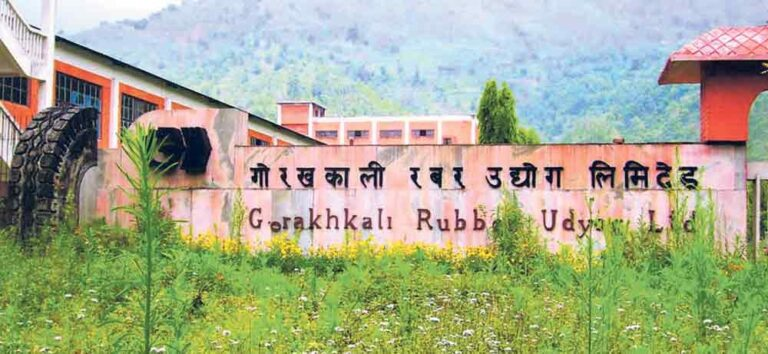
Burlakoti said the visit was aimed at assessing the legal and economic feasibility of resuming the industry’s operations. He said representatives from the Ministries of Finance, Industry and Law were also part of the analytical visit and that discussions would be held following the assessment.
He added that an economic proposal for reopening the Gorkhakali Rubber Industry would be prepared soon.
The Gorkhakali Rubber Industry was established on May 30, 1984 (Jestha 30, 2041 BS) with assistance from the Chinese government. Its foundation stone was laid by the then King Birendra Shah in 1985 (2042 BS), and the industry began commercial production in 1993 (2050 BS).
At its peak, the industry supplied a significant share of Nepal’s domestic demand for tyres and tubes. The facility occupies approximately 670 ropanis of land and received investment from the government, citizens and various organizations.
The industry had developed the capacity to produce approximately 88,000 tyres annually, manufacturing different types of tyres for trucks, jeeps, vans and cars. Its products were distributed through depots located in major cities across Nepal.
The company also exported its tyre products to several South Asian countries, including India, Bangladesh and Sri Lanka.
However, the industry was completely shut down on March 23, 2015 (Chaitra 23, 2071 BS). After remaining closed for years, its buildings, machinery and other physical infrastructure have largely remained unused.
The latest inspection is aimed at assessing how the substantial state investment and existing industrial infrastructure can potentially be utilized through the revival of the long-defunct industry.

 About Us
Comment