
Banking News – An all-party meeting has expressed deep sorrow over the loss of life and property caused by the unexpected flood in river basins including the Bhote Koshi from the Nepal-China border area, and committed to rising above political differences to unite in facing the disaster.
The all-party meeting held at Singha Durbar on Thursday expressed national grief over the human casualties, destruction of physical infrastructure, and environmental crisis caused by the flood in districts including Rasuwa, Nuwakot, Dhading, Gorkha, Chitwan, and Nawalparasi.
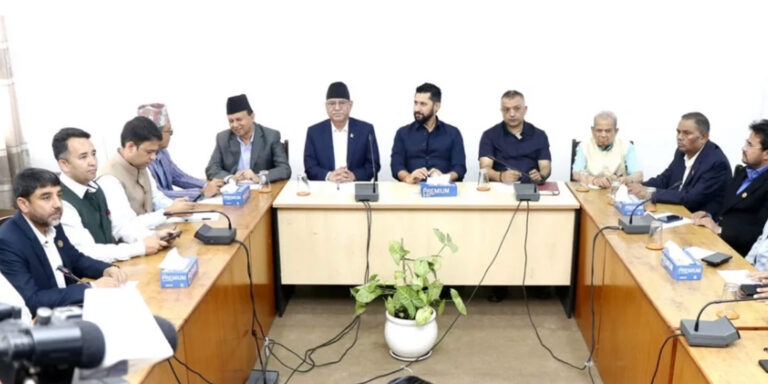
The meeting paid tribute to citizens who lost their lives in the flood and expressed condolences to the bereaved families. The parties were unanimous that the state must take responsibility for the treatment, care, and psychosocial counseling of the injured, while wishing for their speedy recovery.
Stating that the disaster situation is not a crisis of any single geography or government alone but a shared trial for the entire nation, the meeting committed to all political parties standing united by prioritizing citizen protection and national interest above all else.
Following the meeting, eight political parties issued a joint statement, unveiling a 10-point common resolution for sustainable solutions to the disaster and effective preparedness for the future. The resolution includes making disaster management more effective, prioritizing risk reduction and preparedness, and ensuring the state’s effective role in the rescue, relief, and rehabilitation of affected citizens.
The joint appeal was signed by Rabi Lamichhane, Chairman of Rastriya Swatantra Party; Gagan Thapa, Chairman of Nepali Congress; Pushpa Kamal Dahal “Prachanda”, Coordinator of NCP; Shankar Pokharel, General Secretary of CPN-UML; Dhruva Rai, Leader of Labour Culture Party; Rajendra Lingden, Chairman of Rastriya Prajatantra Party; Upendra Yadav, Chairman of Janata Samajwadi Party Nepal; and Chandan Singh, Leader of Janamat Party.
The all-party meeting convened after the Bhote Koshi flood has sent a message that political parties have united during the time of disaster. The parties have committed to prioritizing citizen protection and national interest above ideological and political differences.
1. Depoliticization of Relief Work
We call upon all political parties, their organizations, and members to provide maximum support from their respective areas in disaster management.
We, all parties, are clear that assistance provided during disasters should not become a means of cheap popularity or political self-interest.
Therefore, we call for encouraging the spirit of cooperation over political competition while engaging in rescue and relief work. We urge party leaders, members, and well-wishers to engage purely as humanitarian volunteers.
2. Adherence to Government Single-Window System for Fund Collection
Financial collection in disaster management must be transparent and systematic. We especially call upon all party cadres, citizens in Nepal and abroad, and well-wishers to deposit financial contributions only in the Government of Nepal’s official “Prime Minister’s Natural Disaster Relief Fund” or the official account designated by the government.
3. Responsible Use of Social Media and Sensitive Information Flow
During the sensitive time of disaster, misinformation and exaggerated visuals circulating on social media can create psychological fear in society and hurt the privacy and dignity of affected individuals.
Therefore, we request all citizens and media outlets to transmit only information verified by official bodies and to use social media with restraint, discretion, and responsibility.
4. Scientific Study of Glacial Lakes and Cross-Border Joint Initiative
Glacial lakes in Nepal’s Himalayan region and neighboring China’s Tibet region are at high risk of melting and bursting due to climate change. This flood has signaled the possibility of an even greater catastrophe in the future.
Therefore, we demand that the government immediately initiate a comprehensive scientific study and mapping of high-risk glacial lakes within Nepal to prevent unimaginable future losses. We also draw the government’s serious attention to immediately undertake high-level diplomatic initiatives with friendly nation China for risk assessment and mitigation of cross-border glacial lakes, and to establish a joint scientific and technical study mechanism.
5. Disaster Diplomacy and Early Warning System
Due to the transboundary nature of river systems, there is a need to further strengthen and institutionalize real-time data exchange of early warning systems between the two countries. We recommend that the government develop a technology-friendly and reliable mechanism to protect citizens in downstream areas immediately upon any natural activity in upstream areas.
6. National Unity and Inclusive Rescue
We highly appreciate the role played by local levels as first responders in disaster management.
Acknowledging that women, children, elderly, and persons with disabilities are most at risk during disasters, we urge that they be given first priority in rescue, relief, and management.
7. Resilient Reconstruction and Zero Tolerance
A national campaign for advanced and safer reconstruction of damaged structures must be launched immediately. We draw the government’s serious attention to strictly enforce a “Zero Tolerance” policy against any tendency to engage in black marketing, create artificial shortages, or misuse relief during disasters, treating such acts as serious crimes against the nation.
8. Climate Justice and Global Responsibility
The increasing glacial lake outbursts and abnormal floods in the Himalayan region are a direct impact of global climate change, to which Nepal’s contribution is negligible.
We urge the government to strongly raise the issue of such “Loss and Damage” being faced by Nepal on international platforms and to hold the international community and multilateral development partners accountable in accordance with the principle of climate justice.
9. International Community Support
We appeal to the United Nations, development partners, international non-governmental organizations, friendly nations, and the Nepali diaspora to provide necessary humanitarian, technical, and financial assistance for rescue, relief, rehabilitation, and reconstruction following the unimaginable losses.
10. Formation of High-Level All-Party Mechanism for Long-Term Solutions
It is essential to seek sustainable and long-term solutions beyond limiting disaster management, reconstruction, and risk reduction to short-term relief and response. Therefore, we have agreed to form a Parliamentary Committee to continuously advise, support, and monitor post-disaster reconstruction, climate adaptation, timely reforms in national disaster policy, and government actions. This mechanism will play a significant role in policy reforms by building national consensus not only during crises but also on disaster preparedness and sustainable development agendas.

 About Us
Comment