
Banking News – Executive Director of the Securities and Exchange Board of India (SEBI), Govindayapali Ram Mohan Rao, has stated that Nepal’s capital market appears to be entering a new phase – “Capital Market 2.0.”
Addressing the Nepal Capital Market Discourse 2026, organized by Banking Samachar with NASA Securities as the main sponsor, Executive Director Rao emphasized the need for a clear vision and plan for capital market reforms in Nepal for the next 10 years. He stated that the commitment and enthusiasm of stakeholders participating in the program signals that a new phase of capital market development is about to begin in Nepal.
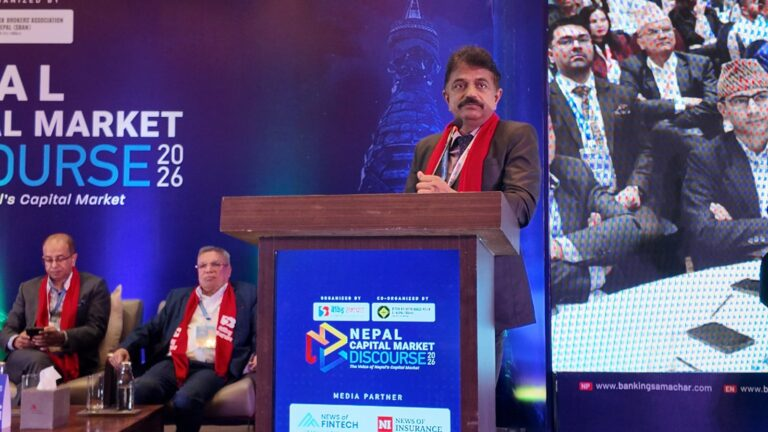
He stated that to make Nepal’s capital market large and strong over the next 20 to 30 years, all parties directly connected to the market must effectively fulfill their responsibilities. He noted that the roles of brokers, market makers, listed companies, stock exchanges, clearing corporations, and regulatory bodies are all important.
Rao stated that the government’s role is the most important in capital market development. According to him, since the capital market cannot advance alone, government policy and priorities will determine its future.
He emphasized that the government must create necessary policies and environment to attract foreign investment, foreign institutional investors, and non-resident Nepalis to Nepal’s capital market. He stated that such investment can accelerate the country’s economic development.
Rao stated that deep trust between investors, market intermediaries, and regulatory bodies is essential for the sustainable development of the capital market. He noted that trust must be demonstrated not only in speeches and meetings but also in practice. He expressed confidence that if all market stakeholders sincerely commit to contributing to the development of the capital market, the goals set for the next 10 years could be achieved in just five years.

 About Us
Comment