
Banking News – The much-awaited Rahughat Hydropower Project in Myagdi has reached the test production stage after a decade and a half since its inception. The project, initially started with a capacity of 32 MW, is nearing completion after a decade and a half due to contractor problems, contract cancellation, restructuring, selection of a new contractor, the COVID-19 pandemic, floods and landslides, and a shortage of river-borne construction materials.
The project, constructed in Raghuganga Rural Municipality of Myagdi with Raghuganga Hydropower – a subsidiary company of Nepal Electricity Authority – as the promoter, has been successfully tested. Ganesh Kc, Managing Director of Raghuganga Hydropower, informed that the two units with a combined capacity of 20/20 MW were tested on Tuesday and Wednesday and power supply to the central system has begun.
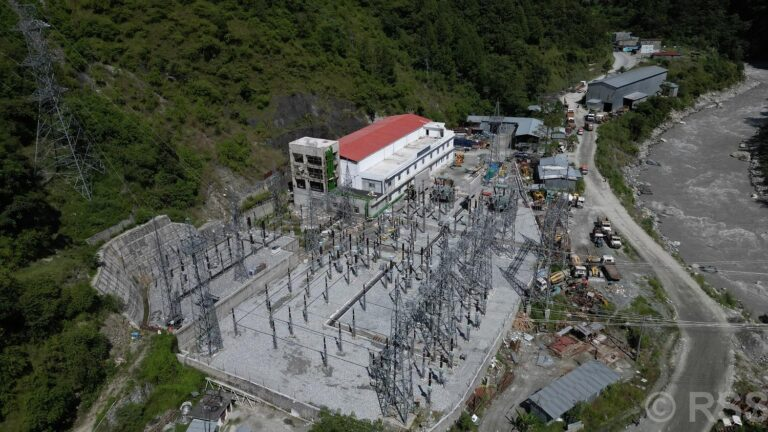
“We have connected both units to the central transmission line by operating them at full capacity,” he said. “According to the agreement with the Nepal Electricity Authority, commercial production will begin after 15 days of test production.” A dam has been constructed at Raghuganga Rural Municipality-4 Dagnam and Ward No. 5 Jhin Fedi, along with a 6-kilometer 270-meter long main tunnel and two water settling ponds. The powerhouse is located at Raghuganga Rural Municipality-3 Tilkenechaur, along the Beni-Jomsom road of the Kaligandaki Corridor.
A switchyard has been constructed within the powerhouse premises and the necessary structure for connecting to the 220 kV (double circuit) Dana-Kushma transmission line under the Kaligandaki Corridor. The project had signed a Power Purchase Agreement (PPA) in Chaitra 2075 with a target of generating 24 crore 5 lakh 93 thousand 34 units of electricity annually.
Journey That Began with IVRCL
Nepal Electricity Authority had signed a civil contract with Indian construction company IVRCL on Kartik 18, 2067 BS, for Rs 2 arab 50 crore for the construction of the Rahughat Hydropower Project. Had IVRCL worked according to the agreement, Rahughat would have started generating electricity by 2070 BS.
After IVRCL failed to work due to weak financial conditions, the Electricity Authority canceled the contract with IVRCL in 2072 BS. At the time of contract termination, the project’s physical progress was limited to 12 percent in five years.
The Authority restructured the project, deciding to increase the capacity from 32 MW to 40 MW and proceed with construction under a company model. The cancellation of the contract with IVRCL, despite facing legal cases, became the first major turn in the construction journey of the Rahughat project.
New Beginning Under Company Model
After the cancellation of IVRCL’s contract, the Authority established subsidiary company Raghuganga Hydropower Limited in 2073 BS and moved the project forward. The construction process for Rahughat was advanced under the Engineering, Procurement and Contract (EPC) model with a $67 million USD concessional loan from the Indian Exim Bank and investment from Nepal Electricity Authority and the Government of Nepal.
A civil contract agreement was signed with Indian company Jayprakash Associates (JP), selected through a new process, on Mangsir 6, 2074 BS, for approximately Rs 6 arab with a target of completion in 45 months.
Tunnel construction began from the third audit at Piple from Asar 2075 BS for the access road and from Asar 8, 2076 BS. The main tunnel of Rahughat was connected on Shrawan 15, 2081 BS.
MS Gaur, Manager of civil contractor Jayprakash Associates, stated that the project construction was delayed due to natural disasters such as the COVID-19 pandemic, floods, and landslides, as well as a shortage of river-borne construction materials.
An electromechanical contract agreement was signed with Bharat Heavy Electricals Limited (BHEL) in Kartik 2076 BS for $1 crore 2 lakh 93 thousand 22.35 USD. BHEL is a company owned by the Government of India. According to Subin Shrestha, President of the Myagdi Chamber of Commerce and Industry, Rahughat, being the first project in the district and operated with government investment, was considered the “gateway” to hydropower development.
“After Rahughat started, 10 projects that entered Myagdi have already been completed,” he said. “Although delayed, we are excited by the news that the Rahughat Hydropower Project has reached the power generation stage after a decade and a half of waiting.”

 About Us
Comment