
Banking News – Foreign Minister Shishir Khanal has stated that Nepal must transform its geographical position into an opportunity amid Asia’s growing economic and strategic influence and move forward as an economic, digital, and strategic “bridge” of Asia.
Addressing a program titled “Steering Nepal’s Future in Asia’s Rising Century” organized by the Asia Society in New York today, he stated that Nepal should not view its geographical challenges as a limit to its national aspirations. Emphasizing the need to change the perspective of viewing Nepal traditionally as a “small country,” he stated that Nepal is strategically located, according to the Foreign Minister’s private secretariat.
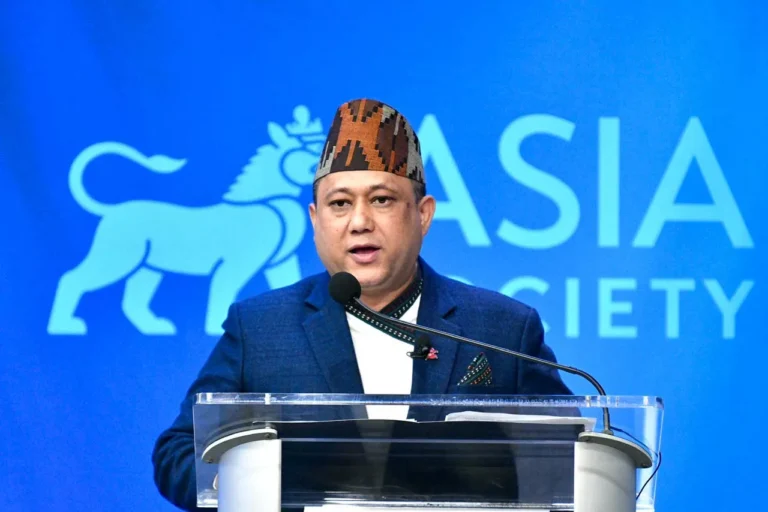
“Nepal is not small. Nepal is strategically in the right place,” Minister Khanal said. “The size of our neighbors is a geographical reality, but that should never become the limit of our ambition.” He expressed the view that Nepal should not be understood merely as a small country when comparing its geography and population with other countries.
Referring to the recent flood, Minister Khanal termed it a “Himalayan tsunami.” “Nepal has long been facing natural disasters, difficult geography, and structural challenges,” he said.
Foreign Minister Khanal stated that the recent disaster has given a clear message that climate change must be taken as a strategic priority of Nepal’s foreign policy. He mentioned prioritizing effective early warning systems, hydrological data exchange, predictable grant-based climate finance, and practical cooperation with neighbors and the international community.
Interpreting Asia’s rise as an important opportunity for Nepal, he stated that approximately 60 percent of the world’s population is in Asia, and Asia has a large contribution to the world economy. Minister Khanal stated that Kathmandu can be developed as an important center of Asia’s economic and social transformation. “Our question is no longer how Nepal survives between two large neighbors. Our question is — how does Nepal create value between them and beyond them?” he said.
He stated that Lumbini, the birthplace of Gautam Buddha, and national luminaries like Araniko and Bhrikuti have made Nepal an important contact point of Asian civilization and culture. “Our ancestors understood one clear truth — connection creates prosperity, isolation increases poverty,” Minister Khanal said.
Noting that Nepal’s hydropower generation capacity can be linked to regional economic transformation, he stated that clean electricity is being exported to Bangladesh via India. He also stated that by expanding production in border special economic zones, the global supply chain can be connected with Nepal.
Stating that Nepal’s cooperation with northern neighbor China should be advanced on a practical, commercial, and long-term basis, Minister Khanal emphasized developing multidimensional trans-Himalayan connectivity including roads, tunnels, dry ports, air services, digital connectivity, and cross-border railways. Stating that Nepal’s future must be determined by the Nepali people, but emphasizing international partnership for that, Minister Khanal welcomed the US, Europe, ASEAN, Latin America, and other partners for investment, cooperation, and partnership in Nepal.

 About Us
Comment