
Banking News – The Economic Crime Investigation Division under the Central Investigation Bureau (CIB) of Nepal Police has said that skilled manpower, technology and resources currently available for investigating economic and financial crimes remain insufficient despite ongoing efforts to strengthen investigative capacity.
The division was established in Jestha last year to investigate cases involving banking offences, fraud, money laundering and suspicious transactions. An SSP-level position was established at the division in Magh. The division was initially envisioned as a separate bureau dedicated to economic crime investigation but is currently operating as a division under the CIB.
Speaking to Banking Samachar, Rishi Ram Kandel, Chief of the Economic Crime Investigation Division, said a separate bureau would require additional budget, manpower and institutional infrastructure. He added that the division could potentially be developed into a separate bureau in the future based on requirements and work plans.
Currently, the CIB has two divisions: the Economic Crime Investigation Division and the Special Crime Investigation Division, both headed by SSP-level officers.
The Economic Crime Investigation Division operates through separate investigative pillars, including the Banking Offence Investigation Branch, Money Laundering Investigation Branch, Fraud Investigation Branch and Suspicious Transaction Investigation Branch. Investigation teams are formed according to the nature of complaints received, and cases are filed by the CIB after investigations are completed.
Separate branches handle different types of economic crimes
According to Kandel, the Fraud Investigation Branch investigates various forms of fraud, including cooperative fraud, embezzlement and other fraudulent activities.
The Banking Offence Investigation Branch investigates cases involving loan misuse, financial embezzlement and other economic crimes related to banks and financial institutions. Crimes associated with banking transactions and misuse of funds from banks and financial institutions also fall under its jurisdiction.
Similarly, cases related to money laundering are investigated by the Money Laundering Investigation Branch, while the Suspicious Transaction Investigation Branch handles cases involving hundi, cryptocurrency and other suspicious financial transactions.
The division also initiates necessary inquiries based on suspicious transaction information received from Nepal Rastra Bank.
Coordination among agencies essential for complex investigations
Kandel said coordination and cooperation among relevant agencies are essential because economic crimes are often complex and multidimensional and cannot always be investigated effectively by a single institution.
Depending on the nature of an investigation, the CIB coordinates with Nepal Rastra Bank, banks and financial institutions, cooperatives, the Securities Board of Nepal, the Department of Money Laundering Investigation and the Department of Revenue, among other agencies.
He said information and assistance from financial and technical experts are also required in some investigations. For example, investigators may need to coordinate with banks to obtain an individual’s banking transaction details and with Nepal Rastra Bank and other agencies for additional information.
Skilled manpower and advanced technology remain necessary
Kandel said economic crime investigations are particularly complex because they involve digital, financial and money-laundering dimensions. Some cases also involve large numbers of victims and stakeholders, making dedicated and skilled manpower essential.
Although the CIB is currently conducting investigations using its available human resources and technology, Kandel said these resources are not sufficient to meet all requirements.
Police officers are being provided with training to enhance their investigative capabilities. He emphasized that technology is becoming increasingly important in economic crime investigations and that the CIB needs both physical infrastructure and specialized software.
For example, investigations involving cryptocurrency require blockchain analysis tools, while digital forensic investigations require updated software. Various specialized software applications are necessary for economic crime investigations, many of which are expensive and require regular renewal and updates.
Economic crime investigations can cost up to Rs. 12 lakh
Kandel said investigations into economic crimes are relatively expensive because they require significant manpower, technology and other resources.
According to him, a single investigation can cost approximately Rs. 8 lakh to Rs. 12 lakh, depending on its nature. Investigations may also continue for an extended period and require the mobilization of substantial human and technical resources.
Therefore, he said economic crime investigations require considerably more resources than investigations into ordinary criminal cases.
Budget support has helped, but infrastructure remains inadequate
The government has been providing budgetary support for investigations, which has enabled the CIB to purchase necessary software and equipment. However, Kandel said the requirements remain much greater.
The CIB also faces a shortage of office space and buildings and is currently operating from two buildings. He said the bureau requires adequate land and infrastructure, along with greater investment in equipment, software and human resources.
He also emphasized the need for continuous training of investigation officers and said institutional capacity would need to be developed gradually.
Legal, institutional and technological reforms needed
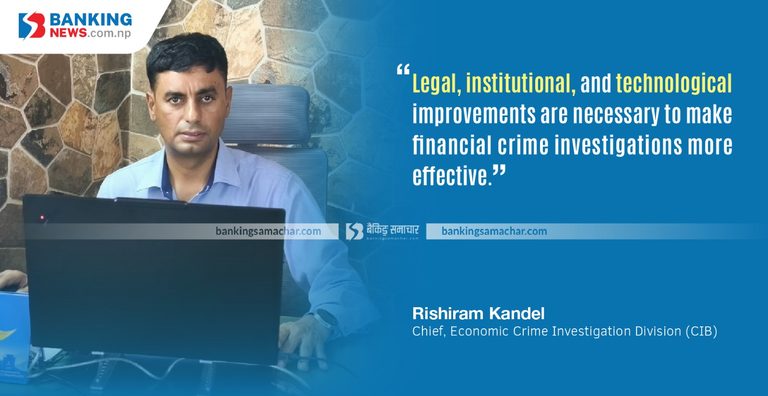
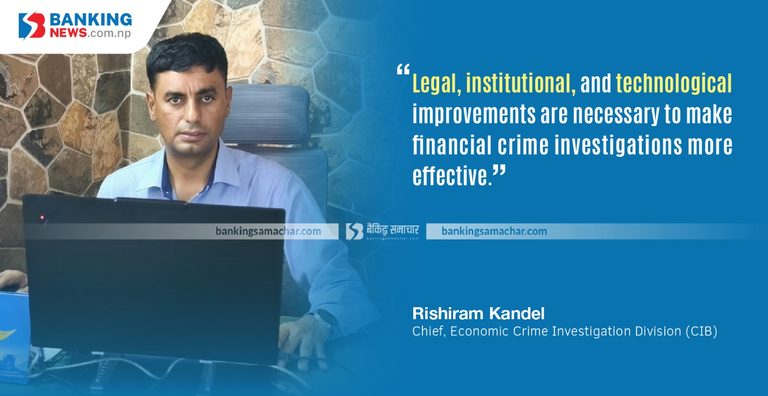
Kandel said making economic crime investigations more effective requires improvements in the legal, institutional and technological frameworks.
A new law related to economic crimes is currently being drafted, and necessary changes in investigative procedures could be made after the legislation is introduced.
He said the changing nature of economic crimes requires investigative capacity to evolve accordingly, which will require significant investment in skilled manpower and resources.
Federal law being drafted to address economic crimes
According to Kandel, a federal law is currently being drafted to address economic crime-related issues. The proposed framework is expected to cover technological aspects as well as questions concerning the institutional structure of economic crime investigation and the legal procedures to be followed when prosecuting cases.
He noted that some existing investigation-related laws are outdated and need to be updated in line with changes in the nature of financial crimes and technology.
As financial and economic crimes are increasingly connected to digital platforms and technology, specialized experts from the financial and technology sectors are also needed.
Kandel said police efforts alone may not be sufficient as economic crimes become more sophisticated. Financial and technology experts should therefore be involved in investigations where necessary.
He also stressed the need for more effective coordination among relevant agencies, particularly because agencies can sometimes face difficulties in providing required information and details on time.
Financial literacy needed from the local level
Kandel emphasized that reducing financial and economic crimes requires not only investigation but also greater financial literacy and public awareness.
He said awareness campaigns should reach the ward and local-government levels so that people can understand financial risks and take preventive measures before becoming victims.
Digital fraud has resulted in some people becoming victims without fully understanding how the fraud occurred. He also warned that allowing others to use one’s bank account for small financial benefits can create serious legal consequences.
In some cases, individuals who allow others to use their bank accounts may later become subjects of investigation if illegal transactions are conducted through those accounts, even when the account holders claim they were unaware of the transactions.
Kandel said expanding financial literacy and public awareness is therefore essential to prevent people from becoming victims or becoming involved in legal proceedings unknowingly.
Training and capacity development being expanded
Kandel said economic crime investigations are highly technical and complex, making it necessary to focus on prevention alongside investigation.
He said skilled manpower development should be pursued as a long-term policy priority. Internal training programs are already being conducted, while work is also underway to develop training curricula focused on identifying and investigating new forms of financial fraud.
A report has recently been submitted regarding the operation of financial fraud identification training and the development of a related curriculum. The proposed training will cover different types of financial fraud, methods of identifying fraud and investigative techniques.
Internal training programs lasting around five to seven days have also begun, with the aim of strengthening skills and knowledge across the department.
Kandel said the development of skilled manpower, appropriate technology and adequate investigative resources must move forward simultaneously to effectively address increasingly sophisticated financial and digital crimes.

 About Us
Comment