
Banking News – President of the Independent Power Producers’ Association, Nepal (IPPAN), Mohan Kumar Dangi, has called on the international community, including Canada, for investment, technology transfer, and technical collaboration in developing reservoir hydropower projects in Nepal. Speaking at the annual conference 2026 and “Trade Show” of the Canada Dam Association, Dangi, who is in Canada to participate in the event, stated that Canada’s experience in dam engineering, reservoir projects, hydropower technology, and climate-resilient infrastructure development would be useful for Nepal, and therefore collaboration could be pursued.
Chairman Dangi, noting that there is immense potential for hydropower development in Nepal, stated that there is a great opportunity for collaboration between Nepal and Canada in building safe, sustainable, and climate-change-resilient hydropower projects. He mentioned that since Nepal can offer sufficient hydropower potential and an expanding energy market, there is an opportunity for a long-term and mutually beneficial partnership for both countries. He expressed the view that Canada’s experience would be important for expanding hydropower generation capacity in Nepal, developing large reservoir projects, making dam safety effective, and increasing the use of modern technology.
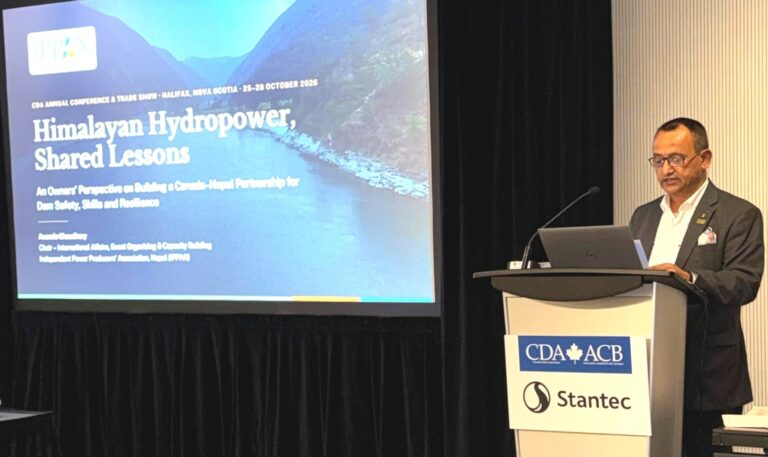
Chairman Dangi stated that IPPAN, an umbrella organization of private energy producers established in 2001, has been continuously working for the promotion of private investment and hydropower development in Nepal’s energy sector.
“After private sector participation in the hydropower sector began in 1999, there has been a significant increase in Nepal’s electricity generation capacity,” he said. “The total installed capacity of electricity generation in Nepal has reached about 4.3 gigawatts, of which more than 80 percent of the capacity is contributed by projects developed by the private sector.”
Noting that Nepal’s hydropower potential is vast, Chairman Dangi stated that according to the assessment made by the Secretariat of the Water and Energy Commission in 2019 and various other studies, Nepal has a technical potential of generating more than 200 gigawatts of hydropower. He stated that through the development of run-of-river, peaking run-of-river, reservoir, and pumped storage projects, Nepal can become a major center of clean and green energy in South Asia.
Noting that the Government of Nepal has set an ambitious target of increasing the installed capacity of electricity generation to 30 thousand megawatts by 2035, Dangi stated that achieving this target requires developing more than an additional 24 thousand megawatts of electricity generation capacity from the current capacity, in which private sector investment will be important. He stated that this target will create opportunities not only to meet Nepal’s growing domestic electricity demand but also to expand electricity exports to neighboring countries. He also informed the conference that along with the development of infrastructure for generation projects, transmission lines, and cross-border electricity trade, Nepal aims to export up to 15 thousand megawatts of electricity to neighboring countries.
Chairman Dangi, discussing major projects that hold potential for investment and international collaboration in Nepal, mentioned that projects including Tamor Reservoir (762 MW), Dudhkoshi Reservoir (670 MW), Budhi Gandaki Reservoir (1,200 MW), and Upper Arun (1,060 MW) are important. He stated that international partnership is necessary in investment, project finance management, engineering, construction, dam safety, energy storage, and the use of modern technology in these projects and other projects in various stages of development.
Noting that more than 98 percent of Nepal’s population has access to electricity, Chairman Dangi stated that hydropower has been contributing to economic growth, employment generation, improving the quality of life of people, and expanding clean energy trade. He emphasized that if regional cooperation can be further strengthened, Nepal can establish itself as an important source of clean electricity supply in South Asia. He called on international organizations, investors, developers, and technical experts to collaborate with Nepal in the areas of hydropower project development, investment, research, technology transfer, professional training, and infrastructure construction capable of facing climate change challenges.
Praising the conference organized by the Canada Dam Association under the main theme “Tides of Change,” Chairman Dangi stated that such international platforms play an important role in the exchange of knowledge, experience, and technology. He also stated that international cooperation is necessary for dam safety, climate resilience, and sustainable hydropower development. At the program, Anand Chaudhary, Coordinator of IPPAN’s International Relations and Program Management Committee, is scheduled to give a presentation on Nepal’s hydropower potential, important lessons learned from the recent Bhote Koshi flood, and opportunities for international collaboration.

 About Us
Comment