
Kathmandu – A common saying in Nepali society states that “a man works from sunrise to sunset, but a woman’s work never ends.” The phrase reflects the reality of women’s daily lives, where responsibilities often extend across both professional and household spheres.
Srijana Bastola, a director at Nepal Rastra Bank, says the traditional social structure in Nepal still poses challenges for women seeking equal opportunities and promotions in the workplace.
Even when women hold office jobs, their responsibilities do not end there. After returning home, many continue with household chores such as cleaning, cooking, childcare, shopping, and managing family needs. As a result, much of women’s labor often remains invisible.
Bastola notes that despite these challenges, the number of women joining the central bank has increased significantly in recent years. Through open competitive recruitment, women’s participation has become more noticeable, which she sees as a positive shift.
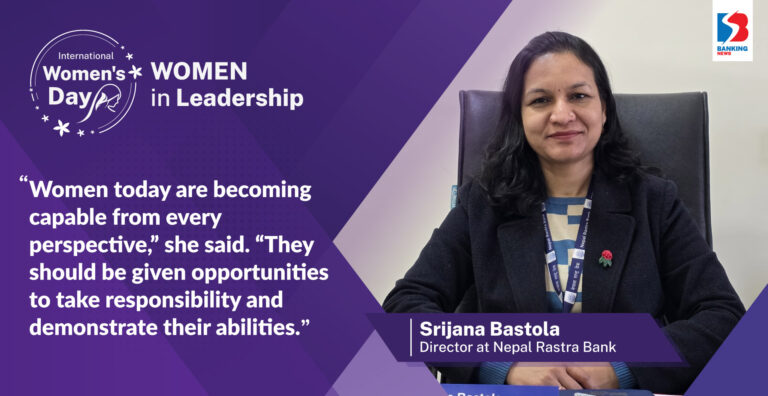
“Women today are becoming capable from every perspective,” she said. “They should be given opportunities to take responsibility and demonstrate their abilities.”
She emphasized that experienced senior staff should guide new employees so that their potential can grow with proper support and opportunities.
Encouraging Women to Take Responsibility
Bastola also urged women to take responsibilities with confidence.
“Sometimes women themselves think, ‘I can’t do it’ or ‘I won’t be able to manage it,’” she said. “Such thinking needs to change. Women should step forward and take responsibility.”
Currently, Nepal Rastra Bank has 18 Executive Directors, but none of them are women, highlighting the continued gap in leadership positions. However, Bastola believes that within the next few years, around seven to eight women could reach the executive director level.
According to her, the increasing number of women entering the institution at entry-level positions will likely translate into greater representation in leadership roles in the future.
Career Challenges and Motherhood
Another major challenge women face in their careers is related to motherhood. Pregnancy and childcare responsibilities can sometimes delay promotions or limit the time women can devote to work.
In such situations, Bastola says family support becomes crucial.
“After marriage and childbirth, a woman’s household responsibilities automatically increase,” she explained.
However, Bastola was able to balance her responsibilities effectively with the help of her parents, who supported her in caring for her children. She also received encouragement and support from her colleagues during that time, which helped her continue her career with relatively limited difficulties.
From Chartered Accountancy to the Central Bank
Born in Bhaktapur, Bastola completed her School Leaving Certificate from a local school in her hometown. She then studied management in Grades 11 and 12 at VS Niketan College.
After completing her higher secondary education, she began studying Chartered Accountancy (CA). While pursuing CA, she also enrolled at Shanker Dev Campus to complete her Bachelor of Business Studies (BBS).
During her three-year articleship training, she balanced both her CA studies and her bachelor’s examinations. She later completed her master’s degree as well.
At the time she passed her CA exams, Nepal Rastra Bank happened to announce vacancies. She submitted her application on the final day of the deadline and was selected as an officer, joining the central bank on June 28, 2007 (Asar 14, 2064 BS).
“I believe in luck as well,” Bastola said. “The application I submitted on the final day was accepted, and I joined the central bank as an officer.”
Early Inspiration and Education
Bastola recalls being a dedicated student who spent more time studying than socializing with friends. However, until completing her SLC, she was unsure which field she would pursue.
Many people suggested she study science because of her strong academic results, but she chose a different path after considering the higher costs, time commitment, and competition associated with science education.
Her decision was also influenced by relatives who had pursued Chartered Accountancy, which inspired her to follow the same field.
Her father, a retired judge, encouraged her to study CA, noting that graduates of the program were often recruited by the central bank as second-class officers.
Balancing Career and Family
After completing her CA training, Bastola worked at a capital market company for about a year before focusing her career entirely at Nepal Rastra Bank.
She is now a mother of two children. Bastola started her married life after joining the central bank, and her husband is a doctor. She credits the support of her husband and parents for enabling her to continue her career.
“Whatever I am today is because of this central bank,” she said. “Working here has given me many opportunities to learn.”
When she joined the institution, the number of women employees was very small. She recalled that it was difficult even to find women’s names on staff lists at that time.
“Back then, we had to search for women’s names,” she said with a smile. “Now, sometimes we have to search for men’s names.”
Today, around 30 percent of employees at the central bank are women, and they are performing exceptionally well, she added.
Bastola advised women aspiring to build careers in any field to remain eager to learn, maintain self-confidence, and demonstrate their abilities through hard work.
“A woman who is willing to learn, confident, and ready to prove herself can succeed in any field,” she said.

 About Us
Comment