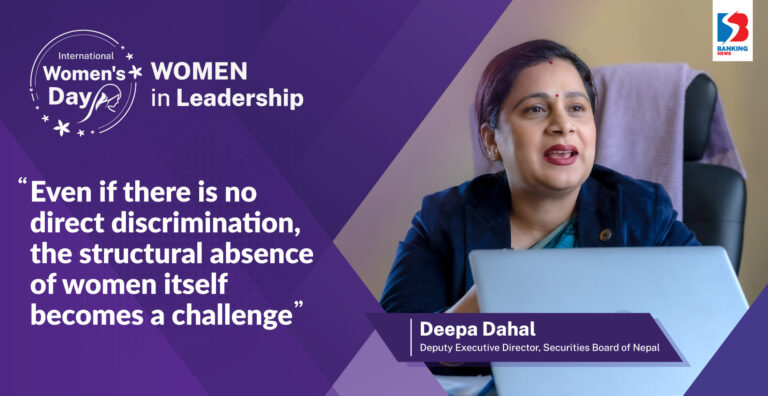

Kathmandu – The journey of Deepa Dahal from Ratnanagar in Chitwan to a leadership position at Nepal’s capital market regulator reflects determination, perseverance, and a commitment to growth despite social and structural challenges.
Today, Dahal serves as the Deputy Executive Director at Securities Board of Nepal, but her path to this position was shaped by limited opportunities, social expectations, and family constraints.
Early Life and Education
Born and raised in Ratnanagar, Dahal was a bright student from an early age. She completed her Secondary Education Examination (SEE) from Endles World School in Tandi and later finished her higher secondary education from International College in the same area.
While studying, she also wanted to become financially independent. Her first job was teaching at a school, where she earned her first salary of NPR 8,000 an achievement she still remembers fondly.
As a student, her dream was to become a lawyer.
“I had planned to study law since grades nine and ten,” she recalled. “But circumstances did not allow it, so I shifted toward management studies.”
Despite changing her academic field, her determination remained strong. She became the college topper, which boosted her confidence further.
“Sometimes circumstances change our path, but if the goal is clear, the destination is never too far,” she said.
From Chitwan to Kathmandu
Like many of her peers, Dahal wanted to pursue higher studies in Kathmandu. However, her family was reluctant to send her alone to the capital due to safety concerns and social perceptions surrounding women living independently.
As a result, she completed her bachelor’s degree at Balkumari College in Narayangadh, Bharatpur.
Her professional journey strengthened from that point onward. Over the next 12 years in the banking sector, she gained extensive experience in financial discipline, risk management, and institutional governance.
Banking Career and Entry into Capital Market Regulation
Dahal later moved to Kathmandu to pursue her master’s degree at Shanker Dev Campus in 2003 (2060 BS). During her first year of master’s studies, Nepal Bank Limited announced a large number of vacancies.
She succeeded in the competitive examination, securing the 17th position. At just 22 years old, she began her professional career in the banking sector.
During her 12-year tenure in banking, she steadily progressed while serving as a Second-Class Officer, earning trust and recognition from colleagues and senior management for her competence and dedication.
Later, when Securities Board of Nepal announced vacancies for Second-Class Officers for the first time, Dahal seized the opportunity. In 2015 (2072 BS), at the age of 34, she joined the capital market regulator.
In 2018 (2075 BS), the board organized an open competition for First-Class Officer positions. Dahal successfully passed the competitive examination and was promoted, eventually rising to the position of Deputy Executive Director.
She has now completed nearly a decade of service at SEBON and says she remains satisfied with her career.
“My studies were already related to the financial sector, which made it easier for me to enter this field,” she said.
Growing Interest in Capital Markets
While working at Nepal Bank Limited, Dahal witnessed the early growth of Nepal’s capital market. She recalls seeing long lines of investors waiting to apply for Initial Public Offerings (IPOs), which sparked her interest in the sector.
“I realized that in the future I didn’t just want a job I wanted to be part of this sector and contribute to the development of the capital market,” she said.
At the time she entered the field, women’s participation in capital markets was extremely limited, which further motivated her to pursue a career in the sector.
Challenges for Women in Finance
According to Dahal, women’s participation in banking, finance, and capital markets was very low at the time she began her career, and even today the situation has not changed significantly.
So far, none of Nepal’s financial regulatory bodies has had a female chairperson.
“Even if there is no direct discrimination, the structural absence of women itself becomes a challenge,” she said.
At one time, among nearly 50 broker companies in Nepal, only two were led by women. Similarly, the number of women working at Nepal Stock Exchange was also very limited.
Although the number of broker firms has now increased to around 90, female participation remains relatively low. Dahal estimates that women investors account for roughly 35–40 percent of the total market participants.
Memorable Moments and Achievements
Dahal describes her career journey from the banking sector to a senior role at SEBON as filled with memorable moments.
One of the most significant achievements for her was securing a position through open competition while she was nine months pregnant, becoming the only woman to join the institution under such circumstances.
Another memorable milestone was being selected from Nepal for a global scholarship program organized by Harvard University.
“I reached wherever I am today through open competition,” she said, recalling the hard work she put in during those years.
She remembers studying late at night after putting her young child to sleep, despite the exhaustion of balancing motherhood and career responsibilities.
Importance of Family Support
Dahal credits her family and husband for playing a crucial role in her success. Her husband also works in the banking sector, which allowed her to learn and understand technical issues such as bank mergers.
“My dedication and effort were important, but without the support of my family and husband, it would not have been possible to move forward in my career,” she said.
Opportunities for Women in Capital Markets
Dahal believes the stock market can be an accessible and opportunity-rich sector for women.
“There is no single path to enter the capital market,” she said. “Anyone can begin through IPO investments and gradually move into the secondary market.”
Because investing can start with small amounts of capital, she believes the sector offers an opportunity for ordinary women to build financial independence.
Encouraging Greater Female Participation
Dahal stresses that women’s participation in economic sectors from government institutions to financial markets remains limited.
She believes identifying capable women and promoting them into leadership roles will strengthen institutional productivity and effectiveness.
“If women are given opportunities, they can contribute not only to their own growth but also to the development of families and society,” she said.
She emphasized the importance of women-friendly policies, institutional encouragement, and supportive regulatory environments to improve female participation in the capital market.
“Now is the time for women to move beyond social hesitation and trust their own abilities,” she said. “There is nothing women cannot achieve.”

 About Us
Comment