
Banking News – Minister for Youth, Labour and Employment Ramji Yadav has pledged to eliminate the need for Nepali migrant workers to take out high-interest loans in order to secure jobs abroad, while announcing plans to introduce more practical and effective foreign employment policies.
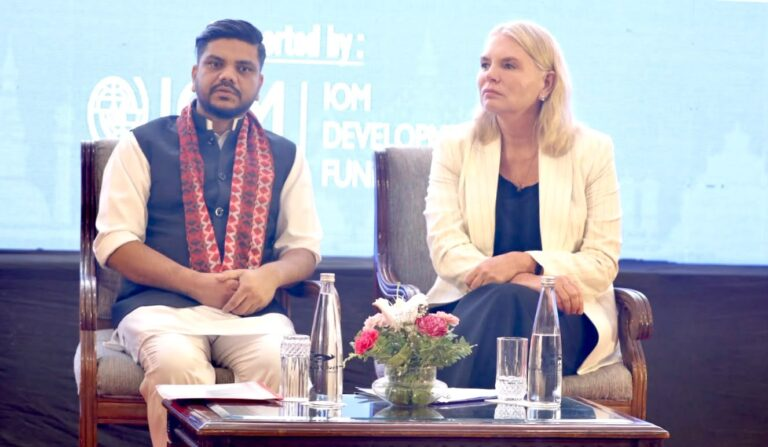
Speaking at the Fifth Nepal Forum on Migration and Development, jointly organized by the Ministry of Youth, Labour and Employment and the International Organization for Migration (IOM), Minister Yadav said the government is reviewing existing foreign employment policies to make them more practical and worker-friendly.
He noted that the “Free Visa, Free Ticket” policy, introduced in 2015, has largely remained ineffective in practice despite its implementation on paper.
“The government has already begun reviewing the policy to make it practical,” Yadav said. “Once the proposed amendment to the Foreign Employment Act, 2007 (2064 BS) is enacted, agencies that comply with the law will be encouraged, while those violating the provisions will face stricter penalties.”
The minister added that the amended law would also enable the government to fully digitize the recruitment process, making it more transparent, accountable, and easier to monitor.
Reflecting on his first 100 days in office, Yadav said he had identified implementation challenges in the existing policy even before assuming office. He revealed that the government has formed a high-level task force to develop a more scientific regulatory framework for foreign employment.
During the event, IOM Nepal Chief of Mission Helen Fores praised Nepal’s leadership in implementing the Global Compact for Safe, Orderly and Regular Migration (GCM), saying the country has demonstrated a strong commitment by translating international commitments into national action plans. She reaffirmed IOM’s commitment to supporting the Government of Nepal in this effort.
Also speaking at the conference, Jerome Alcantara, Assistant Secretary of the Department of Migrant Workers (DMW) of the Philippines, said a 2020 recruitment cost survey found that Filipino workers paid recruitment agencies an average of 1.2 months’ salary in fees. He emphasized that the Philippines’ fair recruitment system is based on legal, transparent, and rights-based recruitment practices that protect workers’ dignity and human rights.
To strengthen support for migrant workers, the Ministry has launched an online grievance platform, “Ujuri.DOFE”, through the Department of Foreign Employment.
Minister Yadav acknowledged that many Nepali workers are still forced to borrow money at high interest rates, sell land, or mortgage family assets such as their spouses’ jewelry to finance foreign employment. Citing a study conducted at Tribhuvan International Airport, he said many workers were reluctant to disclose the actual amount they had paid to recruiters due to fear of losing their jobs.
According to the minister, only around 7 percent of Nepali migrant workers currently benefit from ethical, zero-cost recruitment. He said the government’s long-term objective is to achieve a 100 percent Employer Pays Model, under which employers bear all recruitment costs.
To achieve that goal, the government plans to curb unhealthy competition among recruitment agencies while encouraging direct recruitment mechanisms, reducing the financial burden on migrant workers.

 About Us
Comment