
Banking News – Nepal’s first modern road tunnel, the Nagdhunga–Sisnekhola Tunnel, will be officially inaugurated on Monday, marking a major milestone in the country’s transport infrastructure.
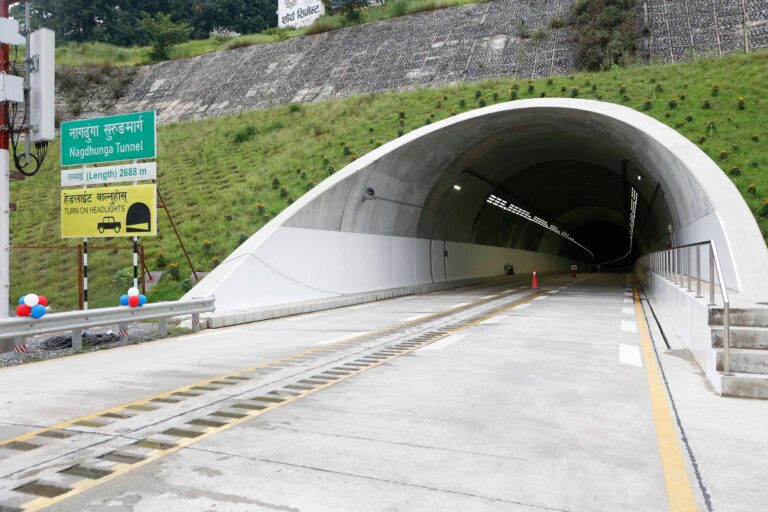
The project, constructed through a joint investment by the Government of Nepal and a concessional loan from the Japan International Cooperation Agency (JICA), has been completed at a total cost of approximately Rs. 19 billion.
According to Department of Roads Director General Dr. Bijay Jaisi, the main tunnel stretches 2.68 kilometers, while the total tunnel network—including the evacuation tunnel and cross passages—extends to approximately 5.5 kilometers.
Construction began in 2019 under Japanese contractor Hazama Ando Corporation. The inauguration ceremony will be jointly officiated by Minister for Infrastructure Development Sunil Lamsal and the President of JICA.
Although the tunnel will be officially inaugurated, it will not be opened immediately to the general public. During the initial phase, only ambulances, fire engines, and emergency vehicles operated by security agencies will be permitted to use the tunnel.
Dr. Jaisi said that within one week of the inauguration, authorities will conduct a mock disaster response drill to test preparedness for potential emergencies such as accidents or fires inside the tunnel.
Following the successful completion of the drill, the tunnel is expected to undergo approximately one week of one-way trial operations. During this testing period, engineers will evaluate all critical systems, including jet fans, ventilation, and emission control equipment.
If all systems perform satisfactorily, the Department of Roads plans to fully open the tunnel within about one month.
The department also confirmed that motorcycles and vehicles carrying flammable or explosive materials will not be allowed to use the tunnel. Other vehicle categories will be permitted in phases after the operational tests are completed.
Dr. Jaisi noted that the project was designed and managed directly by the Department of Roads under the Bill of Quantity (BOQ) model, with technical support from Japanese contractors and consultants. While the Engineering, Procurement and Construction (EPC) model is now more common for tunnel projects, he said the successful completion of this project under the BOQ model demonstrates Nepal’s growing engineering and project management capabilities.
He added that the tunnel was constructed following extensive studies aimed at reducing the risks associated with the steep Nagdhunga section and its frequent landslides. Despite technical and local-level challenges encountered during construction, the project has successfully reached the inauguration stage.
Expressing confidence in the quality of the tunnel, Dr. Jaisi said the project proves Nepal’s ability to build modern road tunnels and represents a significant step forward in the country’s infrastructure development.
Once fully operational, the Nagdhunga–Sisnekhola Tunnel is expected to provide a safer, faster, and more reliable gateway to and from Kathmandu, significantly reducing travel delays caused by steep terrain and recurring landslides along the existing Nagdhunga road.

 About Us
Comment