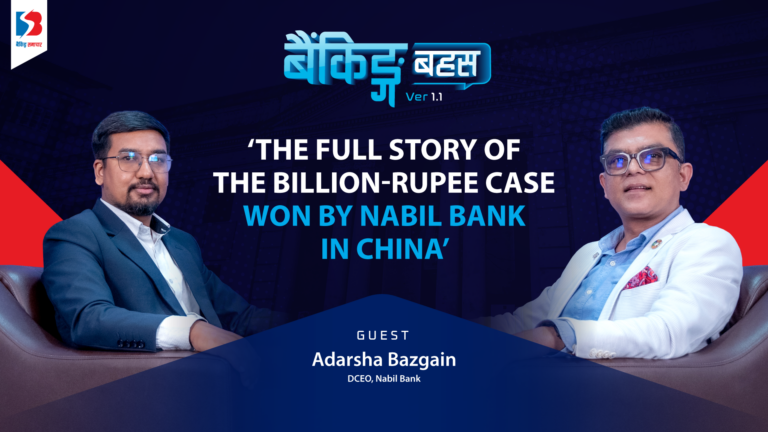

Kathmandu: Nabil Bank has brought more than Rs. 1 billion back to Nepal after winning a legal dispute in China against China Everbright Bank and Chinese construction company Shuifa ANHE Group.
The dispute originated from the Trishuli 3B Hydropower Project, where the Chinese construction company had secured the contract to construct the project but later failed to complete the work as agreed under the contract.
Before the project was awarded, Nabil Bank had issued a US$7.45 million counter-guarantee in favor of the Nepal Electricity Authority (NEA). China Everbright Bank had provided the counter-guarantee to Nabil Bank.
However, after Shuifa halted construction and left the project, the NEA invoked the counter-guarantee and recovered the guaranteed amount from Nabil Bank. The Chinese side subsequently refused to reimburse the amount, leading to a legal dispute in China.
Nabil Bank eventually won the case in China’s Financial Court and also prevailed in the subsequent appeal filed by the construction company. The bank has now recovered the amount and brought the proceeds to Nepal.
According to Adarsha Bazgain, Deputy Chief Executive Officer of Nabil Bank, the recovery from the Chinese case contributed to the bank’s increased profit in the last fiscal year. However, he said the contribution should not be viewed as the sole reason for the bank’s higher profitability.
Nabil Bank recently reported a net profit of Rs. 7.90 billion for the last fiscal year.

Economy Showing Signs of Recovery
Bazgain said the increase in the bank’s interest income and operating income, along with higher net profit compared to the previous year, indicates that the economy is gradually recovering from the difficulties of previous years.
He noted that banks had maintained relatively high provisions in previous years due to the slowdown in economic activity. As economic activities gradually recover, those provisions are also being recovered.
“Various national and international shocks are gradually being absorbed by the economy,” Bazgain said, adding that the market has started moving forward after enduring multiple challenges.
However, he cautioned that it would be premature to say that the economy has fully recovered. According to him, business activity has improved, but the private sector continues to adopt a “wait-and-see” approach amid uncertainty surrounding the new government.
Policy and Political Stability Key to Restoring Business Confidence
Bazgain identified policy stability and political stability as the two major factors necessary to restore confidence among businesses and investors.
He said the country appears to be moving toward greater political stability, but negative news and concerns regarding business security continue to affect investor sentiment.
He added that the Prime Minister and Finance Minister have been continuously meeting with members of the business community and listening to their concerns. Such discussions, he said, appear to be focused on improving market conditions and expanding investment.
Rs. 630 Million Contribution From China Case
Bazgain said the Chinese court victory was one of the factors behind Nabil Bank’s increased profit.
According to him, after recovering the amount that had previously been set aside as a provision, the bank received approximately Rs. 630 million after accounting for taxes and employee-related expenses.
He stressed that the Rs. 630 million contribution alone cannot explain the bank’s approximately Rs. 8 billion net profit, although it made a meaningful contribution.
“The case was won in China after we went there and fought it. We won at the Financial Court as well as in the appeal filed by the other side, and the money has already been received,” Bajgain said.
He attributed the overall improvement in profitability not only to the Chinese case but also to the bank’s strong non-performing asset (NPA) recovery efforts.
According to him, Nabil Bank mobilized its senior management and branches across the country to accelerate recovery. Senior-level officials also directly engaged with troubled borrowers and facilitated solutions for customers facing difficulties.
As a result, the bank’s recovery performance improved significantly and its NPA level declined.
How the China Dispute Began
The dispute began after a Chinese company won the contract for the Trishuli 3B Hydropower Project through a bidding process conducted by the Nepal Electricity Authority.
According to Bazgain, the company had initially submitted a low bid. The situation became more difficult after the Russia-Ukraine war caused commodity prices to rise, increasing the company’s costs.
Unable to proceed with the project as planned and according to the contractual terms, Shuifa eventually left the project and returned to China.
Nabil Bank initially held discussions with the NEA over the matter. The authority informed the bank that it would claim the counter-guarantee amount because the contractor was unable to complete the project.
The bank then approached the Chinese Embassy, requesting assistance in facilitating discussions with the construction company and creating an environment in which the company could complete the project.
When those efforts failed, Nabil Bank CEO Manoj Gyawali and Bajgain travelled to China. They held meetings with representatives of both the construction company and China Everbright Bank, which had issued the counter-guarantee.
Counter-Guarantee Was Unconditional
Bazgain said the counter-guarantee issued by China Everbright Bank was unconditional.
According to him, Everbright Bank was initially prepared to pay the guaranteed amount to Nabil Bank without conditions. However, Shuifa subsequently filed a case at China’s Financial Court and obtained a stay order.
As a result, although Everbright Bank was initially ready to make the payment, Nabil Bank was forced to fight a legal battle.
Importantly, the case was against the Chinese construction company rather than China Everbright Bank.
Nabil Bank Fought the Case in China
After the case was filed in China, Nabil Bank travelled to the country to defend its position.
Bazgain said the bank’s team worked closely with Chinese legal counsel who had already been representing Nepali banks in China. Since Nepali lawyers cannot independently practice before Chinese courts without the necessary Chinese legal license, the bank appointed Chinese lawyers to handle the case.
He also highlighted China’s separate Financial Court system, describing it as an effective and specialized judicial mechanism for financial disputes.
Although the Trishuli 3B project itself did not participate in the Chinese legal proceedings, Nabil Bank continued its legal battle with the construction company.
Four Trips to China
Bazgain said Nabil Bank officials travelled to China four times during the course of the dispute.
He said the successful conclusion of the case demonstrates that Nepali banks are capable of pursuing complex legal disputes abroad and are willing to fight for their legitimate claims.
Nepali banks have previously fought and won legal cases in foreign jurisdictions as well. Bazgain cited Global IME Bank, Nepal Investment Mega Bank (NIMB), and Himalayan Bank among banks that have successfully pursued legal cases overseas.
The successful recovery by Nabil Bank from China is therefore being viewed as another significant example of a Nepali bank successfully defending its financial interests in an international legal dispute.

 About Us
Comment