
Banking News – “Let’s talk tomorrow.” That was what Sabin Ranamagar told his wife Ravina over the phone on Wednesday morning around 6:00 AM from Rasuwa before hanging up. His work was about to start, while Ravina was preparing to send their five-year-old daughter to school. Shortly after, a devastating flood struck the Bhote Koshi in Rasuwa. After hearing the news of the flood, Ravina called her husband, but he didn’t answer. Despite repeated attempts, she couldn’t reach him. The brief exchange that morning, cut short by “Let’s talk tomorrow,” turned out to be their last conversation.
Sabin, a resident of Bhimfedi Rural Municipality-2 in Makwanpur, had been working as a vehicle driver at a hydropower project in Rasuwa for the past four years. He had come home on a month-long leave but returned to work on Sunday, Bhadau 7, after the company called him back within a few days. According to his grandmother Nani Maya Rana, he left home on Sunday, stayed in Kathmandu, and reached Rasuwa only on Tuesday. His work had started from Wednesday.
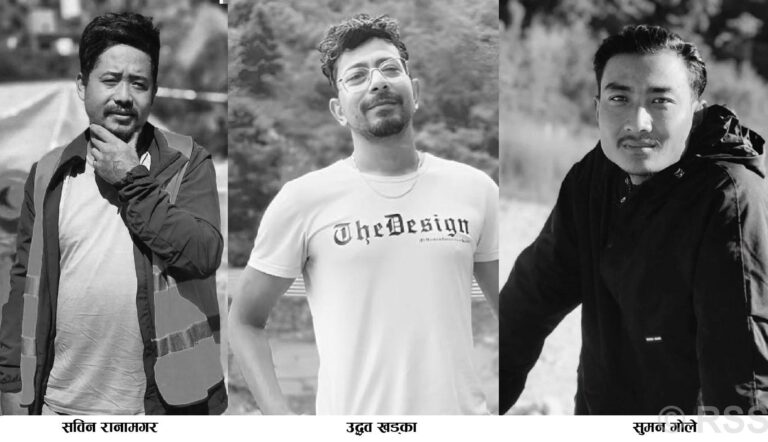
“He said he had come home on a month’s leave. Within five or six days, he returned to work saying the company had called him,” Nani Maya said. “He had just reached Rasuwa on Tuesday. His work started on the very day the flood came. Everything ended in a moment.”
After contact was lost, the family spent the first two days hoping for good news. Then relatives began searching for Sabin, visiting hospitals and places where bodies were kept. Eventually, their search ended on Monday with a body found in Nawalparasi. The body was so decomposed that identification by face was difficult. What helped the family identify Sabin was the tattoo on his left hand.
Bhimfedi Rural Municipality-2 Ward Chair Kashiram Bajyu informed that the family identified Sabin’s body based on the tattoo on his hand. Sabin’s father has been in Saudi Arabia for foreign employment for the past 14-15 years. He is survived by his mother, brother, wife Ravina, and five-year-old daughter.
While Sabin’s family waited in hope for a phone call, another family in Dhungedhara, Hetauda Sub-Metropolitan City-5, was experiencing similar anxiety. Uddhav Khadka, who had been working as a tipper driver at the Chilime Hydropower Project for two years, had taken his wife Niru and daughter Nimisa with him to Rasuwa. He had rented a room near a school so that his daughter could attend school easily.
After videos of the Bhote Koshi flood started spreading on social media on the morning of Bhadau 10, Uddhav’s relatives in Hetauda began calling. Uddhav’s phone didn’t connect. Neither could they reach his wife Niru’s number. For some time, all three were out of contact. On Bhadau 11, a team from Hetauda Sub-Metropolitan City departed for Rasuwa to search for them and other missing citizens.
The team was stopped in Kathmandu due to road blockages. After searching various hospitals in Kathmandu without finding any information about them, the team reached Nuwakot on Bhadau 12. There, police found two names on the list of those rescued by helicopter – Niru Khadka and Nimisa Khadka.
After the mother and daughter were rescued alive, arrangements were made to bring them to Hetauda. After Niru and Nimisa were found alive, the family’s hopes grew that Uddhav might also have been rescued and be in a safe place. But Uddhav’s name was not found on any rescue list. Family members searched from hospitals to possible locations. Eventually, his body was found in Nawalparasi on Bhadau 12.
According to Hetauda-5 Ward Chair Sushil Ghimire, due to work pressures, Uddhav used to come to the room only about one day a week to stay with his family. When the flood came, he was at work. Niru and Nimisa, who were in the room, managed to escape and save their lives by running with others. “Uddhav had come to the room on Saturday and left for work on Sunday. He had rented a room near the school so that his daughter could easily go to school,” Ward Chair Ghimire said. “That morning, the flood suddenly came. His wife and daughter were in the room and managed to escape and save their lives.” Niru and Nimisa have returned to Hetauda.
Sabin had been working in Rasuva for four years, and Uddhav for two years. Suman Gole, a 26-year-old from Bhorde, Hetauda Sub-Metropolitan City-15, had been lured to Rasuva only two months ago by the promise of good income. Previously working as an operator at Riddhisiddhi Cement Industry in Hetauda-15, Suman worked as an excavator driver at a hydropower project in Rasuva. On the morning of the flood, he had just finished his night shift and was returning. Around 6:00 AM, he spoke to his wife Rebika on the phone. He told her he was tired after working all night and would sleep now, and call again in the afternoon. According to Suman’s neighbor Nirmala Ghalan, after that call, he was never able to speak to his wife again. “He had gone there for work just two months ago because of the good salary,” Nirmala said. “After finishing his night shift, he spoke to his wife in the morning. He said he was sleepy after the night’s work and would sleep now and call in the afternoon. The flood swept him away that morning.”
After hearing about the flood, the family called Suman repeatedly but couldn’t reach him. According to Nirmala, the family learned from Suman’s friends that he was sleeping when the flood came. He couldn’t get out in time despite friends urging him to wake up and run. The family’s wait ultimately ended in sorrow. Suman’s body was also found in Nawalparasi. He is survived by his wife, four-year-old son, and brother.
Sabin, Uddhav, and Suman came from different homes. They arrived in Rasuwa at different times. Their responsibilities were different. But the reason that took all three away from their homes was the same – employment.
That same employment had connected all three to hydropower projects in Rasuwa. Until just before the flood, all three were in contact with their families. Sabin had told his wife, “Let’s talk tomorrow.” Suman had said he would sleep after the night shift and call in the afternoon. Uddhav had also been in conversation with his family until the previous day. Then their phones went silent. The families first waited for calls. Then they searched for names on rescue lists. They went to hospitals. They walked to places where bodies were kept, searching for their loved ones. Uddhav’s family had hoped that after finding Niru and Nimisa alive, he too would return. Sabin’s family eventually identified a body, unrecognizable by face, through a tattoo on his hand. The search for all three, who had left home for employment, ultimately ended not on their way back home, but at places of body identification.

 About Us
Comment