
Banking News – On the occasion of Gen Z Martyr’s Day today, Bhadau 23, the Nepal Gen Z Front has released a special debate paper marking the first anniversary of the Gen Z uprising, posing 12 significant questions to the current government, political leadership, and state apparatus.
The debate paper, coordinated by Raksha Bam, calls for a serious review of the agendas of good governance, accountability, transparency, institutional reform, and digital rights raised during the Gen Z movement.
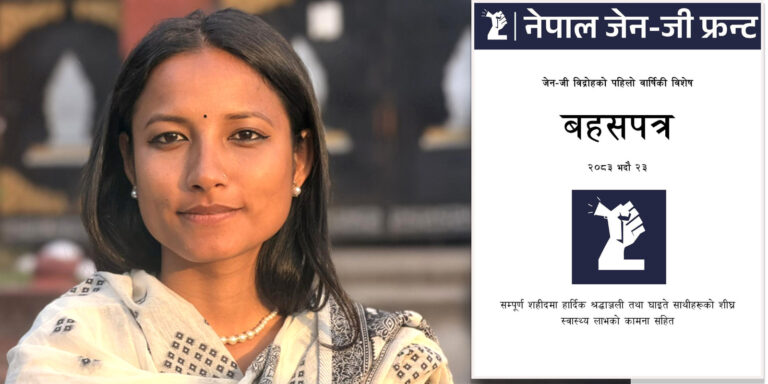
The Front has demanded clear answers from the government on issues including implementation of the 10-point agreement made with the government during the movement, cases against protesters, the problem of landless and squatters, the role of parliament, health insurance, and security agency reform.
Titled “Gen Z in Jail, Leaders on the Train to Power?” , the debate paper accuses leaders of benefiting from political change following the movement while protesters are still facing cases and imprisonment. The Front claims that the commitment to withdraw cases and release protesters as per the 10-point agreement between the government and Gen Z representatives has not been fulfilled.
The Front has also raised questions regarding the use of force against landless and squatters, parliamentary effectiveness, the Prime Minister’s public statements, the state of the health insurance program, the practice of public accountability, investigation into the incidents of Bhadau 23 and 24, and reform of security agencies. Similarly, accusing new political forces of repeating the practices of old parties, the Front has demanded internal purification and accountability within political parties.
The debate paper also raises questions about the relationship between social media and public opinion, stating that debate is needed on whether topics that trend on social media constitute public opinion, and whether citizens are choosing their own questions or algorithms are determining them.
The Gen Z Front has stated that the movement itself must also be ready for self-reflection, and that open debate is needed on the movement’s leadership, internal democracy, transparency, and accountability.
The Front has paid tribute to all those killed in the incidents of Bhadau 23 and 24, and stated that the questions raised during the movement remain alive, and they will continue to raise questions until answers are received.
Full Text of the Debate Paper
First Anniversary Special of the Gen Z Uprising
Debate Paper
Bhadau 23, 2083
With heartfelt tribute to all martyrs and wishes for the speedy recovery of the injured
On this very day last year, the Gen Z youth of Nepal spontaneously took to the streets in a peaceful movement with their voices and some uncomfortable questions, demanding an end to institutionally pervasive malpractices, corruption, nepotism, favoritism, oppression, inequality, and authoritarian arrogance, seeking accountable, citizen-centric leadership, good governance, institutional reform, and freedom of expression.
While a generation was asking questions hoping for some answers from the government, the then state power responded with lethal bullets, committing extrajudicial killings of 19 youths and thousands of questions within hours. Thousands of other youths and millions of questions were injured and left abandoned. Nepali citizens felt that the last thread of trust in every institution of the state had also ended that day.
The arrogant, prideful, and insensitive expressions of the then government and its administration on the evening of Bhadau 23 pushed public outrage to the point of explosion, leading to even greater damage on Bhadau 24. Over two days, 76 citizens lost their lives, including police officers who had sworn to protect the country and citizens, killed mercilessly. Public and private infrastructure was destroyed. Great losses were suffered from the citizen level to the state.
Citizens then had to face the fear that the progressive achievements gained through long and difficult struggles might be lost in the resulting statelessness, constitutional crisis, and uncertainty. The collective efforts of Gen Z, civil society, and all Nepali citizens were crucial in preventing that situation.
After the formation of an interim civilian government on Bhadau 27, honest efforts were made to create an environment for House of Representatives elections, as an exercise in returning sovereignty to the citizens. Ultimately, Nepali citizens exercised their adult franchise, demonstrating full collective commitment to the constitution, and completed peaceful and enthusiastic voting.
The interim civilian government succeeded in its duty to conduct elections but showed no willingness to investigate the incidents of Bhadau 23 and 24 or take action against those responsible. The current government, elected with a massive majority, continues the same reluctance and indifference.
The 10-point agreement signed between the Government of Nepal and Gen Z representatives on Mangsir 24, 2082, was published in the government gazette the next day, but both the interim and elected governments have shown indifference to its implementation. Hundreds of Gen Z and youth friends are still in jail simply for participating in a political movement. The state continues to suppress hundreds of friends by filing false cases against them.
From Bhadau 23 last year to Bhadau 23 today, this country has seen three governments formed under completely different circumstances with different goals and plans. Yet no significant difference in governance style has been found in essence.
As the first anniversary of the Gen Z uprising approaches, the Nepal Gen Z Front believes there is a need for comprehensive review by Nepali society, Gen Z activists, civil society, political parties, security agencies, journalists, social organizations, and various stakeholders, and for honest internalization of the spirit of the Gen Z uprising.
The government that came with unprecedented votes and the entire country today is grappling with the massive disaster caused by the Trishuli-Bhote Koshi flood in Rasuwa. History will certainly review how prompt and honest its disaster response efforts were.
At this time, the most important thing is to support the government and help heal the citizens waiting for rescue and relief. The trust and public confidence lost from state structures, public bodies, and government systems must be restored. There is no doubt that the state will need the support and cooperation of all Nepali citizens for that.
However, the concept that supporting the state during a disaster means turning a blind eye to all other issues is not healthy for democracy. What role have the developments since the Gen Z uprising played in ensuring the core principles of good governance, accountability, transparency, and digital rights?
As the first anniversary of the uprising approaches, have we forgotten to ask questions? Are we ready to debate the following points today? Are questions still as dear to us as they were last Bhadau?
1. Gen Z in Jail, Leaders on the Train to Power?
Clause 2 of the 10-point agreement between the government and Gen Z representatives on Mangsir 24, 2082, provided for withdrawing cases against Gen Z protesters arrested during the movement, releasing those arrested, and not making further arrests related to the political movement.
Despite the long time since the agreement, hundreds of Gen Z protesters are still facing cases and some remain in jail awaiting trial.
On one hand, the state signed an agreement with the protesters and committed to withdrawing cases and releasing them. On the other hand, the leaders who claim political change from that movement are now in power.
Gen Z in jail, leaders on the train to power? Was the agreement meant to release protesters from jail or to put leaders in power?
Does taking ownership of the movement mean only enjoying its fruits, or also taking responsibility? Why are the victims and the beneficiaries of the movement’s achievements different people?
2. Why Are Landless and Squatter Citizens Being Repeatedly Attacked?
Commissions formed to resolve the long-standing landless and squatter problem in Nepal have not completed their work, while state bodies at local and federal levels continue to use force, bulldoze settlements, and physically evict people without providing alternatives.
Article 37 of the Constitution of Nepal guarantees every citizen the right to adequate housing, and Article 40 guarantees the right to land and housing for Dalits and the landless as fundamental rights.
Instead of management, the state has chosen the short, inhuman, and cruel path of displacement, causing a humanitarian crisis and great harm to dignity.
Why is the right to housing and land, guaranteed as a fundamental right by the constitution, limited to paper only for squatters and landless?
What kind of governance is it when the state renders citizens homeless in their own country without providing alternatives and rehabilitation?
3. Has Parliament Become a Place of Power Display Rather than a Legislative Body?
The sovereign parliament, the supreme representative body, is increasingly becoming a place for parties to display political power, controlled clapping, chaos, and violation of rules rather than legislative work.
Important bills are passed hurriedly with clapping without adequate debate, governance is done through ordinances by closing parliamentary sessions, and MPs remain silent spectators or slaves to party whips on burning citizen issues.
The House of Representatives rules provide that the Prime Minister must answer MPs’ questions in the first week of each month. But Prime Minister Balen remained absent from that process for a long time, and the Speaker had to whip him to appear and answer.
How embarrassing is it for democracy when the Speaker has to whip the leader of the party for not following House rules?
Why does a government with nearly a two-thirds mandate find it easier to bypass parliament through ordinances?
4. Why Does the Prime Minister’s Tongue Slip?
The practice of the person holding the highest executive position making irresponsible, insensitive, and remarks contrary to diplomatic and constitutional dignity on public platforms, and later dismissing them as “slips of the tongue” or misinterpretation, has become common.
The executive chief’s speech affects the image of the entire country and citizens’ self-respect.
When Prime Minister Balen stated that Nepal had also encroached on Indian land regarding the Lipulekh-Limpiyadhura-Kalapani dispute, it created great dissatisfaction across the country, and there were even demands to remove that statement from parliamentary records. The Ministry of Foreign Affairs later clarified that the matter was about local land use practices in border areas.
When the Prime Minister’s tongue slips, who bears the burden — the Prime Minister or the nation?
5. Health Insurance: Reform or Let It Die?
The health insurance program, launched with the aim of providing accessible healthcare to citizens, has been in decline due to budget shortages, withholding of payments to private hospitals, and managerial weaknesses.
Many large and government hospitals are warning of stopping services due to non-payment from the Health Insurance Board. Poor citizens have been deprived of treatment.
Outpatient benefits for policyholders were reduced, and insurance services in private hospitals were affected. The government suspended health insurance services in private hospitals except for emergencies. Reports have been published in the media about the impact on insurance renewals.
Why is the state not paying attention to making the health insurance program, directly connected to citizens’ lives, effective and well-managed?
Can someone write or cut about whether this is a game to gradually make it useless and hand over citizens’ health to mafia?
6. ‘Sidhakura with the Prime Minister’ – When?
The most important and popular program that boosted the public image of Rastriya Swatantra Party’s powerful Chairman Rabi Lamichhane was “Sidhakura with the Prime Minister.” The process of making Rabi’s face and name known in every household started from that concept of asking questions to the Prime Minister.
Today, the Speaker had to whip the Prime Minister of the party chaired by Rabi to appear in parliamentary question-answer sessions.
Those who gained popularity by asking questions to rulers through Sidhakura while in media, opposition, or minority, and who advocated transparency through mass and digital media, have shown a tendency to flee from probing questions from citizens, representatives, and media once in power, avoid press conferences or stay in siege, and even script questions for journalists.
How did we get from “Sidhakura with the Prime Minister” to “When will there be Sidhakura with the Prime Minister?” How much further will we go backward?
7. When Will the Investigation Happen?
The report of the Gauri Bahadur Karki-led commission formed to investigate the incidents of Bhadau 23-24 was belatedly “leaked.” The recommendations to take action against leadership at the top political, administrative, and security levels faded within two days.
The report concluded that excessive unlawful force was used by security agencies in the Bhadau 23-24 incidents.
Subsequently, then Prime Minister KP Sharma Oli and then Home Minister Ramesh Lekhak were even arrested, but questions remain about the process of filing charges.
In the case of security agencies, a new committee was formed in the name of separate investigation to avoid accountability.
The reports of past commissions, as mentioned in Clause 7.2 of the agreement between the Government of Nepal and Gen Z representatives, have also not been made public.
When will the practice of forming investigation committees or commissions to temporarily calm public outrage over major corruption, extrajudicial killings, or state suppression, but never making those reports public and never taking action against the guilty, come to an end?
8. How Long Will Citizen Killings Continue?
Since the movements during the constitution drafting period, incidents of excessive force and use of bullets by security forces during protest control have been repeated.
In the Tarai-Madhes movement of 2072 BS, the National Human Rights Commission noted that security forces used excessive force in some incidents. That year, at least 47 civilians and 10 security personnel lost their lives.
Since then, the National Human Rights Commission has repeatedly drawn attention to excessive force by security forces, from persons with disabilities to various citizen movements.
In the Trikune incident of Chaitra 2081 BS, one protester died and others were injured when bullets were fired during protest control.
Even after the government fell following the deaths of 19 people and injuries to hundreds of youths in just hours on Bhadau 23 last year, security agencies’ methods have not improved.
In Shrawan this year, a youth was killed at the scene by security forces’ bullets in Devangunj, Sunsari, and many others were injured. Another youth died during treatment. Most of the injured were shot above the waist.
Following that, another youth died from a bullet wound in the Golbazar incident in Siraha.
From 2072 to 2083 BS, movements changed, governments changed, power changed, but why couldn’t the situation of shooting at protesters change?
How long will citizen killings continue? How long will the state answer citizens who take to the streets demanding their rights with bullets?
When will long-term reform of security agencies and protection of citizens become a priority of this state?
9. Where Is the Filtration Mechanism in New Parties?
The promotion that the arrival of new faces in politics is the complete proof of change is being made. The main question is: is anyone asking it anywhere?
Do we have any concrete political culture or system to test the qualifications, integrity, moral character, accountability, and democratic values of individuals reaching power and public responsibility?
What criteria are being applied in leadership selection, candidate selection, public appointments, and distribution of responsibilities within the ruling party today?
Is the ability to win elections by any means considered the only qualification for leadership?
The Gen Z uprising raised questions against the same arbitrary and opaque culture of old political parties. It highlighted the problem that those committing crimes did not face punishment under the cover of politics, but were increasingly rewarded.
Citizens were outraged by the impunity in the criminalization of politics and politicization of crime. New parties have emerged claiming to be the alternative.
If so, why are the new political forces repeating the same old wrong practices under the cover of new faces?
When a member of the ruling party’s Central Investigation and Documentation Department placed his vehicle at the gate of a media outlet to terrorize the press under the state’s cover, there is no news of any action against them.
What difference has there been between the new and the old?
What are the new parties doing to establish internal purification, accountability, and new quality standards within their parties?
10. Was It Over After the Agreement?
The 10-point agreement between the Government of Nepal and Gen Z representatives has not been fully implemented.
Immediately visible clauses such as declaring the deceased as martyrs, compensation for families, and interim relief have been implemented. But on sub-clauses including free treatment, education, and employment, with the classification of injured and seriously injured, complaints of ambiguity and arbitrariness have kept the work stuck at a partial level, as published in study reports.
The commitment to form a permanent commission for good governance has been completely abandoned.
The most serious contradiction lies in the institutional reform and investigation clauses. The investigation commission’s report was not made public but only submitted to the government, and no action has been initiated against the guilty.
Although the agreement promised to screen arrested protesters within 15 days and release them if no serious crimes were found, in practice most of those arrested had cases filed against them without any screening.
The commitment not to file cases for political participation and the mechanism for security sector reform both have not even come into existence.
Implementation of the clause to end policy-level corruption and partisan appointments remains completely incomplete. The practice of partisan appointments in public institutions has increased further due to the single-majority powerful government.
No steps have been taken toward investigation of assets of political power establishments.
Although the election was completed peacefully, electoral reforms such as the provision for “none of the above” on ballot papers, primary elections, and term limits for party presidents have not even reached debate.
A high-level suggestions commission for constitutional amendment has not been formed.
Regarding transparency, the commitment to make past investigation reports public remains abandoned.
On the digital freedom clause, there is still no legal or structural provision to protect citizens’ digital data from misuse by the state or third parties.
The Gen Z Council, envisioned as a mechanism for good governance monitoring, has also not been formed.
Looking at the fully implemented clauses of the 10-point agreement, they are either immediately visible or were moral, constitutional, and political obligations that had to be done anyway.
The clauses that raised questions about state structure, accountability, and power balance, those that covered investigation, ending partisan appointments, long-term security agency reform, constitutional amendment, etc., are all stuck at zero or very low implementation.
Why did the state, which promised to stop arrests with the agreement as witness, arrest again?
With a single-majority government, there was even more power to do better, so why did partisan appointments increase further?
Is signing on paper and ignoring in practice called good governance?
Was the agreement truly an achievement of the movement, or just a paper weapon to pacify the movement?
Will we be forced to ask these same questions for how many more years, or perhaps for life?
11. What Is the Difference Between Facebook Likes and Public Opinion?
Today, social media has become a large part of how people receive information and conduct public debate.
A topic can spread widely within hours, while another can be overshadowed at the same time. The same message about a topic can be repeated from many pages, profiles, and platforms. Algorithms also determine what content users see.
Is the topic that is shared the most important topic?
Is what is seen most on social media the public opinion?
Are we choosing our questions, or is the algorithm?
12. Is the Movement of Asking Questions Ready to Question Itself?
Many of those who carried questions to the streets and were made the face of the movement are now in power. Some are Prime Minister, some Home Minister, some MPs.
A large part of the movement is still on the streets. There are questions about whether the movement was hijacked. There is a strong voice that power has been hijacked, while the movement and its agendas remain where they were.
Are we equally honest in raising questions about the movement’s own leadership selection, internal democracy, unity, and accountability, as we were in raising questions to the state?
Have we transparently presented the divisions and differences within the movement to the citizens, or have we covered them up?
Is the practice of asking questions meant only for those in power, or are we ready to apply it equally to ourselves?
The questions that bullets tried to stop on Bhadau 23 last year are still alive today. They have returned in greater numbers, sharper.
A year ago, the state gave bullets to those asking questions. Today, the state gives silence to those asking questions.
Bullets and silence are two different weapons carrying the same intent.
Questions do not die forever from bullets or silence. They live on for generations. They beat until they receive answers.
This debate paper is only a small repetition of those still alive, still unhealed questions.
The day this state stops treating those who ask questions as enemies and starts giving answers, perhaps then the struggle of Bhadau 23 will become somewhat meaningful.
Until then, the Nepal Gen Z Front will continue asking questions.

 About Us
Comment