
Banking News – The International Education Providers Association of Nepal (IPAN) has stated that public debate regarding academic programs operated in Nepal under affiliation with foreign universities must be based on facts, law, and evidence. The association has requested that when questions are raised about the legitimacy of institutions or the quality of education, conclusions should be drawn based on provisions in prevailing law, approval of educational institutions and programs, university accreditation, credibility of degrees, international recognition, academic reputation, and the opportunities and acceptance given by the job market to students who have completed their studies.
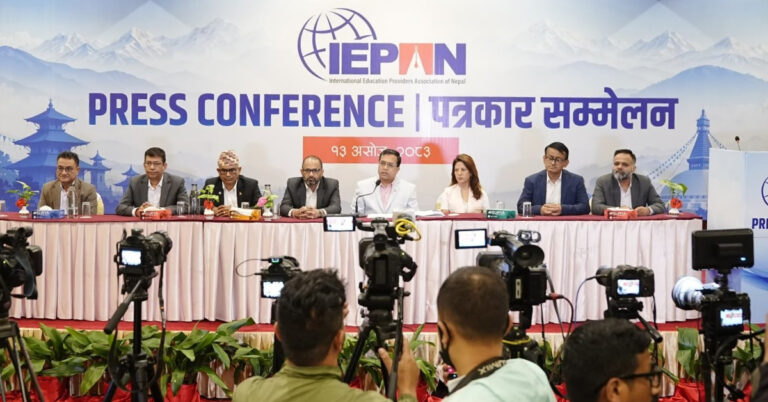
Speaking at a press conference on Tuesday, Laxman Kc, President of IPAN, stated that the claim that programs being operated with the approval of the Ministry of Education can be shut down at any time without legal basis is false. He informed that the “Foreign Educational Program (Operation and Regulation) Regulations, 2083,” issued under Section 19 of the Education Act, 2028, has made arrangements for the operation and regulation of such programs.
According to Kc, programs affiliated with 35 foreign universities from seven countries are currently in operation in Nepal. A total of 37,208 students are studying in 58 institutions that have received permission to operate such programs. IPAN claims that this sector has created approximately five thousand direct and 15 thousand indirect jobs, with an investment of approximately Rs 25 arab. IPAN states that it contributes approximately Rs 50 crore in direct and more than Rs 1 arab in indirect revenue annually, creating economic activity equivalent to Rs 15 to 20 arab.
Kc stated that students can stay with their families when studying for international degrees within Nepal, saving on foreign accommodation and daily expenses. IPAN claims that in some programs, the cost of studying in Nepal can be up to approximately 15 times lower than the total cost of going abroad to study. It estimates that this will help reduce potential foreign currency outflow of approximately Rs 50 to 60 arab annually. However, IPAN has clarified that a conclusion cannot be drawn from this that all students who go abroad would enroll in Nepal’s programs.
“Our main role recently has been in IT human resource production,” says Kc. “The trendsetters of IT education in Nepal have been colleges operated in Nepal under affiliation with foreign universities.” According to an IIDS study, approximately $515 million USD (nearly Rs 68 arab) worth of IT services were exported from Nepal in 2022, and it is estimated that by 2025, this sector will reach near $1 billion USD (nearly Rs 1 kharb 45 arab). According to him, this growth has been possible through the efforts of Nepali IT students who have recently completed their studies, IT companies, freelancers, and the private sector. Kc stated that colleges operated under affiliation with foreign universities have initiated teaching subjects including AI-related courses such as Big Data Analysis, cybersecurity courses such as Cyber Security and Network Security, as well as Hotel and Hospitality Management, Interior Design, Entrepreneurship, and Multimedia and Animation within Nepal.
According to him, after the start of studying such subjects within Nepal, skilled human resources are being produced according to the needs of the global market, and the situation where students have to go abroad with huge investments is gradually decreasing. Mentioning the attraction toward foreign studies, Kc informed that 112,593 individuals took study permits in fiscal year 2080/81 and 123,589 in 2081/82. According to details presented by IPAN, Rs 1 kharb 24 arab 95 crore and Rs 1 kharb 38 arab 48 crore respectively flowed out for educational purposes in those years. Kc stated that to prevent the migration of young students abroad, quality, competitive, and international-level higher education must be provided within the country, along with strengthening the environment for employment and entrepreneurship for youth.
The National Statistics Office’s Nepal Education Institution Survey, 2081, has also shown the broad contribution of non-government-owned educational institutions. According to the survey covering the situation of fiscal year 2080/81, there were 466,805 students studying higher education in those institutions. The survey states that the total value addition of such educational institutions was approximately Rs 1 kharb 60 arab, with 311,516 people involved. These figures are for all non-government-owned educational institutions, not the separate contribution of the 58 institutions affiliated with foreign universities.
Regarding quality, Kc stated that affiliated colleges and branch campuses of foreign universities are different models in terms of ownership and operation. Stating that no model can be automatically considered excellent or weak, he requested that each program be examined based on curriculum, teacher qualifications, infrastructure, evaluation, and student learning outcomes. He also stated that the affiliating university determines the curriculum and academic standards, as well as monitors the partner college.
Kc informed that the Ministry of Education has been conducting on-site monitoring of institutions with teams including experts. According to him, the new regulations have made a provision requiring affiliated institutions to initiate a quality assurance and accreditation (QAA) process within three years. He stated that fees to be paid to foreign universities are paid through the banking system based on the ministry’s approval and recommendation, and details are submitted to the ministry. IPAN has requested that if there is evidence of irregularities by any institution, an investigation should be conducted by the regulatory body.
Kc stated that short training in artificial intelligence or cybersecurity should not be compared to a full academic degree. He says that an opinion should be formed only after examining the duration, credits, curriculum, and evaluation method of the program. He informed that students can be evaluated through assignments, research projects, and presentations along with written examinations.
Kc also shared the goal of developing Nepal as a study destination for foreign students in the future. For this, he requested the government to make clear arrangements regarding evaluation of qualified institutions, student visas, and services required for foreign students. He also demanded making the updated list of permitted institutions and programs public, clarifying quality testing standards, and making the process of addressing student grievances effective.

 About Us
Comment