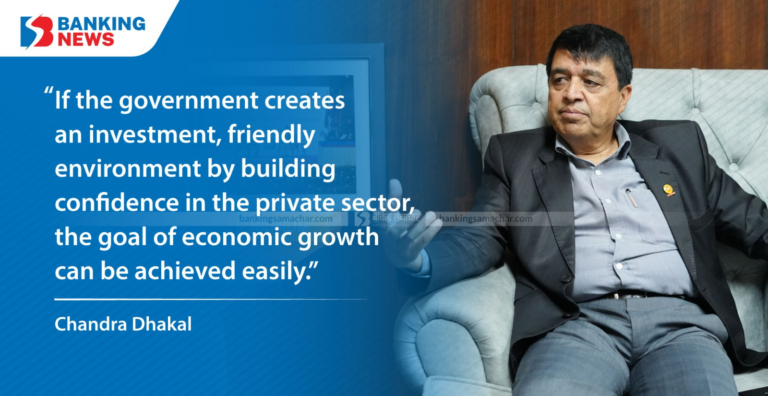

Kathmandu — Chandra Prasad Dhakal is stepping down after completing his three-year tenure as President of the Federation of Nepalese Chambers of Commerce and Industry (FNCCI). The federation’s 60th Annual General Meeting is currently underway in the capital.
Speaking during the inaugural session of the annual assembly, Dhakal reflected on the severe economic challenges faced during his tenure. He recalled how Nepal’s economy, which had only just begun recovering from the COVID-19 pandemic, was further impacted by the Russia-Ukraine war, political instability, and several domestic issues that negatively affected the country’s industrial and business sectors.
Dhakal stated that during these difficult times, solutions were sought through stronger cooperation and partnership between the government and the private sector. As he prepares to leave the leadership of Nepal’s largest private-sector umbrella organization, he emphasized the importance of meaningful collaboration between the state and private businesses for the country’s economic development and prosperity.
In an interview with RSS Deputy Editor Kamal Kumar Basnet, Dhakal shared his views on his tenure, economic reforms, investment climate, and the future of Nepal’s private sector.
Reflecting on His Tenure at FNCCI
Dhakal said Nepal’s economy was already facing serious difficulties when he assumed leadership of FNCCI. The effects of the COVID-19 pandemic were still visible, while the Russia-Ukraine conflict disrupted global supply chains. Interest rates had reached record highs, liquidity shortages affected financial institutions, and political instability remained a persistent issue.
“In such circumstances, my responsibility was to boost the morale of the private sector and help revive economic activities,” he said.
He added that he consistently emphasized the need for the private sector to adopt modern thinking and strategies instead of relying on traditional approaches. Under his leadership, FNCCI focused on creating an investment-friendly environment, identifying policy barriers, and strengthening the idea that the government and private sector are complementary partners.
“We worked not only through formal recommendations but also by promoting meaningful dialogue and presenting objective, result-oriented suggestions,” he said.
Policy Reforms and Legal Improvements
Dhakal highlighted policy reform and legal advocacy as some of the major achievements of his tenure. According to him, FNCCI actively lobbied government agencies, parliamentary committees, ministries, and regulators to amend laws obstructing investment and economic growth.
He noted that the federation successfully pushed for broader economic discussions involving political parties, regulators, and private-sector stakeholders. One key outcome was the formation of the High-Level Economic Reform Recommendation Commission led by former Finance Secretary Rameshwor Khanal.
The commission recommended reforms in more than 30 laws aimed at improving Nepal’s investment climate.
Dhakal also recalled his efforts to convince the government that hosting investment summits without legal reforms would not produce meaningful results. “We pushed for policy changes first so that foreign investors attending the summit would receive a positive message about Nepal,” he said.
Government and Private Sector Relations
Discussing relations between the government and the private sector, Dhakal said FNCCI worked to demonstrate the private sector’s contribution to employment generation, tax revenue, and economic growth.
He specifically mentioned opposing a previous government proposal to bring the private sector under the jurisdiction of the Commission for the Investigation of Abuse of Authority (CIAA). Through extensive dialogue with lawmakers, ministries, and constitutional bodies, FNCCI succeeded in halting the proposal.
“This was crucial for protecting investor confidence at the time,” he said.
According to Dhakal, the federation also helped change the perception that the private sector only seeks benefits from the government. Instead, he stressed that public-private partnership is essential for national development.
Investment Opportunities in Nepal
Responding to concerns that Nepal lacks opportunities and a favorable environment for investment, Dhakal strongly disagreed.
“I have repeatedly said that Nepal is full of opportunities,” he stated.
As an example, he pointed to the establishment of Nepal Development Public Limited, a public company with capital of Rs 10 billion, formed through investments from Nepalis at home and abroad. The company aims to invest in infrastructure, production-oriented industries, and startups.
Dhakal also highlighted FNCCI’s efforts to support women entrepreneurs, startups, and small and medium enterprises by establishing dedicated units and forums.
He said the federation played an important role in introducing Nepal’s startup policy and has continued promoting technical and skill-based education in cooperation with the government.
Expectations from the New Government
Dhakal expressed optimism about Nepal’s political future, noting that stable governments and legal certainty are essential for attracting investment.
“Countries with stable governments, stable laws, and political peace experience faster economic growth,” he said. “Now, Nepal too has begun moving toward stability.”
He welcomed the formation of a majority government and praised the inclusion of young and capable leaders in the Cabinet and Parliament. According to him, the government has already approved and begun implementing a 100-point action plan focused on economic reforms.
He also welcomed the government’s decision to dissolve the Revenue Investigation Department, describing it as a positive signal for investors and the private sector.
“We believe more reforms will continue in the coming days,” he said.
Reforming FNCCI’s Constitution
Dhakal described the consensus-based amendment of FNCCI’s constitution as one of the most memorable achievements of his tenure.
The revised constitution introduces direct elections for the FNCCI president instead of automatically promoting the senior vice president to the top position. It also expands representation for district and municipal chambers and introduces provisions for greater participation of women within the organization.
Dhakal said these changes would make future FNCCI leadership more accountable and inclusive.
Concluding the interview, he thanked former FNCCI presidents, government agencies, regulators, diplomatic missions, donor organizations, media professionals, and all stakeholders who supported him during his tenure.
He also pledged to continue contributing to entrepreneurship development, job creation, and Nepal’s overall economic progress in the years ahead.

 About Us
Comment