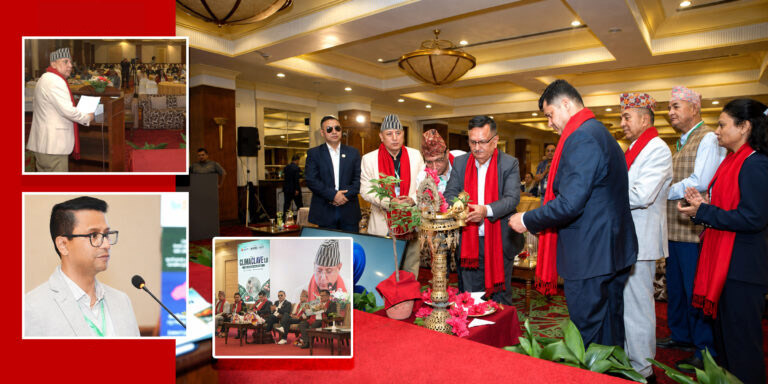

Kathmandu – Experts and policymakers have emphasized the need for stronger green finance mechanisms, increased climate investment, and community-driven solutions to address the growing challenges posed by climate change in Nepal.
The call was made during ClimaClave 1.0, a program organized by Sahara Nepal at Hotel Everest in Kathmandu to strengthen advocacy on climate and environmental issues.
Sharing his experience, Prakash Sarki, a farmer from Kanchanpur, said his dream of contributing to his homeland after spending a decade working for Reliance NGO in India became possible with the support of Sahara Nepal. Through technical assistance, soil testing, and free distribution of thousands of fruit saplings, he successfully cultivated mango, lychee, and jackfruit trees on one bigha of land.
“My field is now fully green and flourishing. Earlier, people used to question my efforts on barren land, but now everyone comes to take photographs in the greenery,” Sarki said.
Similarly, Damodar Yogi of Kailali said he planted 1,300 orange saplings on 16 ropani of land with support from Sahara Nepal. The initiative, he said, inspired him to abandon plans for foreign employment and pursue agriculture instead.
“Now I will not go abroad. I will work productively in this profession here,” Yogi said, while expressing hope for additional support to tackle water shortages during drought periods.
According to Yubaraj Siwakoti, Program Director of Sahara Nepal, the organization has implemented more than 66 projects across 43 districts. It has supported bamboo plantation over 63 hectares of land, treated more than 500,000 bamboo poles, provided livestock management training to over 5,000 farmers, and helped nearly 18,000 families adopt green and alternative energy solutions.
Speaking at the event, Sahara Nepal Executive Chief Mahendra Giri said the organization has been promoting climate adaptation through fruit sapling distribution, particularly in Sudurpashchim and Karnali provinces. He stressed that climate resilience and a green economy should be prioritized, adding that community-based solutions and sustainable livelihoods are essential for a climate-resilient future.
Dr. Aditya Panda, Director of The Coca-Cola Foundation, said the foundation supports organizations such as Sahara Nepal in creating measurable and long-term environmental impacts.
“We are trying our best to maintain climate-friendly activities,” he said, adding that grassroots-level engagement is key to achieving lasting change.
Guru Prasad Poudel, Executive Director of Nepal Rastra Bank (NRB), said the timing of the program was appropriate, noting that while Nepal recognizes the impacts of climate change, policy responses remain inadequate.
“Nepal Rastra Bank has developed a green finance taxonomy. It should be transformed into a national document and later linked to international taxonomy systems,” he said.
Senior Energy Expert Ram Prasad Dhital noted that Nepal has set a target of achieving carbon neutrality by 2030, but current budget allocations are insufficient for building climate-resilient infrastructure.
“With only around Rs 7 billion allocated, it will be difficult to achieve carbon neutrality. Greater emphasis should now be placed on green energy,” he said, appreciating Sahara Nepal’s contribution to climate adaptation and mitigation.
Former Finance Minister Surendra Prasad Pandey praised Sahara Nepal for its distinct and successful approach, despite challenges currently facing the cooperative sector. He suggested establishing dedicated departments for knowledge generation and legal affairs to promote innovation and strengthen policy development in climate and agriculture.
“Farmers need to strengthen their activities through innovation, and their ideas should be shared across generations. A knowledge department can play an important role in this regard,” he said.
Member of Parliament Sushil Khadka highlighted the importance of implementing Nepal’s NDC 3.0 commitments in the coming years but stressed that larger financial allocations would be required. He noted that government resources alone would not be sufficient and said initiatives such as those undertaken by Sahara Nepal could help bridge existing gaps in climate and agricultural interventions.
Participants at the program underscored that collaborative efforts among government agencies, financial institutions, development partners, and local communities are essential to building a sustainable, green, and climate-resilient future for Nepal.

 About Us
Comment