
Banking News — Nabil Bank Chief Executive Officer (CEO) Manoj Gyawali has stated that the establishment of an Asset Management Company (AMC) should not be viewed as a magical solution to all the challenges facing Nepal’s banking sector.
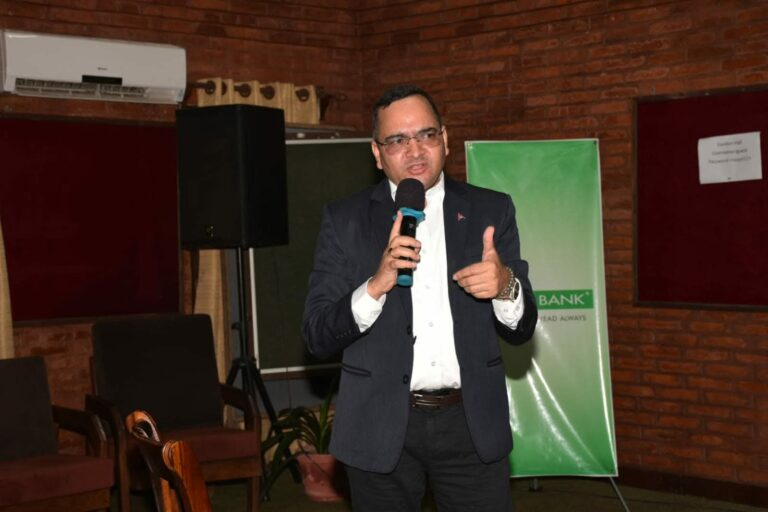
Speaking on the issue, Gyawali dismissed the perception that an AMC would simply purchase all non-performing assets (NPAs) from banks, allowing financial institutions to operate without concern.
According to him, the primary role of an AMC is to evaluate the commercial viability of distressed companies, improve their financial management and cash flow, and undertake restructuring and business remodeling. Where necessary, the AMC may also assume operational control of such companies to facilitate their recovery.
“No bank expects the AMC to purchase all of its distressed assets, nor is it capable of acquiring every problematic asset,” Gyawali said. He cautioned that adopting rigid government policies focused solely on punitive measures, rather than providing flexibility, could further complicate the banking sector’s challenges.
Gyawali also rejected claims that Nepal’s banking sector has become weak or financially unstable due to the rise in non-performing loans. Although the NPA ratio has increased from around 1.5–1.67 percent in previous years to 5.6 percent, he noted that Nepal still maintains the second-lowest NPA ratio in South Asia.
Citing regional comparisons, he said Pakistan’s NPA ratio is around 10 percent, Sri Lanka’s remains above 10 percent despite gradual recovery following its economic crisis, while Bangladesh’s has climbed to nearly 30 percent, largely due to prolonged political unrest and economic instability.
Gyawali explained that the 5 percent NPA threshold has drawn attention because Nepal’s Income Tax Act allows deductions up to that level, while Nepal Rastra Bank’s regulatory provisions also provide certain facilities within the same limit.
He further argued that Nepal Rastra Bank maintains one of the region’s strictest loan classification and reporting systems. Nepali banks are required to maintain 1 percent provisioning even for performing loans—a requirement that underscores the sector’s prudent regulatory framework and financial resilience.
“As of today, the possibility of depositors losing their savings in Nepalese banks remains extremely remote,” he said, emphasizing that public deposits are not at risk.
While acknowledging that banks have made mistakes in certain areas, Gyawali identified three major external factors behind the recent rise in NPAs.
First, he said many borrowers previously managed loan repayments through cooperatives, cheque exchanges, or informal borrowing from friends and relatives. However, the ongoing cooperative sector crisis has effectively eliminated those financing options.
Second, he pointed to a sharp decline in market confidence, saying people are now reluctant to lend even Rs 50,000 without strong assurances, resulting in a significant slowdown in informal financial transactions.
Third, Gyawali highlighted the prolonged downturn in Nepal’s real estate market. In the past, borrowers often sold land or subdivided property to regularize loan repayments. However, weak property demand—driven partly by increasing youth migration abroad—has reduced land transactions to historically low levels, removing another important source of loan repayment.
Despite these challenges, Gyawali expressed confidence that Nepal’s banking sector remains fundamentally stable, while stressing that structural reforms and broader economic recovery will be necessary to address the underlying causes of rising non-performing loans.

 About Us
Comment