
Banking News – Farmers in Mangsabung Rural Municipality are increasingly replacing paddy fields with commercial cardamom cultivation, attracted by rising market prices and significantly higher returns.
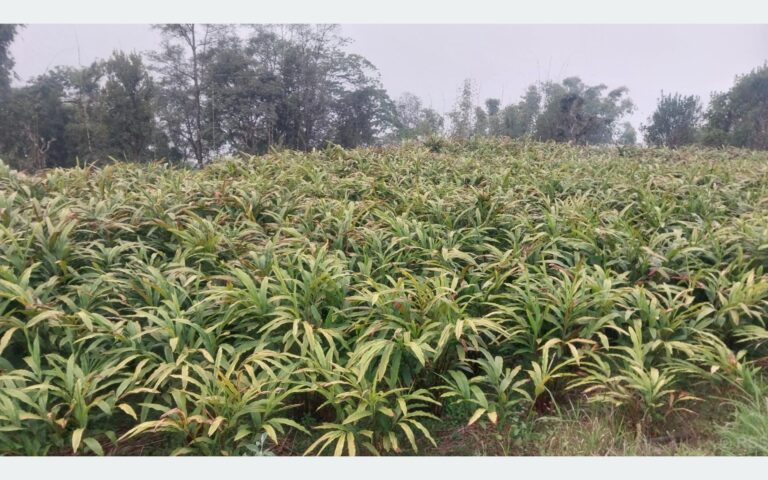
Krishna Budhathoki, a farmer from Simle in Ward No. 3 of Mangsabung, has cultivated cardamom on 23 ropanis of land after converting former paddy fields over the past three years. He earned approximately NPR 1.7 million this year alone by selling dried cardamom at NPR 100,000 per 40-kilogram maund.
Budhathoki, who grows the Jirmale variety, said the profitability of cardamom convinced him to abandon plans to work abroad and instead focus on commercial farming.
Another farmer, Ganesh Limbu of Ward No. 2, generated more than NPR 1.6 million from cardamom sales this year. Having cultivated cardamom commercially for five years across 25 ropanis, he plans to expand production by an additional seven ropanis following favorable market prices.
Limbu said income from cardamom has enabled him to cover household expenses and finance his children’s education. He currently cultivates the Ramshahi and Golshahi varieties.
Local farmers say improving prices, strong market demand, and reduced disease incidence have encouraged many growers to shift from traditional cereal crops to commercial cardamom farming. Farmers also cite labor shortages and frequent monkey attacks on food crops as major reasons for abandoning conventional agriculture in favor of the more profitable spice crop.
Commercial cardamom cultivation has expanded rapidly across Wards 1, 2, 3, and 6 of Mangsabung. Farmers are increasingly utilizing sloping, shaded, moist, and previously underutilized land, as well as former paddy fields, for cultivation.
Cardamom is a perennial crop capable of producing for 20 to 25 years after planting. It thrives at elevations between 600 and 2,100 meters above sea level, with annual rainfall of 2,000 to 2,500 millimeters, making the hilly regions of eastern Nepal well suited for production.
Besides its economic value, cardamom is widely used as a spice, medicinal herb, and traditional remedy. Agricultural experts note that it possesses several medicinal properties and remains one of Nepal’s most valuable high-value cash crops.
Farmers in the area report no difficulty marketing their produce, as traders purchase cardamom directly from their homes. Improved road connectivity has further strengthened market access and ensured competitive prices.
To encourage commercial cultivation, Mangsabung Rural Municipality has been providing subsidized cardamom seedlings under a 50 percent cost-sharing scheme. This year, the municipality distributed 16,000 seedlings, including Ramshahi, Golshahi, and Bharlange varieties, supported by a budget allocation of NPR 150,000.
Rural Municipality Chairperson Hemanta Rai said agriculture remains the municipality’s top development priority, adding that additional farmer support programs will continue to promote commercial farming and improve rural livelihoods.

 About Us
Comment