
Banking News – The picturesque Dhorpatan Valley, adorned with vibrant seasonal wildflowers, is witnessing a steady rise in domestic tourist arrivals as visitors flock to experience its breathtaking monsoon landscape.
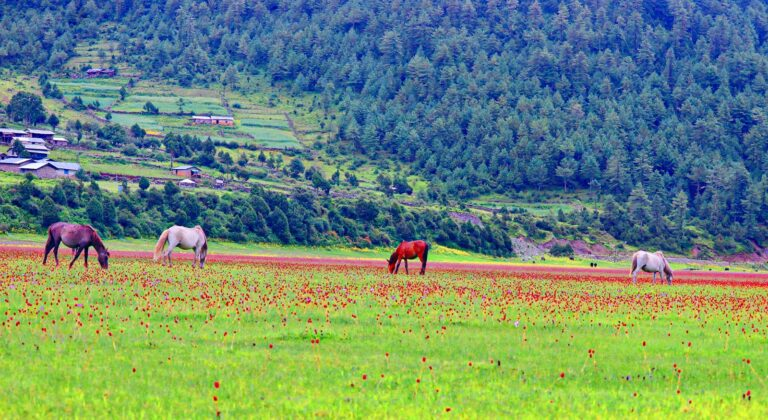
Blanketed with red, yellow, pink, and purple wildflowers across its vast grasslands, the valley surrounded by towering mountains has become one of Nepal’s most attractive monsoon travel destinations. Every day, hundreds of visitors are traveling to Dhorpatan to enjoy the spectacular floral display.
Located within Nepal’s only hunting reserve, Dhorpatan has seen a significant increase in tourist interest over the past three years, largely driven by widespread exposure on social media and news platforms.
Until around 2018 (2075 BS), tourist arrivals remained relatively low, with most visitors coming primarily to worship at the Dhor Baraha Temple. However, increased online promotion through photographs and videos has transformed the valley into a popular destination for nature enthusiasts.
Unlike many tourist destinations across Nepal that experience a slowdown during the rainy season, Dhorpatan sees its peak attraction during the monsoon when the valley is covered with blooming wildflowers.
According to Jeevan Pun, President of the Hotel Entrepreneurs’ Association, more than 200 tourists visit Dhorpatan daily during the flowering season.
“The flowers have always bloomed here in abundance, but the destination remained largely unknown due to limited promotion. Today, social media and media coverage have significantly increased tourist interest. A decade ago, very few visitors came here, and most locals practiced seasonal migration,” Pun said.
The wildflowers, locally known as Rake Phool, are also referred to by the Dhorpatan Hunting Reserve as Nakephuli, Bukiphool, and Madanefool. The flowers flourish naturally across the meadows, nourished by the grazing of horses, sheep, goats, cattle, and buffaloes, with animal manure contributing to their healthy growth.
Tourists are arriving from major cities including Kathmandu, Pokhara, Nepalgunj, Bhairahawa, and Chitwan.
Mahesh Thapa, a visitor from Madi, Chitwan, said he decided to visit Dhorpatan after seeing viral photographs and videos on social media.
“We had planned this trip since last year. This time, our group of 13 finally came to witness the wildflowers. The colorful blossoms and the surrounding environment are truly mesmerizing,” he said.
Similarly, Kulendra Paneru from Tulsipur, Dang, described the experience as refreshing.
“While Dang is extremely hot at this time of year, Dhorpatan offers cool weather and incredible natural beauty. With better promotion, the area could attract many more international tourists,” he said, while also pointing out that poor road conditions made the journey challenging.
Visitors currently travel around 32 kilometers on an unpaved road from Burtibang to Dhorpatan. Although the section from Burtibang to Phalleghar has been graveled, the road beyond remains in poor condition, causing inconvenience for travelers.
Dhan Bahadur Kayat, Deputy Mayor of Dhorpatan Municipality, said the municipality is working to improve the road above Phalleghar.
He explained that road widening work is underway as part of preparations for blacktopping, which has temporarily made some sections muddy. The municipality is placing gravel on difficult stretches to ease travel for visitors.
Kayat said the increasing number of tourists has encouraged local authorities and businesses, expressing confidence that continued infrastructure improvements will further strengthen Dhorpatan’s growing reputation as one of Nepal’s premier eco-tourism destinations.

 About Us
Comment