
Banking News – Changing weather patterns and delayed monsoon rains are forcing farmers in Lamjung to abandon their traditional rice planting calendar, as many fields remain unplanted due to water shortages.
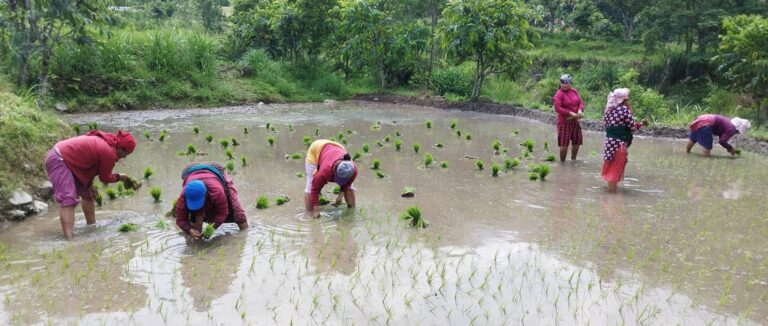
In the past, rice transplantation would begin as soon as the month of Asar started, with most fields planted by the end of the month and lush green paddy fields visible by early Shrawan. However, irregular rainfall in recent years has significantly delayed planting, leaving many farmers waiting for rain.
With Asar nearing its end this year, many rivers and streams in Lamjung still lack sufficient water, preventing farmers from transplanting rice. While some have used river water, irrigation canals, and other alternative sources, many others continue to rely on rainfall.
According to Kiran Sigdel, Chief of the Agriculture Development Office, only about 30 percent of rice transplantation had been completed in the district as of Asar 27, mainly due to delayed rainfall and limited irrigation facilities. He noted that rice planting was significantly ahead at the same time last year.
Sigdel said delayed planting affects crop yields differently depending on altitude. While warmer areas may experience limited impact, timely transplantation is crucial in colder regions, where delays can increase pest infestations, damage crops, and reduce productivity.
He also noted that farmers in Lamjung are increasingly shifting from traditional rice varieties to hybrid seeds, which are more tolerant of delayed planting and generally offer higher yields. However, a shortage of agricultural labor and unreliable rainfall remain major challenges.
According to the Agriculture Development Office, Lamjung has 61,819 hectares of cultivable land, of which 9,299 hectares are used for rice cultivation.
In Dordi Rural Municipality, rice transplantation has also fallen behind schedule. Niranjan Poudel, head of the municipality’s agriculture section, said only around 55 percent of planting had been completed by the end of Asar, compared to 70–80 percent during the same period last year.
Most farmland in Dordi depends on rain-fed agriculture, with limited permanent irrigation facilities. Insufficient rainfall and the lack of water flowing into fields have delayed planting across the municipality.
Farmer Laxman Gurung of Nauthar Sera, Dordi-4, said he has managed to transplant rice on only about half of his eight ropanis of farmland where water is available, while the remaining land remains dry.
Similarly, Lalmaya Mijar of Dubar Village, Dordi-8, said she has prepared her fields and seedlings but is still waiting for rain. She expressed concern that rice seedlings, which are normally transplanted within 40 days, have now remained in seedbeds for nearly two months, raising fears of lower productivity.
The changing climate is reshaping farming practices and the traditional agricultural calendar in Lamjung, with delayed rice transplantation expected to postpone harvesting and potentially reduce overall crop production, increasing uncertainty for farmers who remain dependent on timely monsoon rainfall.

 About Us
Comment