
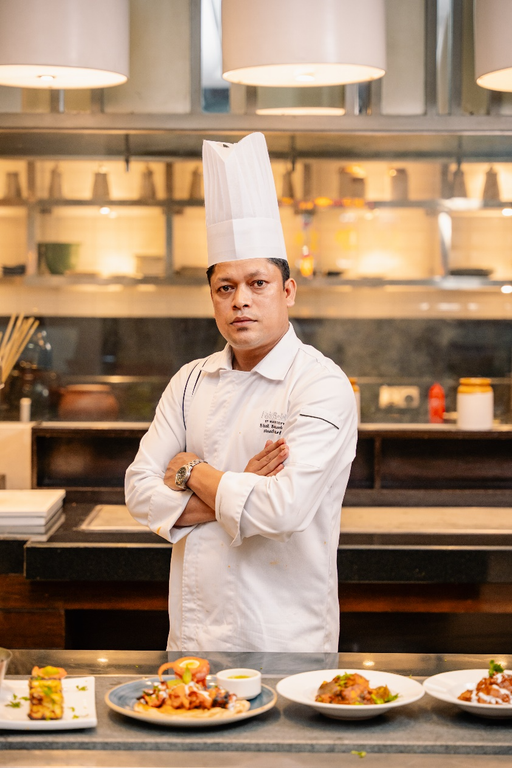
Banking News – Every chef has a story behind the uniform. Chef Bhol Bahadur Bishwakarma’s began with no plan at all.
He was a young man from Khotang who went to India without knowing what work he would do or where life would take him. He only knew he wanted to work, learn, and build a better future.
Today he is Head Chef at Fairfield by Marriott Kathmandu, with a deep command of Indian cuisine. Every stage of that journey taught him something about how to lead.
An Uncertain Start
About ten days after reaching India, Bishwakarma found work at a club. It was not a glamorous job, and he stayed about two months. But he did something that changed his path: he got curious. He watched the chefs, studied how food was prepared, and slowly began to love the kitchen.
Many people treat an early job as a stop on the way to something better. He treated it as a place to learn. That curiosity was his first lesson in leadership. Good leaders are usually people who kept watching, asking, and learning long before anyone put them in charge.
The Tandoor, His First Teacher
His next chance came at a catering company, where he worked casually in the tandoori section. He stayed almost two years. There he learned Indian cooking from the ground up: kebab making, marination, spices, heat, timing, and texture.
He soon understood that Indian cuisine is not about adding spices. It is about understanding ingredients. How long should the meat marinate? How hot should the fire be? When should the food be turned? How do the spices work together?
The tandoor taught him three things. The heat taught him patience. The spices taught him balance. The kitchen taught him discipline. He made mistakes, corrected them, and learned again. That habit of learning from mistakes stayed with him through every promotion.
Proving Himself in Delhi
In 2009, he joined Keeya Kainosh, a restaurant in Vasant Kunj, Delhi, as Commis II in the Indian tandoori section. His employer later described him as an Indian tandoor specialist and noted his honest, punctual work.
He spent about a year and seven months there, working on marinades, spice mixes, portion control, and presentation. Here he learned a lesson every leader needs: a good chef makes one good plate, but a professional makes the same quality again and again. People trust a leader who is consistent.
The Food Test That Changed Everything
After a short time as a Demi Chef at a bar and restaurant in Connaught Place, Bishwakarma got a call from The Westin Gurgaon. A senior who had worked with him earlier had recommended him. It was a five-star hotel, and he had to cook for the chefs in a food test.
He made a simple choice. He did not try to show off dishes he did not know. He cooked what he knew best, the Indian and tandoori food he had practised for years. The chef was impressed by the quality and presentation, and Bishwakarma joined as Commis II.
The lesson was honesty. Leaders who pretend to know everything lose trust. Those who stand on real skill earn it.
Learning to Lead Under Pressure
At the Westin, Bishwakarma learned that cooking well was only the start. A five-star kitchen also needed hygiene, standard recipes, mise en place, teamwork, and communication. He listened to every senior chef and practised everything he was taught. He was promoted to Commis I and stayed three years and seven months.
Two moments from those years stand out. He was trusted to run the tandoor section alone during two banquets, one for 350 guests and one for 400. He also helped the team reach a food safety audit score of 96.75 percent. The first taught him to stay calm when an entire event depends on you. The second showed him that high standards are built by a team, not by one person.
India Is Many Cuisines
At Sheraton Hyderabad, Bishwakarma widened his knowledge into South Indian cooking. He saw how different the food of the North and South can be, in spices, ingredients, techniques, and traditions. Through his portfolio runs the soft galouti kebab of Awadh, the mustard-rich tikkas of Punjab, the fiery laal maas of Rajasthan, and Chettinad and Meen Moilee from the South.
He was promoted to Chef de Partie, and later worked in that role at The Den in Bengaluru. By then he was not only thinking about his own plate. He was thinking about quality, consistency, timing, his team, and the guest, all at once. The lesson was that a leader can never say “I know enough.” Every new city made him a student again.
Bringing the Recipes Home
While working in Bengaluru, Bishwakarma saw online that Marriott was opening a hotel in Nepal. He applied, passed the interviews, and decided to return home. On 18 February 2019, he joined Kathmandu Marriott Hotel as Chef de Partie. Years of Indian cooking now had a new home, and he was closer to his family.
Over about five years he became Demi Sous Chef and then Sous Chef. He worked on à la carte and banquet service, menu planning, training, and kitchen organisation. He also began paying attention to local ingredients and Nepali food. His menus now place butter chicken, seekh kebab, and dal makhani beside momo, timur chicken, and Mustang aloo. He builds his curries in layers, with base spices for body, whole spices for aroma, and finishing spices for freshness. Each spice has its own job, much like each person on a team.
His biggest lesson from these years was ownership. When something goes wrong, a leader does not ask who made the mistake. A leader asks what can be done to fix it.
From Following Orders to Making Decisions
In 2024, he moved to Hyatt Place Soalteemode Kathmandu, which later became Hyatt Centric, to learn another hotel culture. He grew from Sous Chef to Chef de Cuisine, and his work changed from cooking to caring for people, systems, and standards. He earned trainer certificates from both Marriott and Hyatt, and won recognition at Marriott as Brilliant Executive of the Month and Cleanliness Champion.
He often says that when he started, he waited for someone to tell him what to do. Today, people wait for his decisions. Step by step, his job grew from preparing his own section, to supporting a team, to running a shift, to planning menus, to taking responsibility for the whole kitchen.
Even as Head Chef, Bishwakarma has not stopped learning. In 2026 alone, he earned a National Skill Certificate in food production from the National Skill Testing Board (CTEVT), which formally recognizes the skills he built over years in the kitchen. He also completed management-level Food Hygiene and HACCP training with the Scottish Hospitality Academy, so that his kitchen meets international food safety standards. And he received a Professional Chef Instructor and Advisor certificate from StarChef Hospitality, for guiding students in cooking techniques, hygiene, and kitchen safety. These honors are evidence that a leader keeps growing and keeps sharing what he knows.
Leading the Next Generation
Today, Bishwakarma sees his role as bigger than cooking. He wants a team in which chefs share knowledge instead of hiding it. He remembers what it was like to start with very little, so he gives young cooks room to learn, practise, make mistakes, and grow.
His view of Indian cuisine has grown too. He believes tradition and modern presentation can live together, as long as the soul of the dish is not lost.
His journey began in uncertainty. Indian cuisine gave him a foundation. Five-star kitchens gave him discipline. Leadership taught him responsibility. And now he is passing it all on. For any young person starting with no plan and no connections, his story offers a clear message: where you start does not decide how far you can go.

 About Us
Comment