
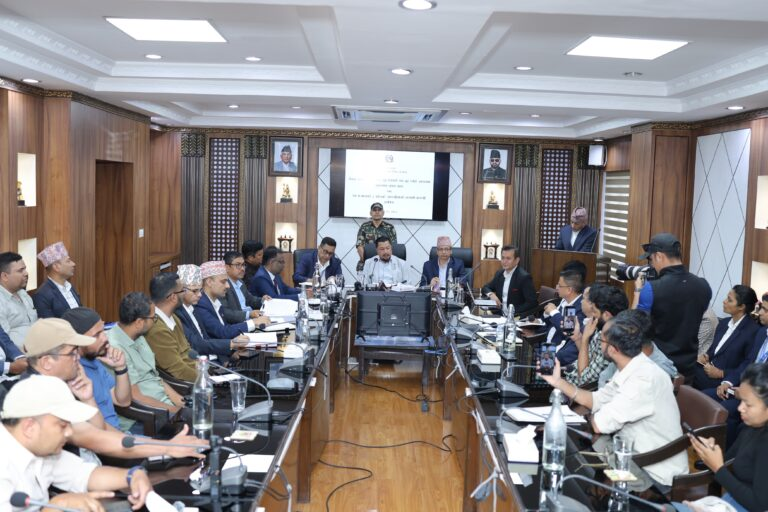
Banking News – Minister for Energy, Water Resources and Irrigation Biraj Bhakta Shrestha has stated that the policy arrangement necessary to bring the private sector into electricity trade has reached its final stage and preparations are underway to provide Letters of Intent (LOI) to the private sector. Speaking at a program organized at the ministry on Wednesday to review the progress of the last six months, Minister Shrestha stated that electricity generation, transmission, market expansion, and increasing domestic consumption have been advanced in an integrated manner with the objective of making the energy sector the foundation of the country’s economic development. He stated that even though energy infrastructure was damaged due to natural disasters, work on service restoration and development construction has been continued.
Minister Shrestha informed that scientific and objective criteria have been prepared to advance the Power Purchase Agreement (PPA) process according to national needs and system demand. The proposed criteria will prioritize production capacity capable of meeting high evening demand during the dry season, energy contribution during the dry season, stability of monthly production, availability of transmission infrastructure, and the situation ensuring power evacuation by the date the project’s commercial production begins.
RCOD Extension for 27 Hydropower Projects
During the review period, the Required Commercial Operation Date (RCOD) has been extended for a total capacity of 540.47 MW of 27 hydropower projects in the final stage of construction. Minister Shrestha stated that efforts have been made to advance stalled investment in the energy sector, create a foundation for private sector participation, expand transmission infrastructure, and intensify the implementation of irrigation projects.
He informed that an agreement has been reached to increase Nepal-India electricity import capacity from 1,000 MW to 1,400 MW and export capacity from 1,100 MW to 1,650 MW. Work has been advanced to strengthen the foundation of electricity trade through cross-border transmission infrastructure expansion, open access, and transparent transmission fee determination.
Intensification of Transmission Infrastructure Expansion
Construction work in the Hetauda area of the long-obstructed Hetauda-Dhalkebar-Inaruwa 400 kV transmission line has reached its final stage. Construction of the Bahrabise-Lapsiphedi 400 kV transmission line has been completed, and the Bahrabise and New Khimti substations have been completed and brought into partial operation. Similarly, the Markichowk-Bharatpur 220 kV and Dhalkebar-Balaganga 132 kV transmission lines under the Marsyangdi Corridor have been brought into operation.
The Lalbandi-Salempur 132 kV transmission line and related substations have also come into operation. An emergency restoration system has been installed in the damaged section of the Kohalpur-Surkhet transmission line. Construction of the Balkot and Dahachowk substations and the Chandrapur-Sukhdevchowk and Lahan-Sukhipur transmission lines has also been started. Minister Shrestha stated that work has been advanced with a schedule to complete the construction of an additional 12 transmission lines within the current fiscal year. The process of distribution line expansion for rural electrification in Madhesh and complete electrification in Karnali has also been advanced.
Expansion of Irrigation Facilities, National Pride Projects Prioritized
On the irrigation front, implementation has been advanced by preparing an action plan with the goal of completing national pride projects within the designated timeframe. An additional 13 kilometers of canal has been constructed in the Sikta Irrigation Project, expanding irrigation facilities to 1,300 hectares of land. Contract agreements have been signed for 11 of the project’s 27 bids, and construction has begun. Minister Shrestha informed that irrigation facilities have been expanded to an additional 1,155 hectares in the Mahakali Irrigation Project, 610 hectares in Badkapath, 600 hectares in Babai, and 150 hectares in Rani Jamara Kulariya.
Work is underway with a work schedule targeting the completion of the Babai Irrigation and Bheri-Babai Diversion Multipurpose Project within the next two fiscal years. An integrated work schedule has been prepared by coordinating between major contracts of the Bheri-Babai project. For the civil construction of the Sunkoshi Marin Diversion Project, bids have been re-invited and technical evaluation has been completed. Minister Shrestha stated that financial proposal evaluation is currently underway and a contract agreement is expected soon. To improve the management of the irrigation system, real-time water flow monitoring through telemetry technology has been started in Rani Jamara Kulariya and Rajapur. Regular irrigation service has been provided to about 2 lakh 33 thousand hectares of arable land through irrigation systems operated under joint management.
Focus on Legal Reform and Renewable Energy
In the course of institutional and legal reform of the energy sector, the bill related to renewable energy and energy efficiency has been registered in the House of Representatives, while the bill related to water resources has been submitted to the Cabinet. The process of preparing drafts of the electricity and irrigation bills and seeking opinions and suggestions from stakeholders has been advanced. The Electricity Consumer Tariff Determination Directive, 2083 and the National Electricity Transmission Grid Transmission Fee Calculation Standards, 2083 have been issued. A directive related to open access in the electricity transmission and distribution system has been prepared. Preparations for amending the Electricity Regulations, 2050 to maintain the license period of reservoir-type hydropower projects at 50 years have also been advanced. To expand electricity access in rural areas, 693 kilowatts of electricity has been generated from micro and small hydropower and 841 kilowatts from solar minigrids. Rooftop solar systems with a capacity of 18,575.30 kilowatts have been installed in various institutions. To increase energy use in the agricultural sector, 315 solar irrigation pumps have been installed.
Priority to Post-Disaster Restoration and Relief
Minister Shrestha stated that although energy infrastructure was damaged due to floods and other natural disasters, priority has been given to restoring electricity service and providing relief to citizens in affected areas. He mentioned that although the national transmission system was seriously affected by the flood, efforts by employees and technicians of Nepal Electricity Authority prevented power supply from being affected across the country. After the flood in Rasuwa and Nuwakot on Bhadau 10, relief distribution has been started to dependent families of Authority employees who went missing. So far, 6 families have received relief. According to the decision of the Authority’s Board of Directors, each family will be provided Rs 5 lakh immediately and half the amount of the starting salary of the concerned employee’s position for 6 months.
Flood Forecast Period Extended to Five Days
For climate-related risk reduction, the flood forecast period in major rivers has been increased from three days to five days. The forecast period for flash floods in small rivers has been increased from 24 hours to 48 hours. Impact-based weather forecast service has been implemented in 15 local levels, while testing is underway in an additional 16 local levels. According to Minister Shrestha, in the last six months, work has been advanced prioritizing the expansion of energy production and trade, transmission infrastructure construction, increased irrigation facilities, legal reform, and disaster management. In the days ahead, the goal is to make these programs more effective and make the energy sector the main foundation for economic development and increased agricultural production.

 About Us
Comment