
Banking News – A Nepali finance minister’s name appearing on lists of awards, honors, and influential figures given by international institutions is a matter of pride in itself. But direct achievements in the country’s economy, people’s lives, and national interest from such honored personalities appear to be zero. From former Finance Minister Dr Ram Sharan Mahat to former Finance Minister Dr Yubaraj Khatiwada and to current Finance Minister Dr Swarnim Wagle, the list of Nepali finance ministers receiving international honors appears long. International platforms have given them various titles and honors. However, there is no consistency between those honors and the evaluation of their economic and policy performance within the country.
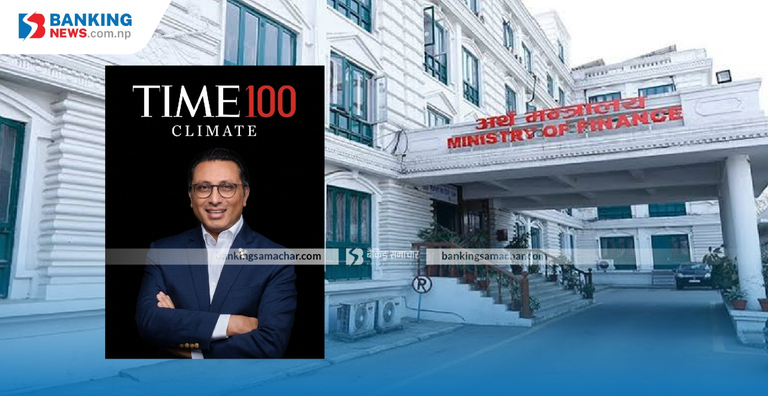
This debate has again surfaced after Finance Minister Wagle was recently included in Time magazine’s list of the 100 most influential climate leaders for 2026. It is understood that Time honored the role he played in bringing to the world stage the disasters seen in Nepal’s Himalayan region, including the Bhotekoshi area, due to climate change, the demand for climate justice, and international compensation. But while an individual’s international identity is being established, the issue of the Himalayan climate crisis raised by Nepal is not being able to move forward diplomatically and politically.
An Individual’s Identity and the Country’s Achievement Are Not the Same
In 2016, then Finance Minister Ram Sharan Mahat was honored with The Banker magazine’s ‘Global Finance Minister of the Year’ and Asia-Pacific Best Finance Minister awards, published from the UK. His role in post-earthquake reconstruction of 2015, organizing the donors’ conference, economic and financial reforms, and mobilizing foreign aid was made the basis for his honor. At that time, Mahat’s international prestige was presented as an achievement of Nepal’s economic management. But receiving an international award and resolving the structural problems of the country’s economy are different matters.
Mahat is known as a proponent of liberal economic policy. His political and policy identity lies in expanding the role of the private sector, economic liberalization, and market-oriented reforms. However, when evaluating his tenure, experts say changes in economic growth, employment creation, production capacity, public services, and the living standards of ordinary citizens should also be viewed alongside. Although international honors established his personality and economic policy identity, that cannot be interpreted merely as proof of the success of the entire Nepali economy.
Similarly, former Finance Minister Yubaraj Khatiwada was also discussed for receiving international honors related to the Sustainable Development Goals (SDGs) of the United Nations. But such honors could not displace the debates and criticisms within the country regarding his economic policy. Experts say international recognition and domestic public acceptance are separate matters. But when politicians from non-economic backgrounds Bharat Mohan Adhikari, Surendra Pandey, and Barshaman Pun held the Finance Ministry, the influence of political priorities was seen in budgets, social security, popular programs, and economic policy.
What Is the Basis of Wagle’s Honor?
The background of Finance Minister Wagle being included in Time’s list is somewhat different from previous honors. This is not an award for traditional economic management or budget reform. Its main basis is the damage that low-emission countries like Nepal have had to suffer due to climate change and the international advocacy made for its compensation.
The devastating flood that occurred in the Bhotekoshi–Trishuli watershed area on August 26 had caused huge human and physical damage. After that, Nepal attempted to internationalize the issue of climate justice. Finance Minister Wagle played a role in the campaign to raise Nepal’s concerns about climate-induced damage before major greenhouse gas emitting countries such as China, the US, and India, and to demand international compensation. An initial estimate of about USD 4.71 billion has been made for post-disaster reconstruction and rehabilitation.
In its profile published on November 9, Time gave importance to this very campaign of Wagle. The magazine linked the issue of developing countries that contribute little to climate change but suffer its disproportionate effects with his advocacy. One concrete result of Wagle’s climate diplomacy can be taken as the decision to allocate support funds for Nepal from the ‘Fund for Responding to Loss and Damage’ under the United Nations. On October 22, the board of the fund had provisionally decided to allocate USD 21.6 million for Nepal. This was the first such initiative by the fund for a country affected by a disaster. However, the process of receiving the amount remains to be completed, and the board must approve it after Nepal submits a formal application. On the other hand, this amount is very small compared to the estimated USD 4.71 billion needed for Nepal’s reconstruction and rehabilitation. This is less than 0.5 percent of the total requirement.
COP31: Himalayan Issue Raised, But Institutional Recognition Still Uncertain
Another important context of Finance Minister Wagle being included in Time’s list is the 31st Conference of the Parties (COP31) to the United Nations Framework Convention on Climate Change. At the conference being held in Antalya, Turkey from November 9 to 20, Nepal has been trying to keep the climate crisis of the Himalayan region on the international priority. Nepal and Bhutan had jointly proposed including the issue of ‘1.5 degrees Celsius temperature rise and the Himalayan region’ in the conference’s additional agenda.
However, consensus has not yet been reached on transforming this issue into a permanent and separate institutional action plan. According to the November 14 report of the Earth Negotiations Bulletin (IISD), which keeps records of international negotiations, some agreement is seen on continuing further dialogue on the Himalayan issue, but differences remain on through which institutional structure to move it forward. The conference chair has said further consultations will be held on this matter.

 About Us
Comment