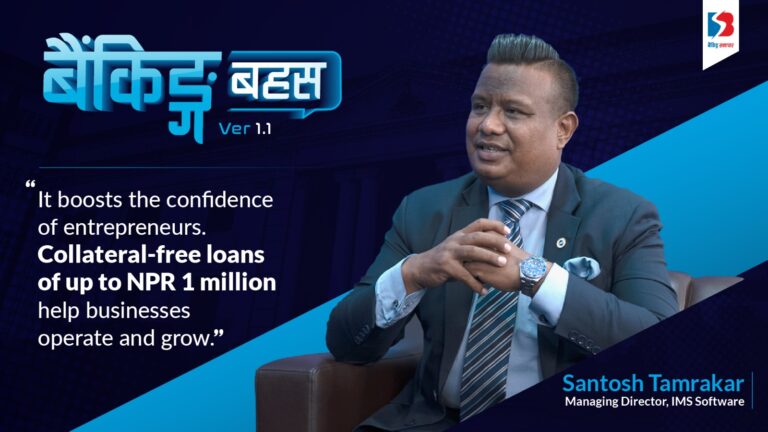

Banking News — Nepal’s banking sector is currently witnessing record-high liquidity, with more than Rs. 1.3 trillion available for lending. However, credit expansion into productive sectors has remained sluggish despite historically low interest rates and the formation of a politically stable government.
In a recent interview with Banking Bahas, the Managing Director of IMS Software, a company that provides technical services and automation solutions to businesses in Nepal and abroad, shared his views on the country’s investment climate, the challenges facing entrepreneurs, and the potential impact of the Nepal Rastra Bank’s newly introduced collateral-free digital lending policy.
Below are the edited highlights of the conversation.
Why is lending still slow despite excess liquidity?
The Managing Director said that while banks have been holding more than Rs. 1.3 trillion in excess lendable funds for quite some time, investor confidence has yet to recover fully.
“Although the country now has a stable government, confidence among investors has not completely returned. Once confidence improves, investment will naturally increase,” he said.
Drawing from IMS Software’s experience as a software vendor, he noted that market activity remains subdued.
“We can clearly see the slowdown from our own business. The number of inquiries and business engagements we receive today is lower than in previous years. However, we expect conditions to improve gradually.”
Stable government alone is not enough
Despite nearly three months of political stability and lower borrowing costs, investment activity has yet to accelerate.
According to him, rebuilding confidence takes time.
“A government has been in place for only three months. Building a company takes years, so expecting immediate positive changes across the economy would be unrealistic. Improvement will come gradually.”
Consumer spending is shifting rather than declining
Asked whether consumer behavior has changed, particularly as IMS Software manages billing systems for major retailers including Bhatbhateni, he said overall consumption has remained resilient.
“The demand for essential goods remains as strong as before, if not stronger. Younger generations appear to be consuming less alcohol, but spending has simply shifted to other sectors, particularly healthcare.”
What does IMS Software do?
He described IMS Software as a technology solutions provider that helps businesses simplify operations through billing, automation, and digital systems.
The company is also supporting the implementation of the Nepal Rastra Bank’s recently introduced policy that allows banks to provide collateral-free loans of up to Rs. 1 million through mobile banking channels, primarily targeting small and medium-sized enterprises (SMEs).
How does the digital lending system work?
According to the Managing Director, Kumari Bank has already gone live with the system and has begun disbursing loans.
“We have been working on this initiative for the past two years. The only reason lending had not started earlier was because Nepal Rastra Bank had not yet issued the required circular.”
He added that the regulatory process was delayed by approximately six months due to the absence of a Deputy Governor.
Under the system, IMS Software manages billing information for businesses. Eligible companies are informed that they qualify for financing, and with their consent, their financial data is securely shared with partner banks for credit assessment.
A new category of Technical Service Providers
When asked whether other companies also facilitate this type of lending, he explained that licensing has not yet formally begun.
“At present, we have been categorized as a Technical Service Provider. According to the Inland Revenue Department, there are more than 1,100 registered companies like IMS Software.”
Collateral-free lending can unlock idle liquidity
The Managing Director believes the new lending framework could help mobilize the banking sector’s large pool of idle funds while easing cash flow constraints for small businesses.
“This policy can play an important role in putting the banking system’s excess liquidity into productive use.”
He also shared a personal business experience.
“There was a time when our business was performing well, but we couldn’t obtain bank financing because we lacked collateral. That experience inspired our vision of making collateral-free lending accessible to deserving entrepreneurs.”
Managing lending risks
Responding to concerns over potential defaults, he acknowledged that lending without collateral naturally involves some level of risk.
“Banks exist to manage risk. Before approving loans, they evaluate borrowers’ credit history, credit scores, and whether they are blacklisted. Based on these assessments, banks make the final lending decision, while we provide recommendations based on verified business data.”
The Managing Director said the new digital lending model has the potential to strengthen financial inclusion by enabling qualified small businesses to access formal financing more quickly and efficiently, without the traditional requirement of physical collateral.

 About Us
Comment