
Banking News— Rapidly evolving customer expectations have become the biggest challenge facing Nepal’s banking industry, according to Dr. Kattel, Chief Executive Officer of Excel Development Bank.

Speaking during the third session of the National Banking Discourse 2026, titled “Sustainability of Development Banks: Contribution, Competition and Policy,” Dr. Kattel said that while commercial banks, development banks, and finance companies operate under the same legal framework, they face different competitive realities.
He explained that development banks compete primarily with commercial banks, which enjoy lower funding costs, lower base rates, broader branch networks, and greater capacity to finance large-scale corporate projects. In contrast, development banks generally operate with higher costs of funds and comparatively higher lending rates, placing them at a competitive disadvantage.
Despite these differences, Dr. Kattel emphasized that development banks have maintained a cooperative relationship with commercial banks rather than viewing them solely as competitors.
He also dismissed the notion that financial technology (FinTech) companies pose a competitive threat to the banking sector. Instead, he described FinTech as a valuable partner that has simplified banking channels and accelerated innovation.
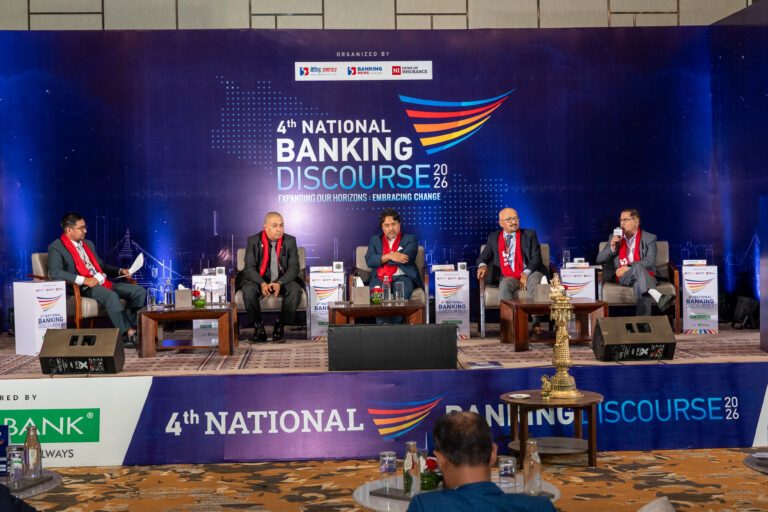
“Banking has evolved from manual ledger-based systems to AI-powered services,” he said. “FinTech should be viewed as a collaborator and co-creator rather than a competitor.”
According to Dr. Kattel, today’s banking customers expect services to be delivered instantly, making speed and responsiveness the industry’s greatest challenge.
“Customers expect immediate service and quick results. If banks fail to meet those expectations on time, customers can easily move to another institution,” he said.
He stressed that the real competition in banking is no longer limited to interest rates or branch networks but lies in delivering customer-centric products, responding quickly to customer needs, and providing efficient solutions.
Dr. Kattel noted that development banks have kept pace with technological advancements and now offer digital banking services comparable to those of commercial banks. As a result, customer confidence in development banks has continued to improve.
He further argued that banks should not be viewed merely as deposit-taking institutions and credit providers but also as long-term economic partners that contribute to sustainable local development.
To strengthen their role, he called for policy reforms that recognize local and national development banks as provincial economic partners, enabling them to mobilize capital more effectively within their respective regions.
“If local capital is mobilized locally, it will encourage investment in industries, small and medium-sized enterprises, agro-based businesses, and agro-tourism, ultimately supporting regional economic development,” he said.

Dr. Kattel also highlighted policy disparities between commercial and development banks. He pointed out that many government services and financial transactions require citizens to maintain accounts with commercial banks, while accounts held at development banks are often not recognized.
“There remains a policy-level discrimination between commercial and development banks,” he said. “Removing these barriers would allow development banks to play a much stronger role as regional and local economic partners.”
He concluded by urging policymakers to create a more level playing field, enabling development banks to contribute more effectively to Nepal’s financial inclusion, regional investment, and sustainable economic growth.

 About Us
Comment