
Banking News– Nepal’s banking sector is not facing a shortage of liquidity, but rather a crisis of investor confidence, according to Sunil Sharma, Member of Parliament and spokesperson for the ruling CPN-UML, who called for greater trust, policy consistency, and stronger collaboration between the government and the private sector to revive economic activity.
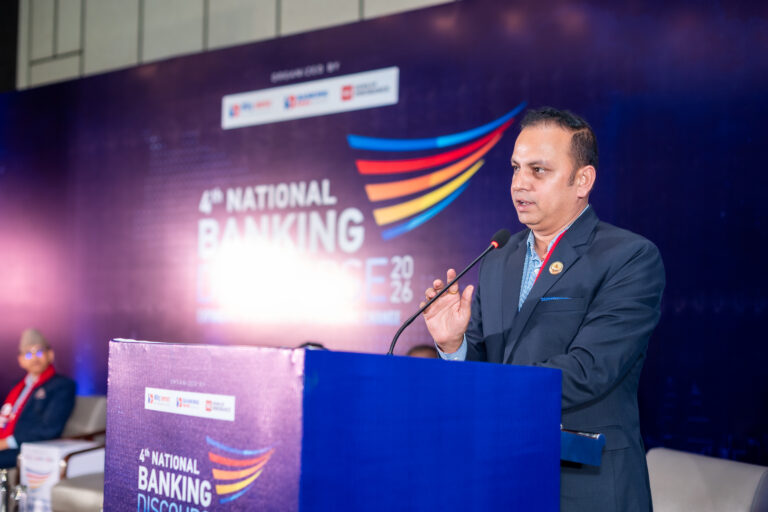
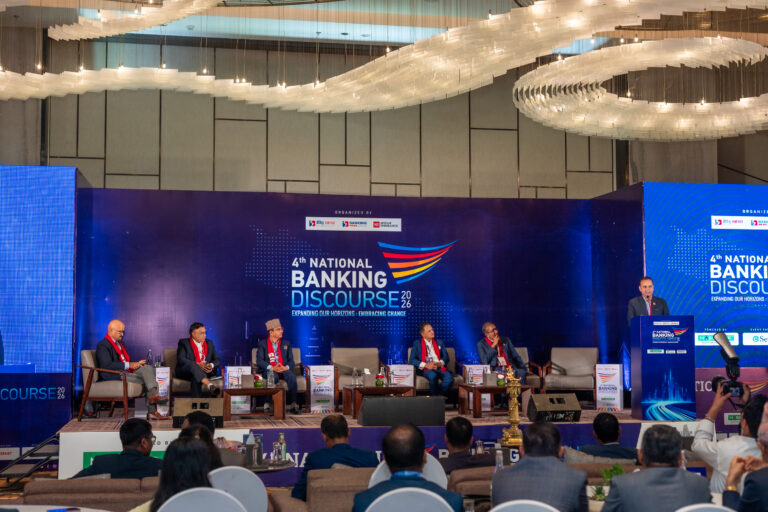
Speaking at the opening session of the Fourth Banking Discourse, Sharma said that while banks currently have sufficient funds available for lending, uncertainty surrounding investment decisions has weakened demand for credit and slowed economic momentum.
Banking Sector Has Become Broadly Inclusive
Sharma began by acknowledging the remarkable progress Nepal’s banking sector has made in expanding financial inclusion. However, he pointed out that gender representation in leadership positions remains inadequate and urged organizers to ensure greater gender balance in future industry events.
Although he described himself as someone without a formal academic background in banking or finance, Sharma said his experience as an entrepreneur, founder of the research company Tax Nepal, and policymaker has given him practical insight into the country’s financial system.
Banking Remains One of the World’s Most Respected Professions
Reflecting on the history of banking, Sharma described it as one of the world’s most respected professions, emphasizing that lending practices existed even before the invention of modern money.
He noted that savings culture began to emerge around the 13th century, laying the foundation for modern economic systems. According to Sharma, economic development continues to depend on three fundamental pillars: resources, productivity, and markets.
Similarly, successful entrepreneurship requires access to skills, capital, and markets, he said.
Nepal’s Digital Banking Growth Has Been Remarkable
Highlighting Nepal’s rapid financial digitalization, Sharma noted that the country’s first ATM card was introduced in the 1980s by Alpine Travels, while Nabil Bank launched the first banking ATM service in 1990.
Today, approximately 13.8 million ATM cards are in circulation after more than four decades.
By comparison, mobile banking has existed for only about 22 years—and has expanded aggressively over the past 16 years yet Nepal now has nearly 29.7 million mobile banking accounts, demonstrating the rapid pace of digital financial adoption.
He said these figures illustrate how quickly Nepal’s financial sector is evolving toward a knowledge-based and increasingly digital economy.
The Challenge Is Confidence, Not Liquidity
Despite healthy deposit levels and improved banking services, Sharma argued that the country’s biggest economic challenge is not a shortage of money.
“The banking system does not lack liquidity. What is lacking is confidence among investors,” he said.
According to Sharma, businesses remain uncertain about where, how, and under what policy environment they should invest.
He stressed that confidence must be rebuilt through stronger policy certainty, ethical governance, and greater mutual understanding between the government and the private sector.
Both Government and Private Sector Must Accept Responsibility
Sharma emphasized that economic recovery requires accountability from both policymakers and financial institutions.
While acknowledging that the government bears significant responsibility for creating a stable investment climate, he argued that banks and other stakeholders must also examine their own practices.
He questioned whether all shortcomings could simply be attributed to government policies, noting that improvements are also needed in lending practices, credit assessment, and banking operations.
“The government may bear 80 percent of the responsibility, but who will take responsibility for the remaining 20 percent?” he asked.
Dialogue Is Essential for Economic Recovery
Drawing lessons from countries such as Turkey, India, Malaysia, and Saudi Arabia, Sharma said successful economic transformation has been achieved through coordinated reforms involving both governments and private sector institutions.
He stressed that Nepal must follow a similar path by fostering continuous dialogue, mutual trust, and institutional discipline.
According to Sharma, the banking sector remains the strongest pillar of Nepal’s private sector and therefore has a critical role to play in rebuilding business confidence and supporting long-term economic growth.
Banking Discourse Encourages Constructive Policy Dialogue
Concluding his remarks, Sharma praised the organizers of the Fourth Banking Discourse for creating an important platform for dialogue between policymakers, bankers, entrepreneurs, and other stakeholders.
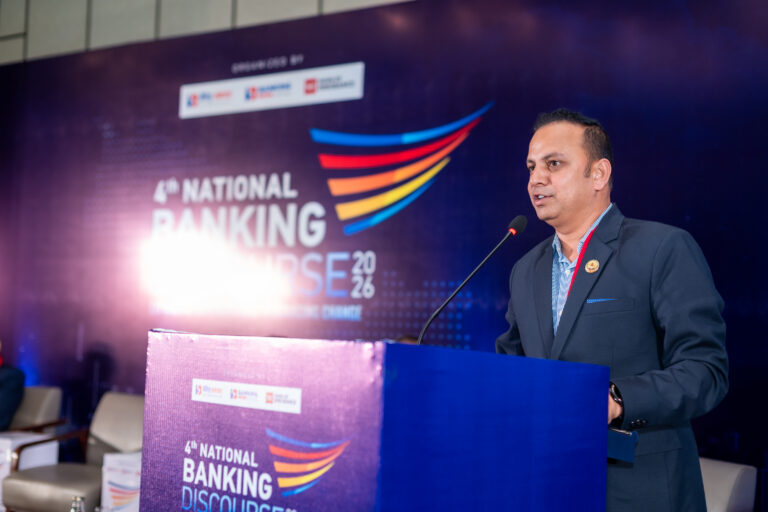
He also acknowledged recent efforts by banking leaders to explain government policies in simple language, saying such initiatives help improve public understanding and encourage cooperation across sectors.
Sharma expressed confidence that continued engagement between the state and the private sector would strengthen Nepal’s financial system and contribute to sustainable economic development.

 About Us
Comment