
Banking News – Chief Executive Officers (CEOs) of Nepal’s commercial banks have urged the government to work closely with the banking sector to accelerate economic expansion and achieve sustainable growth during a discussion with Finance Minister Dr. Swarnim Wagle.
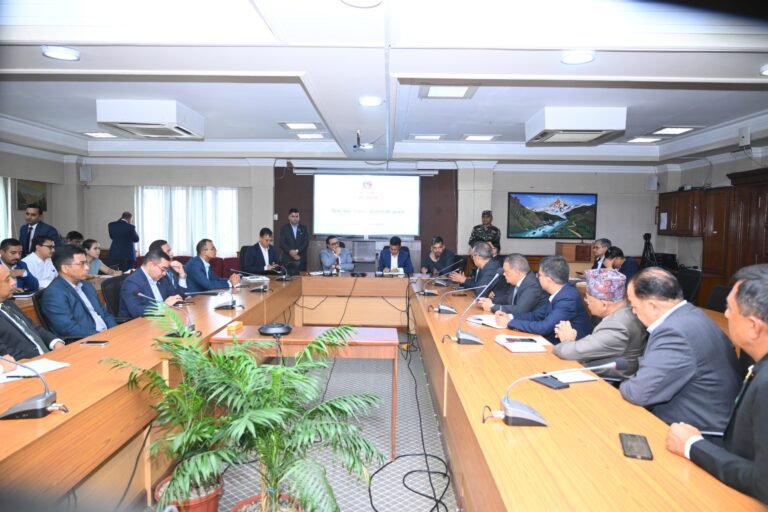
The interaction, organized by the Ministry of Finance to discuss the implementation of the national budget and the current financial market situation, focused on identifying practical solutions to revive investment and economic activity.
Addressing the meeting, Finance Minister Wagle said the government is committed to steering the economy toward higher growth and aims to expand Nepal’s economy to Rs. 7.4 trillion. He encouraged bankers to openly present the challenges limiting credit expansion and investment, assuring them that the government would sincerely consider and address their concerns.
“We have redirected the course of economic governance to expand the economy. Investment must increase, jobs must be created, and we need your support. Let us know what the government should do to facilitate this process,” the minister said.
He also questioned why credit demand remains weak despite favorable banking conditions and requested banks to submit a consolidated list of policy and operational issues requiring government intervention.
During the discussion, bank CEOs said the perception that Nepal lacks an investment-friendly environment is exaggerated, noting that the banking sector is facing manageable regulatory challenges rather than structural weaknesses.
They highlighted growing investment interest in the hydropower sector and expressed confidence that demand in other sectors would gradually improve if the government and Nepal Rastra Bank (NRB) introduced timely policy support.
Machhapuchchhre Bank CEO and Nepal Bankers’ Association President Santosh Koirala called for additional facilitation to sustain investment momentum in hydropower and urged the government to complete large infrastructure projects on schedule while strengthening confidence among businesses.
Citizens International Bank CEO Ganesh Pokharel described the current slowdown in banking as part of a normal economic cycle, stating that the banking system is not as weak as it is often portrayed.
Global IME Bank CEO Surendra Regmi emphasized the need to restore business confidence and requested regulatory measures from NRB to improve banks’ lending capacity. He also expressed optimism that the proposed Asset Management Company for non-banking assets would be established soon.
Everest Bank CEO Sudesh Khaling stressed the importance of expanding credit access to rural communities and underprivileged groups while calling for higher government capital expenditure and stronger institutional capacity.
Himalayan Bank CEO Ashok Rana said entrepreneurs are showing renewed interest in investment for the new fiscal year, describing it as a positive sign for the economy.
NIC Asia Bank CEO Sujit Shakya urged policymakers to review loan provisioning rules introduced after the COVID-19 pandemic, arguing that requiring 100 percent provisioning within one year places excessive pressure on banks.
Similarly, Standard Chartered Bank Nepal CEO Gorakh Shumsher Rana recommended reviewing the working capital loan guidelines, while Siddhartha Bank CEO Rameshwor Basyal said the existing provisioning requirements should be reconsidered due to their impact on loan quality.
Nepal SBI Bank CEO Ram Kumar Tiwari recommended increasing government investment in large infrastructure projects by drawing lessons from India’s economic development model.
Nepal Investment Mega Bank CEO Jyoti Prakash Pandey said demand is expected to improve not only in hydropower but also in the food and construction sectors. He also pointed out that banks affected by forced mergers continue to face challenges in expanding lending and called for stronger government support in recovering non-performing loans.
Laxmi Bank CEO Ajaya Shah stressed the need to increase financing for small and medium-sized enterprises (SMEs) and urged the government to build confidence among banks and businesses. He also noted that the slowdown in the real estate sector has contributed significantly to the broader economic slowdown.
Prime Commercial Bank CEO Sanjiv Manandhar said recent legal actions against banks and businesses have negatively affected market confidence.
Nabil Bank CEO Manoj Gyawali called for reforms to the provisioning policy for bad loans and suggested reviewing the country’s blacklisting system, noting that both cheque defaulters and loan defaulters are grouped under the same mechanism.
Meanwhile, Nepal Bank CEO Tilak Pandey said banks are increasingly burdened by non-banking assets and urged the government to introduce effective measures to address the issue.
The meeting concluded with both the government and banking leaders expressing their commitment to maintaining close coordination to strengthen investment, improve credit expansion, and support Nepal’s long-term economic growth.

 About Us
Comment