
Banking News – The budget for the current fiscal year introduced two or three months ago has included topics on how to connect the “diaspora” to Nepal’s capital market. Recently, the Securities Board of Nepal amended the Securities Registration and Issue Regulations to establish an NRN Fund, in which the Government of Nepal holds 10 percent shares. Accordingly, up to 85 percent of NRNs’ investment, or Rs 10 arab, can be sold as primary shares (IPO).
From the Act to the Foreign Investment and Technology Transfer Act, various laws are in the process of being amended to create the necessary environment to connect Nepalis residing outside Nepal to the capital market. For example, the Foreign Exchange Regulation Act, 2019, is in the final stages of amendment. It will soon go to parliament. In addition, the Securities Act has also been brought into the amendment phase. Work on amending all necessary laws to bring in investment is underway.
There are two reasons for this. The first reason is the trading mentality of investors. Many investors, after purchasing a company’s shares, focus more on earning profits from share price fluctuations rather than receiving dividends. There is no tendency among investors to “long-term hold” and select companies with good financial indicators for that purpose.
The second reason is that it is said there are 8 million Demat accounts. Even if there are 2 million duplications in this, 6 million people are connected to the stock market. This means it can be understood that a limited number of people are influencing the stock market. Among those called investors, there are many who do not even understand the stock market. Therefore, there may be a lot of manipulation.
Moreover, our capital market has remained limited only to the stock market. With fewer financial instruments, the stock market is also limited to IPOs and mutual funds only. We have few “corporate bonds” and productive industries. In such a situation, to make Nepal’s capital market international-level, this sector must be “diversified” and strong “governance” must be established in the capital market. The government has also made a start on this. Many actions have also been taken recently. The market is moving toward purification.
Similarly, if large “stock dealers” can be brought into the market, stability can be given to the market for long-term development. Additionally, good work has been done in the capital market sector after this government came. I was in this role during the time of appointing the Chairman in both the previous and current Securities Board of Nepal. I have personally seen that distinction toward the government. After this government came, a lot of work has been done and reforms have also taken place.
We cannot just talk about securities. We must also talk about Nepal Stock Exchange (NEPSE), CDSC, and the private sector. We had previously issued an IPO of a company through book building. Some groups objected to it. They complained that the price was high. But the policy has clearly given the market a system where institutional investors do “price code.” The market was also challenging the price code done by the market. For this reason, we are all responsible. There are weaknesses in everyone, which must be improved.
Now we have also talked about NEPSE restructuring. Its main objective is to make NEPSE a dedicated platform. In the past, the issue of establishing a new stock exchange remained in dispute for a long time. This may be why investment did not happen in the market. Now the discussion of a new stock exchange has cooled down, and the discussion of NEPSE restructuring has moved forward. There will be technical investment in NEPSE.
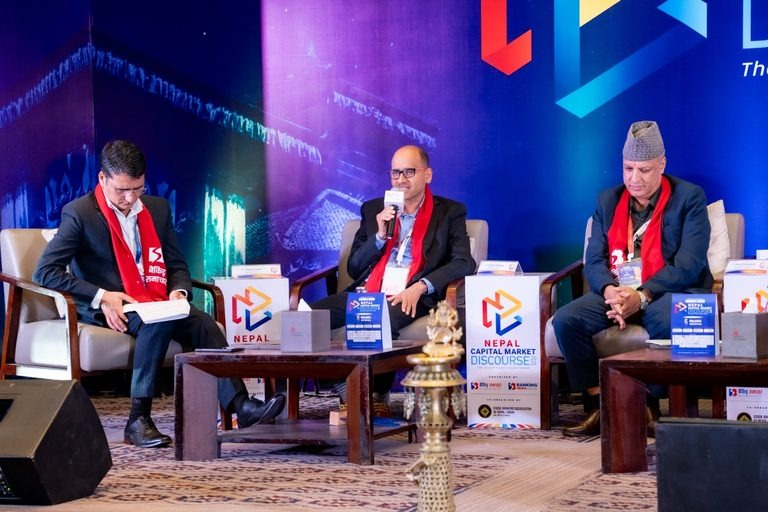
(Edited excerpts of views expressed by Under-Secretary Acharya of the Ministry of Finance in the first session of the Nepal Capital Market Discourse 2026)

 About Us
Comment