
Banking News – Since assuming leadership of the Securities Board of Nepal (SEBON), I have been trying to speak through documents, situations, and rules rather than verbally. After bringing a ‘blueprint’ for the development of Nepal’s capital market under my leadership, discussions and debates are taking place everywhere. That blueprint has provided a direction for the capital market. It has raised the question of where we currently stand. At present, we are in a capital market with only one product. We have also been discussing only one product.
Interest is also growing in where the market will go next. Currently, we are in limited products. From this situation, the market must move toward ‘instrument diversification.’ Currently, investors are limited to only one instrument. They have to go into that one. If we want to invest, there is a tendency to search for that same share and all investors focus on it. That situation will no longer remain. In ‘instrument diversification,’ there are different instruments. Investment proceeds according to different investor desires in those instruments.
Different investors have different desires and different ‘risk preferences.’ Some investors in the market want to take high risks, while some do not want to take risks at all. In Nepal, there are various instruments for investors who do not want to take risks. But there is no market for it. The market has not been able to develop. There is no risk in government securities. But there is no market for purchasing them. When I was in the Debt Management Department of Nepal Rastra Bank, I tried to develop the market for government securities. While there, we also succeeded in making some improvements in the primary market. But during the time to develop the secondary market, I had to leave due to time constraints. That unfinished work has still not been completed. At present, the Public Debt Management Department has moved from Nepal Rastra Bank to the government. The work of taking it to the government was also done with my involvement. Even after going to the government, ‘innovation’ has not been possible.
“Highest Risk in Modern Securities”
From zero risk, securities with some risk are bonds. There is low risk in corporate and municipal bonds. There is also no market for those bonds. Plenty of bonds are listed on the Nepal Stock Exchange (NEPSE). But if we look at their trading location or number, there are problems there too. Another low-risk product is ‘preferred stock.’ Some time ago, Nepal Rastra Bank itself requested the issuance of preferred stock. Their large trading is also not seen.
The highest risk is in modern securities. High risk is in ‘common stock.’ The market is expanding in this. The general public perceives this as low risk. There is also a market for it. There is both a primary and secondary market for it. But this is the highest-risk ‘security.’ It may be because the general public lacks information or our education is insufficient. There is excessive risk in various tested modern securities. Their market needs to be expanded.
Currently, excessive securities are in operation. Options, futures, swaps, and others. Earlier, attempts were made to bring only ‘futures.’ A market for ‘commodity futures’ had also been created at one level. We brought an Act to regulate it. Regulations were made, and SEBON has now been made its regulator. After the Act came, the market that had been built has deteriorated. After the Act came, the plight of commodity futures began. Yet they themselves had demanded that we needed an Act, regulation, and regulator. That was a good opportunity to ‘risk diversify.’ But we need to ‘revise’ that market as well. Because that is also SEBON’s responsibility.
“Productive, Infrastructure, and Technology Sectors Needed in Capital Market”
If an attempt is made to bring a Nepali commodity-based exchange, we are moving toward another diversification by bringing it too. Besides this, there is also future potential for index-based derivatives and options. Market diversification must also be brought for access to all markets.
For example, if startups need funds, they should be able to go to the capital market; if SMEs need money, the capital market; similarly, if large companies need money, and not just good companies but also bad companies whose business has gone down but someone wants to revive them, investment should be opened. The government should also move forward by including public participation in weak companies. If companies in bad condition want to rise again and enter the capital market, we are moving forward to open doors for them as well.
Therefore, in today’s capital market, industry, infrastructure, and technology are extremely important. At a time when technology issues are coming up extensively, the capital market must also move forward with greater use of technology. Similarly, the legal system is also important. SEBON’s main job is not to ‘play’ the market but to build and regulate the system. One system is provided through legal frameworks, and another is provided through the supervisory system. The supervisory framework is moving from reactive toward AI-based or risk-based supervision. We are also regulating accordingly.
“Low Manpower, Much Work to Do”
SEBON has been developing infrastructure. We have been trying to develop the market externally. Currently, SEBON is working on many fronts simultaneously. At this time, various questions are coming about IPOs being halted. I came to SEBON on Asar 15. The previous fiscal year ended from Asar. In the meantime, there was not even time to think about IPOs. After that, the new fiscal year started. When approving IPOs, the latest fiscal year’s financial statements are required. All the financial statements of companies that had applied and were waiting with us were only up to the previous fiscal year.
By now, the financial condition of the companies has changed. Therefore, we need the latest fiscal year’s financial statements. Currently, various companies are sending their latest fiscal year’s financial statements. As financial statements are coming in, we have given all responsibility to merchant bankers. We have told companies to submit financial statements by directly contacting merchant bankers. Since companies selling IPOs are clients of merchant bankers, we have made this arrangement. SEBON is awaiting updated financial statements.
SEBON has also provided trigger points on what to look at before IPO issuance. Until now, SEBON had not developed an internal ‘Processing Standard Operating Mechanism’ for IPOs. Since I assumed leadership, this has also been developed. Now we are preparing to ‘screen’ IPOs under that. Here too, since we have a pile of files, there was no ‘standard procedure’ on what to look at, from where to look, which to start, and which to end. But now it has been made.
“Policy of Embracing Technology”
Along with this, SEBON has moved forward saying it will digitize all work and make the institution digital. SEBON’s entire IT team is focused on this. Because until now, an IPO issuance required files that had to be carried in baskets. We are moving toward ending this situation and going digital. Colleagues in SEBON’s regulation department have been working extremely hard. We are preparing to move forward by doing ‘pilot testing’ of one file. After completing this, we will send it to the board. After that, the process for other IPOs will become easier.
Hydro files are piled up at SEBON. Directives related to hydro, manufacturing, hotels, and other sectors have been prepared. Additionally, SEBON has also prepared the IPO (Eligibility Form) . A committee has been formed under the coordination of Binay Dev Acharya, Head of SEBON’s Regulation Department, for preparing its policy. That committee will complete all documents, seek public suggestions, and prepare to implement it. All documents are in a ready state. We are preparing to take ownership, discuss, and implement it.
Only the final stage remains for IPOs. Most preparations are nearing completion. From the coming week, good companies will be selected gradually, accessible companies will be selected, and companies that pass with numbers will come to the market. There is also a question about why SEBON is doing this and whether all companies that apply should be given issuance permission. SEBON is the body that protects the interests of general investors. Just as Nepal Rastra Bank is the body that protects depositors’ deposits, for SEBON, important investors are the priority. Therefore, when SEBON sends any company for public fundraising, it must also take all responsibility for it.
Even if a company is approved after its net worth, trading history, financial condition, governance, and risk management capacity are found appropriate, only then is it issued to the general public. SEBON will now use the ‘Price Discovery Mechanism’ in IPOs. The book building system also falls under this. In this, there is a policy of making qualified institutions and companies buy shares, not just put in money, before going to the general public. Only after that do general investors also take interest in buying. After passing all these processes and stages, IPOs of many companies are coming within Ashwin 15.
Similarly, for the secondary market, we are also starting ‘margin lending’ institutionally. We are currently providing margin loans too. But it is in an incomplete state. To regularize this, SEBON has already made public the policy and rules for margin lending. After revising it with suggestions received and passing it through the Ministry of Finance, this policy will be implemented. After complete information about margin lending is available, infrastructure will also be required for it. After bringing margin lending, broker companies and NEPSE will need necessary preparation.
“Revised Broker Companies”
SEBON has been working to increase interest in broker companies. We have been working to develop broker companies as an aspect of developing market infrastructure and give them a new form. We are bringing a policy for the growth, improvement, and reform of the brokerage sector. From that policy, everyone can understand what the brokerage sector will be like in the future. Along with this, the Broker Revised Regulations are coming. This will facilitate broker grading, risk management systems, IT infrastructure, and various mechanisms, short sellers, and intraday traders. Now policies will come with risk governance at the center. Matters including merger and acquisition, settlement, and rescue of failed brokers will be covered in it. After discussion with brokers, this regulation will be made public. But it is not enough for brokers alone to be ready. NEPSE must also be ready.
“NEPSE Restructuring Is Government’s Job, Other Management Done by SEBON”
Broker companies work under SEBON, but since the government and Nepal Rastra Bank also have ownership in NEPSE, SEBON alone cannot do it. I have also been requesting Finance Minister Dr. Swarnim Wagle himself to bring a program for NEPSE restructuring. SEBON is capable of improving other aspects of NEPSE. SEBON has prepared everything for NEPSE restructuring. In this too, SEBON will continue giving directives from this week itself. From this directive, NEPSE will also be ready for margin trading.
There is not much work to be done in CDS and Clearing. Only making it a CCP remains. We are preparing for that by the end of this year as well. Other market PVCs and the NEPSE index need immediate reform. We have been working on this. For this, SEBON has already issued regulatory directives at a time when debates have been taking place repeatedly. Similarly, SEBON has also developed many directives in the mutual fund market. The Nepal Securities Act and the Market Infrastructure Act have also been prepared. This will reach the Ministry of Finance in some time. The Act being brought now has ignored many issues. We are trying to make the Act public, saying it will be difficult to regulate in the future.
Most investors have been complaining that they do not have access to companies’ financial statements. An important element of the capital market or market mechanism is transparency and openness.
“NEPSE Portal to Hear Complaints”
This issue is quite serious. To address this, SEBON has already requested NEPSE to develop a portal. In it, arrangements will be made for information related to the market that companies must provide to come on a single platform. ‘Instruction Components’ are also in a ready state. NEPSE has been instructed to develop the NEPSE portal so that all information of each company that is necessary for investors or information worthy of making investment decisions is updated on that portal.
Similarly, companies rush to get listed, rush to come to the general public, and not just rush but also pressure. But after coming to the general public, they have not understood that what goes to the general public is not a small matter. Most companies tend to forget their responsibility after taking money from the general public and issuing IPOs. Therefore, SEBON is now trying to work on two issues. In this, one is ‘Post IPO Audit,’ which is also important for us. This issue has also come into policy and will also come as a regulation.
“Post IPO Audit Mandatory”
In the post IPO audit, after taking money, a full audit is conducted on where it was used. The mechanism for that audit may need to be done by them themselves, or we may tell someone to do it. The second is ‘Continuous Disclosure Requirement.’ After coming to the public, the commitment of companies increases not only when taking money initially but even more after taking it. All their relevant information — board information, governance information, risk management information, financial information, income information — must be provided publicly.
Companies must understand this issue before public issuance. If any company is going for public issuance, it must obtain information on all these issues. For those who have already completed public issuance, it is mandatory. There is also a surveillance department that looks at listed companies. From that department, in the first phase, we suggest and advise completing disclosure requirements. But if the company does not comply with regulatory directives, there is the Securities Board Act.
We remind them that it will ‘penalize’ them. If that is also not enough, we use regulatory tools and take action under ‘Enforcement Activities.’ I have worked in a regulatory body. I have experience working in the Regulation Department of Nepal Rastra Bank. When regulating banks and financial institutions, we used to apply the Nepal Rastra Bank Act. Here, a stricter Act, the Securities Board Act, applies.
According to policy, there is a provision for not just monetary penalties for those who do wrong but even suspension for up to 10 years. Currently, the regulation department has moved forward on that aspect as well. From the regulatory aspect, the market must be given adequate ground to play at a tiered level. It is SEBON’s job to provide facilities to them. All companies that are eligible to take capital from the market or go for IPOs should come and give shares to investors by telling them their risks.
Companies that have come to IPOs have SEBON’s policies and rules, which must be followed. But after violating the rules, just as a referee does in a game, we will also be compelled to do the same. Therefore, companies must also understand this. In this, we cannot say that what happened in the past, what the practice in Nepal has been until now, and what the regulation is now — our system is different. The current government itself is different.
Now the regulator issues policies and regulations. Now companies must make necessary disclosures. I appeal to all companies to fully complete disclosure requirements as per law. Otherwise, SEBON has a regulation department to take action as per the law made for this. If companies do not fulfill that requirement, a letter will be issued giving a clear opportunity for explanation, and necessary action processes will proceed.
There is also talk of promoting private equity and venture capital. But now this market is also expanding. Those who previously talked about running banks and microfinance are now saying they are in PEVC. Former bankers and businesspersons in the market are entering that area. There is currently a group itself seeking many licenses from SEBON. In the current situation, there is also a request to remain aware that the cooperative disease seen in Nepal may now return to this capital market through PEVC. International agencies have also come and said that PEVC can develop as a major vehicle of the capital market in Nepal. It needs good regulation. If this market can develop well, they have been saying they are ready to support you in various aspects, in capacity enhancement and other areas, and that external institutional investors can also come through it.
Now, to bring all three aspects together, we have prepared guidelines including policy and regulation for PEVC. A seminar will be held on it, involving relevant stakeholders. We will complete it within this quarter and make it public in a way that does not become like the current cooperative. Since the document is in a ready state, it will not take much time. Only internal processing and taking ownership remain. Currently, questions are also coming about when PEVCs that have applied for licenses at SEBON will receive approval. Licensing is a regular process. Although SEBON may look big, staff capacity is quite low. Digitization has also not happened in it. Since we are going in many directions at once, it has taken some time. As IPO work has started regularly, their work will also start similarly. In some time, firms will also receive licensing.
“Environment Created to Bring NRNs into the Market”
The issue of Nepalis residing outside Nepal being able to easily trade in the share market has been much debated. This issue is in the government’s priority. The government has given it great importance in its policy and budget. If this market is to be expanded further, the size and depth of market transactions will also increase. Therefore, NRNs must be made to participate in Nepal’s capital market, stock market, or any market. For that, an environment of facilitation must be created by SEBON. In this, work must first be done on the aspect of making them participate.
We must move forward by removing obstacles to participation. Similarly, the issue of currency comes up in this. The foreign exchange reserve mechanism must also be facilitated — there is a banking system in it. There is a foreign exchange management system. The third party is the exit mechanism. By facilitating the mechanism for exiting from here, NRNs can enter. In these three aspects, the entry mechanism is more related to SEBON. We have been trying to facilitate it. Some positive messages related to it may come within this week.
On the tax aspect, SEBON acts as a regulatory advisor to the government. We have already advised the government on how to facilitate taxes. The government is also preparing for it. The government may soon announce it as a rescue mechanism and facilitation mechanism. In the forex aspect, the government will not do it alone; Nepal Rastra Bank and the banking system must also participate. Everything is connected for that. The exit mechanism is also related to the government, Nepal Rastra Bank, and the banking sector.
“Capital Market Size Becomes Time-Appropriate”
The question is arising whether the size of Nepal’s capital market is appropriate. This must be viewed from two aspects. If all shares in the market were sold at today’s price, how much capital would there be — that is called market capitalization. If the listed shares in NEPSE are multiplied by today’s share price, the total capital comes. Shares that cannot be sold are also added to total capitalization. When developing a new type of index, this will also be addressed. Currently, indices are made in three ways — price-weighted index, market-focused index, and equal index.
Currently, there are 22-23 companies that do not even trade. But they are counted in capitalization. We have told NEPSE to look into what to do with those companies. Some founder shares are also lying idle. They are not traded, but they are also included in capitalization. SEBON and NEPSE agree that new technology must be developed to address all these.
“Eligible Companies Come According to Book Building”
SEBON does not regulate 300 companies. There is a regulator for banks and a regulator for insurance companies. But companies without regulators are regulated from the market aspect. Besides this, we also regulate those with regulators from the market part. SEBON regulates with the objective that companies’ information is publicly available and the general public makes investment decisions based on information.
Currently, the issue of 10-unit IPO cancellation is being raised. Problems exist on both sides. We have not said anything about the 10-unit policy. We have said that most IPOs will be taken through the book building mechanism. Small companies can go through SME and the fixed price system. But good companies will not say they will give shares at only Rs 100. Therefore, they can go through the book building system. When going through the book building system, eligible institutional investors do price bidding. During bidding, it can come above face value, which can also be called premium.
But if some companies are bad, they may buy even below face value. Such companies can also come. For this, we will also create a price disclosure mechanism and price determination mechanism. In this, we have already made rules for issuance. We will also implement it. If that gradually takes the market on a new path, many institutional investors can be brought in. After they enter the market, the general public can also select and invest in shares.
“Core Reform Philosophy”
Finally, I clarify what the core reform philosophy is. The goal is to bring capital market as a supporting economy from a high-risk bank-dominated market. The second policy is to move from a market dominated by retail to an ‘Institutional and Diversified Investor Base.’ Third is to move from an equity-dominated market to a multi-product market, fourth is to move from reactive regulation to risk-based regulation, fifth is to move from direct supervision to AI data-driven supervision, sixth is to move from a domestic market to an internationally integrated market, and seventh is to move from regulatory reform to a global standard capital market architecture. SEBON’s goal is not just to make Nepal’s stock market big but to make Nepal’s capital market credible, deep, liquid, technology-friendly, institutionally inclusive, and competitive for international investment.
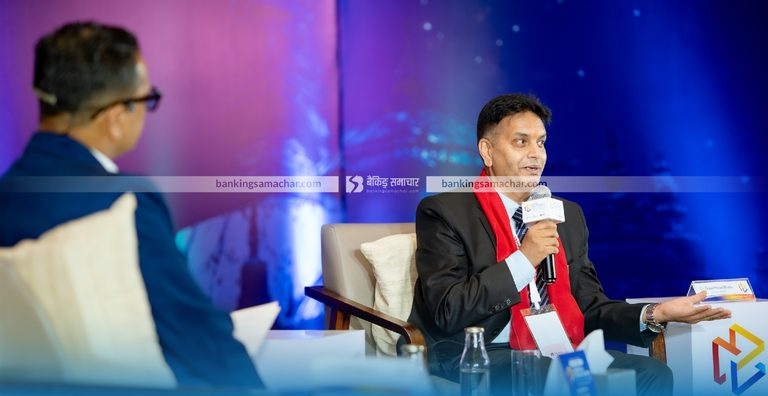
(Remarks made by SEBON Chairman Bhatta at the ‘Duologue’ session of the Capital Market Discourse)

 About Us
Comment