
Banking News – Throughout the past week, a chill was felt in New York’s weather. Drizzle, strong winds, and a cold nip. This was not the expected September weather. In previous years, the weather was not like this at this time. According to the experienced, such weather used to occur only in November, not this early. Therefore, participants arriving at the General Assembly this time were experiencing something different, and some were even seen searching for warm clothes.
Some were also interpreting this as an effect of climate change. And they were saying — in the coming years, when coming to New York, there may be a different experience every year. Perhaps in the coming years it will be even colder, and possibly after a few years, it may even snow here during this same season.
Along with New York’s weather this year, I remembered Nepal from two years ago. The weather of the beginning of the second week of Ashoj two years ago. When talking about Nepal’s weather, Ashoj is the time to store paddy. But the weather was like Shrawan. Two years ago too, while I was in New York for General Assembly reporting, there was sudden continuous rainfall and massive floods and landslides in Nepal on Ashoj 11 and 12. This had claimed more than 200 lives.
This year too, the situation is similar. In Nepal, during this same season this year, more than 24 people lost their lives, and road connectivity in western Nepal has been severed. Roads have collapsed in various places at the mouth of Dashain, making it very difficult for citizens to travel. Not to mention the Bhote Koshi flood of Bhadau 10.
Following the outside weather, much of the discussion at this year’s General Assembly was also on this same issue of climate change. Around the United Nations headquarters, important individuals from nearly 200 countries of the world — from heads of government to heads of state, foreign ministers, distinguished figures from the diplomatic field, and activists advocating for climate justice — debated well on climate change, its impacts and effects, and justice.
From US President Donald Trump, UK Prime Minister Andy Burnham, Israeli Prime Minister Benjamin Netanyahu, Ukrainian President Volodymyr Zelenskyy, to Japanese Prime Minister Sanae Takaichi — they drew the world’s attention through their addresses. UN Secretary-General António Guterres focused this time in his address on climate change, war, poverty, and artificial intelligence. In Guterres’s address, press conferences, and bilateral meetings, who has been continuously leading the UN for up to 10 years of his life, some of his dissatisfactions were visible.
Because globally, supply systems have become difficult due to wars, leading to problems like inflation and malnutrition. The number of citizens trapped in the cycle of poverty in the world is increasing massively.
On the other hand, he has also been saying that he has focused his attention on the problems climate change is beginning to cause in the world and the experiences of citizens. For example, recalling his Nepal visit three years ago regarding its impact, he said:
“I had said three years ago, standing in Nepal, where the highest peak Sagarmatha is located, that the roof of the world is collapsing. But people said it was exaggerated. I had said at that very time that the world should focus on studying the impacts of climate change, but the world still does not appear ready to do this today.”
Secretary-General Guterres also clarified that the world has seen the example of Nepal suffering loss of life and property due to climate change recently. His statement was targeted at the issue of the flood of Bhadau 10 and the unimaginable human, physical, and infrastructure damage it caused. His statement was also important because scientific studies, available evidence, and data had made clear to him how devastating the impacts of climate change can be.
Particularly, heads of governments from around the world interpreted in their own ways the topics of global war, the threat of nuclear weapons, the extreme state of poverty, the world sinking into climate crisis, the rapid expansion of information technology, nuclear disarmament, and sustainable development goals. Neighboring country Bangladesh focused on the Rohingya refugee issue more than other topics, while African countries strongly raised the issue of participation in the Security Council.
Meanwhile, US President Trump, who went to address the first day of the high-level political debate, spoke not only about America’s power in the world but also expressed strong anger in the following days on the issue of the Iran-US war. His address was more on conflict issues. In his speech, neither the issue of climate change was raised as Secretary-General Guterres worried about, nor the effects of sea-level rise that the world will face in the near future.
Nepal’s Participation and Activism
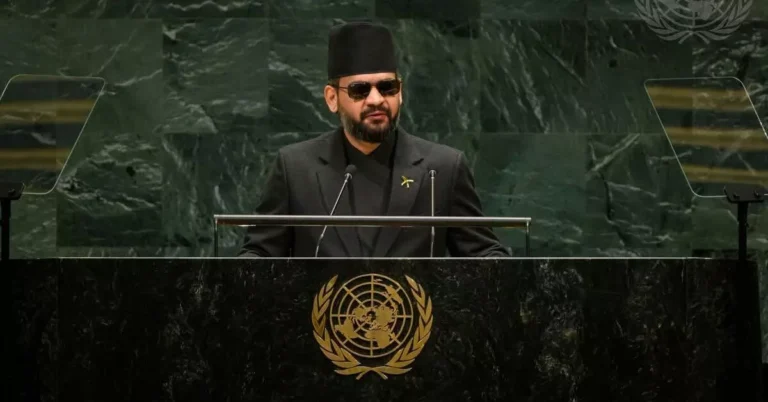
In this year’s General Assembly, Prime Minister Balendra Shah raised the issue of climate change with high priority and also clearly placed Nepal’s climate-induced disaster situation on the world stage. This not only reflected the state of climate change impacts Nepal has been unnecessarily suffering on the world stage but also once again brought out our problems and compulsions. Nepal’s appeal for climate justice once again reached the world. This also forced and prodded the world community to think about us.
Prime Minister Shah pointed out that Nepal’s contribution to greenhouse gas emissions, considered an important aspect of climate change, is 0.1 percent, but it has to suffer its impacts seriously. He also clearly stated that under climate justice, the mobilization of climate finance and compensation for loss and damage must be in the form of grants, and Nepal cannot bear the burden of loans.
Nepal’s presentation this time has further highlighted the fact that developed countries of the world have not worked according to their commitments. Another important aspect is that, as Secretary-General Guterres said, it has also demonstrated the situation where every member state must work according to its commitments. Prime Minister Shah also stated that the climate crisis must be faced through a common mechanism of South Asian countries, where the world’s largest population resides. This can be expected to put additional pressure on countries around the world to make urgent and emergency decisions.
Nepal, as in its traditional manner, also gave importance to bilateral meetings, multilateral participation, and sideline meetings this time as well. Officials including Foreign Minister Shishir Khanal, Foreign Secretary Amrit Bahadur Rai, and Head of Nepal’s Permanent Mission to the UN Lok Bahadur Thapa were active and busy. As a country that has directly experienced the impacts of climate, those gathered in New York from around the world appeared interested in listening attentively to Nepal’s issues.
Expectations and the Future
Currently, rich countries in the world are focused on how to make bets and leaps in artificial intelligence rather than climate change. Their concern appears greater about whether they will succeed in keeping technology under human control. That is why, while leaders of countries around the world were debating in New York, the presidents of the United States, a world superpower, and China, struggling as an emerging power, were busy discussing their agendas in Washington DC.
Additionally, countries of the world have also realized that in the coming days, it will not be possible to face the challenges that arise in the world from just one or two countries. The time has come to seek paths to solutions collectively through a multilateral and multipolar system in the coming world.
Therefore, the Earth is one common home in which eight billion people reside. Easy access to minimum essential goods and services for them is the main challenge today. On the other hand, if in the coming days, due to artificial intelligence, there is a situation of facing complex diseases, extreme unemployment, or famine, then how can the UN work by bringing its member states into confidence at that time? For that, the UN must initiate work on the existing problems according to a plan now, and countries around the world must participate enthusiastically.
Humans are inherently gripped by the psychology of considering only the crisis in front of their eyes as a crisis. If, as the impacts of climate change caused floods and landslides in Nepal four weeks ago, within the coming two to three decades, sea levels rise and New York’s lower coast is inundated, or if a situation arises where heavy snowfall around the General Assembly building forces the General Assembly itself to be postponed, only then will their awareness awaken.
Therefore, if countries reducing greenhouse gas emissions can unite and create widespread pressure at the General Assembly in the upcoming session, then Nepal and other landlocked, least developed, and underdeveloped countries around the world will be able to obtain climate justice. If Nepal itself can lead countries like Nepal that are in a situation of nature and injustice, it will certainly be the fragrance in gold.

 About Us
Comment