
Banking News – Independent Power Producers’ Association, Nepal (IPPAN) President Mohan Dangi has warned that nearly 19,000 megawatts (MW) of hydropower projects could remain at risk unless the country’s Forest Act is amended, arguing that the current legal framework and lengthy administrative procedures are obstructing infrastructure development.
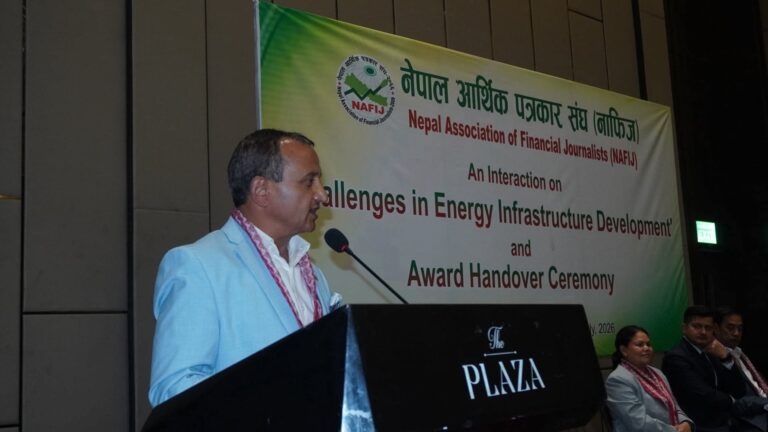
Speaking at an interaction program on “Challenges in Power Infrastructure Development and the Way Forward” organized by the Nepal Economic Journalists Association (NAFIJ), Dangi described the existing Forest Act as “development-unfriendly” and called for urgent reforms to facilitate investment in Nepal’s energy sector.
Dangi welcomed the recent Nepal–India energy cooperation agreements, particularly the decisions made during the Nepal–India Energy Secretary-level Joint Steering Committee (JSC) meeting in Pokhara, which increased cross-border electricity import capacity to 1,400 MW and export capacity to 1,650 MW. He said the agreement has generated new optimism for Nepal’s power sector.
However, he argued that despite billions of rupees in private sector investment, many hydropower projects remain stalled due to strict policies under the Ministry of Forests and Environment.
“Around 45 percent of Nepal’s land is covered by forests, another 15 percent consists of Himalayan regions and protected areas, leaving nearly 19,000 MW of hydropower projects affected,” Dangi said. “On one hand, the government grants project approvals, while on the other, a single letter issued by a forest official or warden can halt investments worth billions of rupees.”
He stressed that the current Forest Act and related regulations have become a major obstacle not only for the energy sector but also for the country’s broader infrastructure development, urging the government to introduce development-friendly legal reforms without delay.
Dangi also highlighted the bureaucratic burden faced by investors, stating that developers must obtain approvals from eight ministries, 24 government departments, and more than 200 agencies before completing a single hydropower project, discouraging private investment.
He further noted that around 1,000 MW of electricity generated during the monsoon season goes to waste due to insufficient domestic demand and limited transmission infrastructure, emphasizing the need to expand power consumption and accelerate transmission line development.
Dangi welcomed the government’s decision to allocate Rs. 70 billion for transmission line construction in the current fiscal year and its initiative to allow the private sector to participate in transmission line development and electricity trading.
He also urged the current government to utilize its strong political position to implement policy and legal reforms, saying many of the challenges facing Nepal’s energy sector could be resolved by fulfilling commitments already outlined in political party manifestos.
Concluding his remarks, Dangi expressed confidence that close cooperation between the government, private sector, and media would enable Nepal to achieve its long-term target of exporting 10,000 MW of electricity within the next decade.

 About Us
Comment