
Banking News – Nepal Rastra Bank (NRB) Executive Director and Spokesperson Guru Prasad Poudel has said the central bank is committed to removing policy bottlenecks and introducing investment-friendly measures to encourage greater financing in Nepal’s hydropower sector.
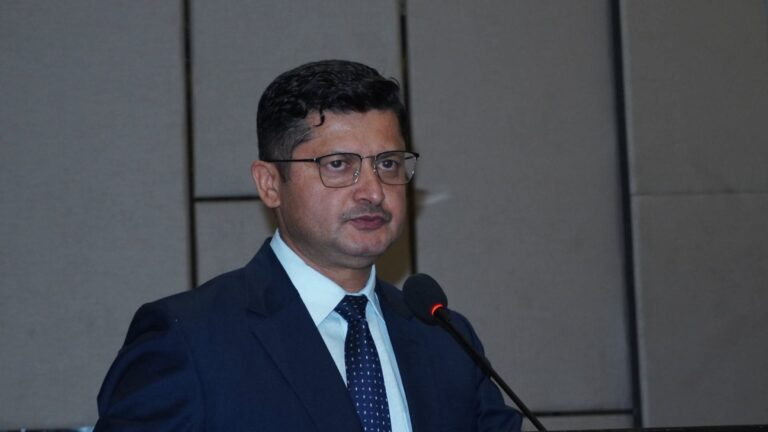
Speaking at the interaction program on “Challenges in Power Infrastructure Development and the Way Forward,” organized by the Nepal Economic Journalists Association (NAFIJ), Poudel said that banks and financial institutions (BFIs) still have significant capacity to increase lending to energy projects.
According to Poudel, the outstanding loan portfolio of BFIs in the hydropower sector currently stands at around Rs. 500 billion.
“Banks have a total loan portfolio of nearly Rs. 6 trillion. If up to 15 percent is allocated to the energy sector, investment could reach Rs. 900 billion. This means the banking sector still has the capacity to invest an additional Rs. 400 billion in hydropower,” he said.
Poudel noted that Nepal Rastra Bank has introduced special regulatory provisions for infrastructure projects such as hydropower plants and transmission lines. While the Single Obligor Limit (SOL) is generally capped at 25 percent of a bank’s core capital for other sectors, the limit has been increased to 50 percent for energy projects, allowing banks to finance larger projects.
He also highlighted a flexible loan classification policy designed to support hydropower developers.
“In most sectors, missing a single installment requires the entire loan to be classified as non-performing. However, for hydropower projects, only the overdue installment is classified, protecting borrowers from unnecessary deterioration in their credit ratings,” Poudel explained.
To reduce the financial burden on banks during project construction, NRB has also allowed lenders to maintain only a 1 percent loan loss provision throughout the grace period. In addition, hydropower projects with a capacity exceeding 50 MW are permitted to capitalize interest expenses during the construction phase, easing financing costs.
Poudel stressed that bank deposits alone will not be sufficient to meet Nepal’s growing investment needs in the energy sector and called for a diversified financing model.
“The future of energy financing lies not only in bank lending but also in energy bonds, debentures, and international climate funds. These sources must be mobilized to support Nepal’s energy ambitions,” he said.
He added that NRB’s recently introduced Green Finance Taxonomy is expected to facilitate the issuance of international green bonds and help attract foreign investment into environmentally sustainable projects.
Concluding his remarks, Poudel reaffirmed the central bank’s commitment to introducing innovative and supportive financial policies to help the government achieve its long-term energy development goals.

 About Us
Comment