
Nepal has been practicing fiscal federalism for nearly a decade, yet for many citizens it remains difficult to clearly understand how the government revenue is generated, how public funds are allocated, and how effectively they are spent across federal, provincial, and local levels.
To address this gap in fiscal transparency and improve public access to financial information, the World Bank recently launched the Nepal Fiscal Dashboard. This digital platform brings together and visualizes key fiscal data, including revenues, expenditures, intergovernmental fiscal transfers, public debt, and performance indicators across all three tiers of the government in a simple and user-friendly format.
What is the purpose of this dashboard? Why was it introduced now, and how can it strengthen transparency, accountability, and evidence-based policymaking in Nepal’s public finance system? Can it also evolve into a more real-time fiscal information tool aligned with Nepal’s digital transformation agenda?
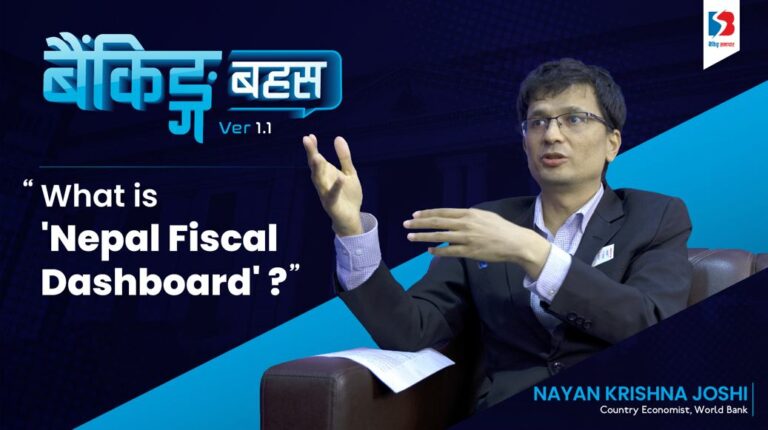
To explore these questions, we are joined by Nayan Krishna Joshi, Country Economist at the World Bank.
WHAT IS NEPAL FISCAL DASHBOARD?
Nepal Fiscal Dashboard, was launched in February 2026. In simple terms, the Nepal Fiscal Dashboard is an online platform where people can see how the government collects money, from which sources, and how that money is spent.
Technically, we call these revenues and expenditures. The dashboard also shows how much money provincial and local governments receive from the federal government through intergovernmental fiscal transfers.
Essentially, the dashboard covers all three tiers of government’s federal, provincial, and local and provides fiscal data related to revenues, expenditures, transfers, debt, and fiscal performance indicators.
What are the strategic objectives, key features, and capabilities of this dashboard?
The dashboard mainly has two strategic objectives. First, to strengthen fiscal transparency by making fiscal data more accessible and consistent. Second, to support evidence-based policymaking.
In terms of features, the dashboard provides detailed information on revenue, expenditure, debt, fiscal transfers, and fiscal performance indicators developed by the Ministry of Federal Affairs. The platform currently includes data from fiscal year 2017/18 to fiscal year 2023/24.
Another important feature is that users can compare budgeted revenue and expenditure with actual collection and spending at the federal and provincial levels.
How does the dashboard translate complex government accounts into information that helps the public understand where their taxes go?
That’s a very important question. Government financial reports are often highly technical and difficult to understand. We collect data from consolidated financial statements, provincial budget speeches, and federal budget documents.
Although some data are available digitally, many are not machine readable. So, we clean, standardize, and organize the data to ensure consistency across provinces and across years.
Then we present the information through simple charts, graphs, and visualizations so that ordinary users can easily understand government activities and spending patterns.
In Nepal, language remains a barrier because many people are not comfortable with English. Is there any plan to launch a Nepali language version of the dashboard?
Yes, that issue was raised during consultations with stakeholders including government officials, academics, civil society representatives, and journalists.
We recognize that a Nepali-language version is important. However, the current version of the dashboard does not yet support bilingual functionality.
But this is something we consider important and may explore in future versions depending on how the platform evolves.
Currently, the dashboard only presents data up to fiscal year 2023/24. How can it be upgraded to provide timelier or near real time insights instead of remaining a backward-looking tool?
Our dashboard entirely depends on official government data. If the government has not released updated data, we cannot include it.
As of now, fiscal year 2024/25 data have not yet been officially released, which is why the dashboard currently ends at 2023/24.
Can we expect monthly or quarterly fiscal reports in the future?
That is something we can explore in the medium term. However, for monthly or quarterly reporting, the government would first need to release detailed high-frequency revenue and expenditure data. If such data become available, it would not be difficult for us to incorporate them into the dashboard.
What are the primary data sources used in this dashboard?
We rely on multiple government agencies. Major sources include the Financial Comptroller General Office for consolidated financial statements, provincial and federal budget speeches, the National Statistics Office for GDP and population data, Nepal Rastra Bank, and the Public Debt Management Office.
So yes, the World Bank compiles data from different government institutions into a single platform.
How is data quality ensured, especially for figures reported by remote municipalities?
Since we rely on official government data, overall quality depends on the quality of government reporting. However, we conduct consistency checks.
For example, government expenditure data are presented in different classifications — economic, functional, and administrative. Ideally, total expenditure should match across all classifications.
If inconsistencies appear in historical data, we flag them in the dashboard metadata to alert users.
Does the dashboard allow cross sectoral analysis?
At the federal level, users can analyze spending across sectors such as education, transport, and health.
At the provincial level, the dashboard currently supports comparisons between recurrent and capital expenditure, but sector-wise breakdowns are not yet fully available for all years.
For local governments, only aggregate-level analysis is currently possible.
Can users compare provinces based on internal revenue and spending patterns?
Absolutely. Users can compare all seven provinces in terms of revenue composition, revenue execution, spending execution, and fiscal performance over time.
This makes the platform useful not only for policymakers, but also for researchers, journalists, civil society, and ordinary citizens.
What is the long-term sustainability plan for this dashboard?
This is a question many stakeholders ask. Our medium- to long-term goal is to officially hand over the dashboard to the Government of Nepal so that it becomes a government-owned platform.
We are already in discussions with government agencies, and the response has been encouraging. In the short term, the World Bank will continue maintaining the dashboard, but eventually ownership, maintenance, financing, and technical operations should transition to the government.
How can the dashboard be used as an active tool to drive fiscal reforms rather than remaining just a passive data platform?
The dashboard helps identify fiscal performance gaps. For example, users can compare budgeted versus actual expenditure across provinces and across years.
This helps policymakers identify whether poor fiscal performance is caused by structural issues, province specific problems, or external shocks such as COVID-19.
Once those patterns are identified, policymakers can design targeted interventions and reforms.
What does the dashboard reveal about vertical fiscal imbalance between federal and provincial governments?
The dashboard allows users to calculate indicators such as the share of intergovernmental fiscal transfers in total revenue.
If provincial or local governments depend heavily on transfers from the federal government, that indicates more fiscal imbalance.
So, while the dashboard itself does not directly interpret the data, it provides the necessary information for such analysis.
Can this data help refine equalization grant formulas for geographically disadvantaged regions?
Partially. Equalization grants require detailed indicators related to fiscal capacity and fiscal needs, including service delivery costs.
The current dashboard contains some relevant indicators, but not all the required variables.
If more detailed data become publicly available in the future, we can certainly incorporate them.
How does the dashboard account for the informal economy and possible fiscal leakages?
Since we rely entirely on official government data, the dashboard mainly captures the formal economy.
Informal sector activities are generally outside the scope of official fiscal reporting, so they are not reflected in the current version.
Can this platform serve as a model for other South Asian countries facing similar fiscal transparency challenges?
Definitely. The dashboard demonstrates how scattered fiscal data across multiple levels of government can be standardized, integrated, and presented in a user-friendly format.
Other South Asian countries can certainly learn from Nepal’s experience.
How does the Nepal Fiscal Dashboard align with Nepal’s Digital Transformation 2026 agenda?
The dashboard strongly aligns with Nepal’s broader digital governance goals.
In the long term, different government reporting systems could be connected through APIs, enabling high-frequency updates and better integration of public financial information.
So yes, the Nepal Fiscal Dashboard can be viewed as an important step toward Nepal’s digital transformation journey.
WHAT IS NEPAL FISCAL DASHBOARD?
Nepal Fiscal Dashboard, was launched in February 2026. In simple terms, the Nepal Fiscal Dashboard is an online platform where people can see how the government collects money, from which sources, and how that money is spent.
Technically, we call these revenues and expenditures. The dashboard also shows how much money provincial and local governments receive from the federal government through intergovernmental fiscal transfers.
Essentially, the dashboard covers all three tiers of government’s federal, provincial, and local and provides fiscal data related to revenues, expenditures, transfers, debt, and fiscal performance indicators.
What are the strategic objectives, key features, and capabilities of this dashboard?
The dashboard mainly has two strategic objectives. First, to strengthen fiscal transparency by making fiscal data more accessible and consistent. Second, to support evidence based policymaking.
In terms of features, the dashboard provides detailed information on revenue, expenditure, debt, fiscal transfers, and fiscal performance indicators developed by the Ministry of Federal Affairs. The platform currently includes data from fiscal year 2017/18 to fiscal year 2023/24.
Another important feature is that users can compare budgeted revenue and expenditure with actual collection and spending at the federal and provincial levels.
How does the dashboard translate complex government accounts into information that helps the public understand where their taxes go?
That’s a very important question. Government financial reports are often highly technical and difficult to understand. We collect data from consolidated financial statements, provincial budget speeches, and federal budget documents.
Although some data are available digitally, many are not machine readable. So we clean, standardize, and organize the data to ensure consistency across provinces and across years.
Then we present the information through simple charts, graphs, and visualizations so that ordinary users can easily understand government activities and spending patterns.
In Nepal, language remains a barrier because many people are not comfortable with English. Is there any plan to launch a Nepali language version of the dashboard?
Yes, that issue was raised during consultations with stakeholders including government officials, academics, civil society representatives, and journalists.
We recognize that a Nepali-language version is important. However, the current version of the dashboard does not yet support bilingual functionality.
But this is definitely something we consider important and may explore in future versions depending on how the platform evolves.
Currently, the dashboard only presents data up to fiscal year 2023/24. How can it be upgraded to provide more timely or near real time insights instead of remaining a backward looking tool?
Our dashboard entirely depends on official government data. If the government has not released updated data, we cannot include it.
As of now, fiscal year 2024/25 data have not yet been officially released, which is why the dashboard currently ends at 2023/24.
Can we expect monthly or quarterly fiscal reports in the future?
That is something we can explore in the medium term. However, for monthly or quarterly reporting, the government would first need to release detailed high-frequency revenue and expenditure data. If such data become available, it would not be difficult for us to incorporate them into the dashboard.
What are the primary data sources used in this dashboard?
We rely on multiple government agencies. Major sources include the Financial Comptroller General Office for consolidated financial statements, provincial and federal budget speeches, the National Statistics Office for GDP and population data, Nepal Rastra Bank, and the Public Debt Management Office.
So yes, the World Bank compiles data from different government institutions into a single platform.
How is data quality ensured, especially for figures reported by remote municipalities?
Since we rely on official government data, overall quality depends on the quality of government reporting. However, we conduct consistency checks.
For example, government expenditure data are presented in different classifications — economic, functional, and administrative. Ideally, total expenditure should match across all classifications.
If inconsistencies appear in historical data, we flag them in the dashboard metadata to alert users.
Does the dashboard allow cross sectoral analysis?
At the federal level, users can analyze spending across sectors such as education, transport, and health.
At the provincial level, the dashboard currently supports comparisons between recurrent and capital expenditure, but sector-wise breakdowns are not yet fully available for all years.
For local governments, only aggregate-level analysis is currently possible.
Can users compare provinces based on internal revenue and spending patterns?
Absolutely. Users can compare all seven provinces in terms of revenue composition, revenue execution, spending execution, and fiscal performance over time.
This makes the platform useful not only for policymakers, but also for researchers, journalists, civil society, and ordinary citizens.
What is the long-term sustainability plan for this dashboard?
This is a question many stakeholders ask. Our medium- to long-term goal is to officially hand over the dashboard to the Government of Nepal so that it becomes a government-owned platform.
We are already in discussions with government agencies, and the response has been encouraging. In the short term, the World Bank will continue maintaining the dashboard, but eventually ownership, maintenance, financing, and technical operations should transition to the government.
How can the dashboard be used as an active tool to drive fiscal reforms rather than remaining just a passive data platform?
The dashboard helps identify fiscal performance gaps. For example, users can compare budgeted versus actual expenditure across provinces and across years.
This helps policymakers identify whether poor fiscal performance is caused by structural issues, province specific problems, or external shocks such as COVID-19.
Once those patterns are identified, policymakers can design targeted interventions and reforms.
What does the dashboard reveal about vertical fiscal imbalance between federal and provincial governments?
The dashboard allows users to calculate indicators such as the share of intergovernmental fiscal transfers in total revenue.
If provincial or local governments depend heavily on transfers from the federal government, that indicates a higher degree of fiscal imbalance.
So while the dashboard itself does not directly interpret the data, it provides the necessary information for such analysis.
Can this data help refine equalization grant formulas for geographically disadvantaged regions?
Partially. Equalization grants require detailed indicators related to fiscal capacity and fiscal needs, including service delivery costs.
The current dashboard contains some relevant indicators, but not all the required variables.
If more detailed data become publicly available in the future, we can certainly incorporate them.
How does the dashboard account for the informal economy and possible fiscal leakages?
Since we rely entirely on official government data, the dashboard mainly captures the formal economy.
Informal sector activities are generally outside the scope of official fiscal reporting, so they are not reflected in the current version.
Can this platform serve as a model for other South Asian countries facing similar fiscal transparency challenges?
Definitely. The dashboard demonstrates how scattered fiscal data across multiple levels of government can be standardized, integrated, and presented in a user-friendly format.
Other South Asian countries can certainly learn from Nepal’s experience.
How does the Nepal Fiscal Dashboard align with Nepal’s Digital Transformation 2026 agenda?
The dashboard strongly aligns with Nepal’s broader digital governance goals.
In the long term, different government reporting systems could be connected through APIs, enabling high-frequency updates and better integration of public financial information.
So yes, the Nepal Fiscal Dashboard can be viewed as an important step toward Nepal’s digital transformation journey.

 About Us
Comment