
Banking News – Community forests in Banke District are evolving beyond their traditional role of environmental conservation to become a key pillar of rural economic development, generating employment, supporting local livelihoods, promoting tourism, and conserving biodiversity.
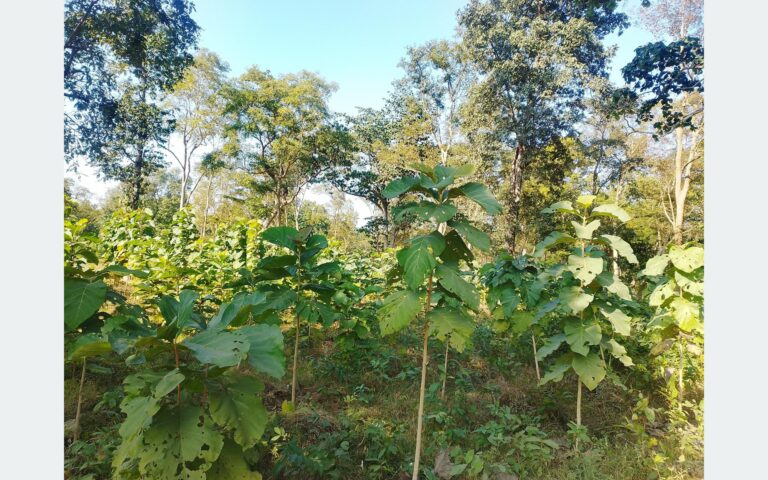
According to Shankar Prasad Gupta, Senior Divisional Forest Officer at the Banke Division Forest Office, improved forest conservation has led to an increase in the population of tigers, rhinos, elephants, leopards, deer, wild boars, and blue bulls, while also enhancing forest density across the district.
Community forest user groups are now earning millions of rupees annually through the sustainable management of timber, firewood, fodder, and non-timber forest products (NTFPs). The income is being invested in forest conservation, community development, schools, roads, and support programs for low-income families, creating a balance between environmental protection and social development.
The district also has significant potential in non-timber forest products, including Satuwa, Kurilo, Harro, Barro, Amla, Bel, honey, and medicinal herbs. Growing commercial cultivation and processing of these products have created new employment opportunities for local youth, reducing dependence on foreign employment.
The Banke National Park has also become a major contributor to eco-tourism, attracting domestic and international visitors through wildlife safaris, nature-based tourism, and environmental studies. This has generated employment for local residents as nature guides, hotel operators, and tourism service providers.
Gupta stressed that forests should now be viewed as the foundation of a green economy, with opportunities in carbon trading, ecosystem services, eco-tourism, and forest-based industries. He added that sustainable forest management can significantly contribute to economic growth, climate resilience, agricultural productivity, and food security.
Expansion of Block Forests (Chakla Forests)
To strengthen sustainable forest management, two new Chakla (block) forests have been established during FY 2082/83, increasing the total number in Banke to three.
The newly established Bhuvar Bhawani and Kharchhetal Chakla Forests complement the existing Mathewas–Shamsherganj Chakla Forest, which is Nepal’s largest block forest, covering 2,578 hectares and incorporating 31 community forests.
With the expansion, 58 community forests covering approximately 7,500 hectares are now operating under the Community Forest Promotion System, promoting scientific and sustainable forest management.
According to forest officials, the Chakla Forest Management Program has generated more than Rs. 107.4 million in annual revenue since its launch in FY 2073/74, with the two newly established forests expected to produce similar annual revenue.
The program has also created year-round employment for 30–35 workers while providing direct benefits to around 400–450 local residents through activities such as tree harvesting, transportation, road construction, and forest maintenance.
Community Forests Strengthen Local Development
Banke currently has 118 registered community forests covering 26,116.58 hectares, of which 58 forests have already adopted sustainable forest management systems over 12,153 hectares.
According to Savitra Pun, Chairperson of the Community Forest Users Federation, Banke, revenues generated by community forests are being invested in electricity expansion, road and drainage construction, school infrastructure, teacher support, maternal health programs, interest-free loans of up to Rs. 100,000 for low-income members, agricultural subsidies, and fencing projects to reduce human-wildlife conflict.
Youth Employment Through Forest-Based Enterprises and Eco-Tourism
Community forests have become an important source of income through medicinal herbs, forest products, and eco-tourism, creating new opportunities for young entrepreneurs.
According to Mahendra Shahi, Lumbini Province Member of the Community Forest Users Federation, improved forest conservation has also protected water sources and watersheds, ensuring better irrigation, regulating temperatures, maintaining rainfall patterns, and improving agricultural productivity.
Despite these achievements, challenges remain, including forest fires, illegal logging, encroachment, human-wildlife conflict, complex legal procedures for forest enterprises, inadequate processing industries for forest products, and limited market access.
Officials believe that addressing these issues while expanding sustainable forest management could make community forestry one of Nepal’s strongest models for green economic development and rural prosperity.

 About Us
Comment