
Banking News – The Annapurna Conservation Area Project (ACAP) collected Rs 67 crore 75 lakh 90 thousand 986 from tourist fees in the last fiscal year 2082/83. Revenue from entry fees also increased after the highest number of foreign tourists ever entered the area last fiscal year. According to Dr. Rabin Kadariya, Project Chief, a total of 5 lakh 8 thousand 476 foreign tourists visited the Annapurna Conservation Area last fiscal year, including 3 lakh 84 thousand 145 from South Asian countries and 1 lakh 24 thousand 331 from other countries.
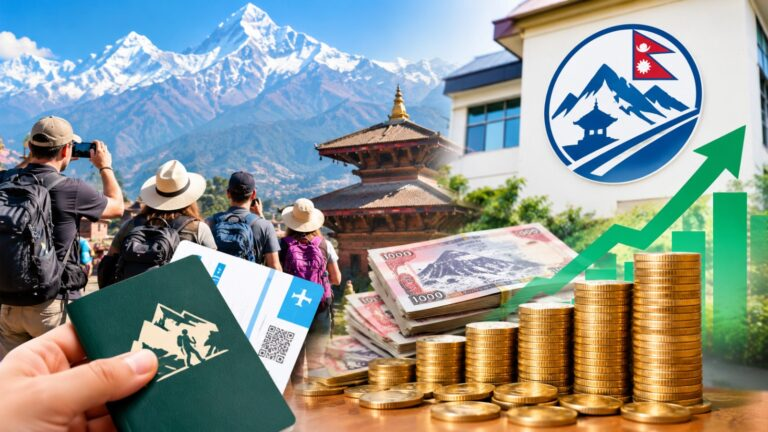
Among them, the highest number was 3 lakh 75 thousand 797 Indian tourists. ACAP charges an entry fee of Rs 1,000 from tourists from South Asian countries and Rs 3,000 (including VAT) from tourists from other countries.
“The amount collected from tourist fees also increased last fiscal year because many Indian tourists came,” said Project Chief Dr. Kadariya.
He stated that both the number of tourists and the amount collected from tourist fees are the highest ever. In fiscal year 2081/82, a total of Rs 46 crore 48 lakh 81 thousand 484 was collected as tourist entry fees. In fiscal year 2080/81, Rs 38 crore 94 lakh 61 thousand 483 was collected in tourist fees.
According to data from the project office, tourists from 169 countries including India entered the Annapurna area last fiscal year. Project Chief Dr. Kadariya stated that nearly double the number of tourists came last fiscal year compared to fiscal year 2081/82. In fiscal year 2081/82, a total of 2 lakh 78 thousand 113 tourists entered the Annapurna area.
He stated that a large portion of the income from tourist fees and other sources is spent on conservation activities and tourism promotion programs. According to Project Chief Dr. Kadariya, the government does not provide a separate budget for ACAP, and the office, staff management, and annual programs are operated from its own income. The budget and programs are implemented through conservation area management committees at the local level. ACAP has been conducting activities including trail construction, waste management, small irrigation, drinking water project construction, income generation, and conservation education. The project office has stated that income from tourist entry fees remains with ACAP, while amounts collected from the use of natural resources including medicinal herb collection are deposited in the Government of Nepal’s revenue.
Revenue is also being collected from fees of hydropower projects operated within ACAP, mountaineering fees, and restricted area entry fees. It has been stated that Rs 21 crore 69 lakh 97 thousand 500 in entry fees was collected last fiscal year from tourists entering the restricted Upper Mustang and Nar Phu areas of Manang for foreign nationals. The restricted area entry fee is collected through the Immigration Office. In the world-famous Annapurna area for trekking tourism, more tourists come for trekking during the two main tourist seasons — Ashoj-Kartik and Chaitra-Baisakh. Although the number of trekking tourists coming to this area during the rainy and cold seasons is low, there is activity of domestic and foreign tourists at other times. The Annapurna Conservation Area, spread over 7,600 square kilometers, includes 87 wards of 15 local levels in Kaski, Lamjung, Manang, Myagdi, and Mustang.
Most Indian tourists going to destinations including Muktinath use road routes, while tourists from other countries prefer trekking. Destinations including Annapurna Base Camp, Mardi Himal in Kaski, Sikles, Lwang, Ghandruk village, Tilicho Lake in Manang, Thorong La Pass, Upper Mustang, Muktinath area, Ghodepani in Myagdi, and Poon Hill along the Annapurna Circuit trekking route see hundreds of thousands of domestic and foreign tourists annually.

 About Us
Comment