
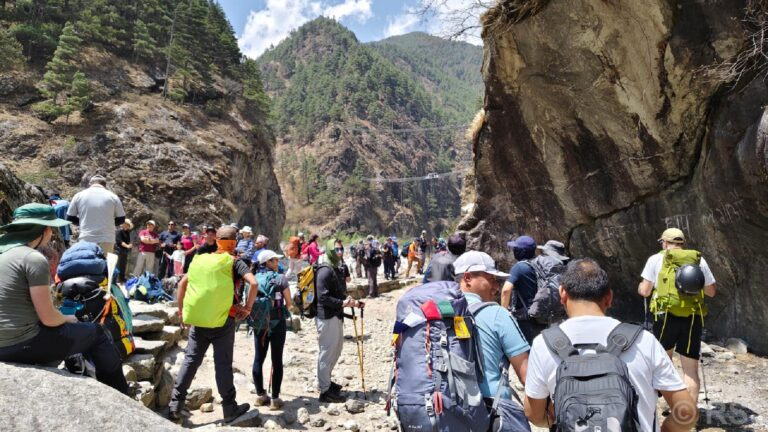
Banking News – As the winter cold intensifies this year, the number of tourists leaving the Everest region by air has increased. According to weekly data provided by the District Police Office, in the recent period, the number of tourists exiting the Khumbu region has been seen to be more than double those entering.
According to police data, in the last seven days, 1,180 tourists exited the Everest region (Khumbu) by air, while 529 tourists entered. The number of those exiting is 651 more than those entering. The data showing the number of departing tourists at more than twice that of arrivals signals that the autumn tourism season is gradually coming to an end.
According to District Police Office Information Officer Inspector Mausam Tamang, the available weekly details show that the number of foreign tourists exiting is 877 and domestic tourists 303. During the same period, 374 foreign and 155 domestic tourists entered the Khumbu region.
According to the details, among the foreign tourists exiting the Khumbu region, 327 are women and 550 men. Among domestic tourists, 46 women and 257 men exited. Likewise, among foreign tourists entering the Khumbu region, 102 are women and 272 men, while among domestic tourists, 54 are women and 101 men. Local Dali Sherpa said the trend of tourists returning has increased as cold intensifies in Khumbu. He said, "Temperatures are starting to go below zero at night in the Namche area itself; with temperatures going below zero at night and in the morning, water has started freezing, so the cold has been felt more."
Among the main tourist seasons in the Everest region, tourist flow is higher in Asoj and Kartik during autumn. After the monsoon ends, the weather clears, the mountains are clearly visible, and a favorable environment is created for trekking, so tourist arrivals tend to increase in this region. However, as temperatures drop toward the latter part of Kartik, nights become extremely cold, and the possibility of snowfall increases in high Himalayan areas, the pace of tourists returning tends to accelerate.
Sagarmatha Pollution Control Committee (SPCC) Chair and tourism entrepreneur Lamakaji Sherpa said the rising cold in high Himalayan areas affects tourists' length of stay and activities. He stated that since tourists manage their travel keeping in mind weather conditions, temperature, possibility of snowfall, and trekking conditions toward the end of the season, the return trend increases.
Noting that tourism activity in the Khumbu region is directly linked to weather, Sherpa said seasonal changes affect tourist movement. Tourism entrepreneur Spidakaji Sherpa said that although tourist flow is higher in the autumn season, travel to high Himalayan areas becomes increasingly difficult and tourist numbers decline once winter begins.
According to Amrit Magar, Station Incharge of Tara Air in Lukla, seasonal conditions and the tourism season are seen to affect tourist movement. He said that when tourist flow is higher, air traffic also increases, and as the season weakens, the trend of tourists exiting increases. "Weather conditions are important for flights, so flight activity from Lukla Airport is also affected by the weather," Incharge Magar said.
Local Toya Kumar Shrestha of Lukla said changes are beginning to be seen in tourist movement and local tourism business activity as cold intensifies. Locals' experience is that as the main season with high tourist flow nears its end, activity in hotels, shops, trekking services, and other tourism businesses gradually decreases. He said that as cold increases in high areas, tourists tend to shorten their trips or return to lower areas.
The police's latest weekly details also mention that 69 plane flights and 28 helicopter flights took place during that period. Since air service is an important means for tourist movement in the Khumbu region, weather, tourist flow, and the state of the season affect flight activity.
The Everest region is a major Himalayan tourism destination of Nepal. Areas including Sagarmatha National Park, Everest Base Camp, Namche Bazaar, Khumjung, Gokyo, Thame, and Lukla are centers of attraction for international tourists for trekking, mountain viewing, and mountaineering. Tourism expert Ang Chhiring Sherpa says tourist movement is higher here in the two main tourism seasons—spring and autumn.
The spring season from Falgun to Jestha and the autumn season from late Bhadra to Mangsir are considered the main tourism periods. Although tourist flow remains higher in Asoj and Kartik during the autumn season, as the season nears its end, temperatures in high Himalayan areas drop and weather changes, affecting tourism activity, according to Laxman Adhikari, Ward Chair of Khumbu Pasanglhamu Rural Municipality-4.
The police's latest weekly data showing the number of tourists exiting the Khumbu region significantly higher than those entering signals that the return trend has accelerated in the final phase of the autumn season. Tourism entrepreneur Temba Chhiri Sherpa estimates that as cold increases in high Himalayan areas, weather conditions that may become adverse in the coming days could show the impact of seasonal change on tourist movement.
Comments
Thank you! Your comment has been received. It will appear here once it is approved.