
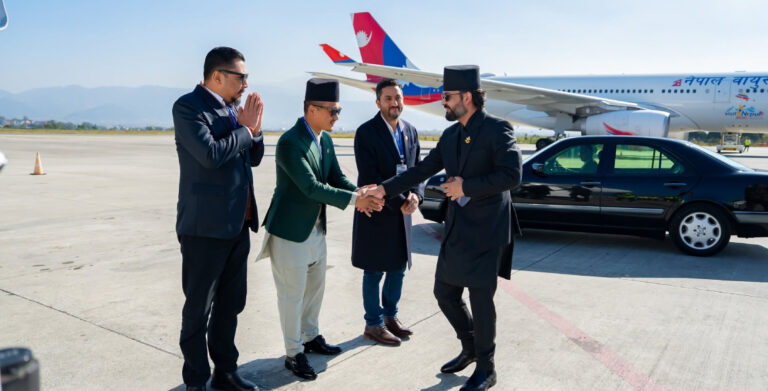
Banking News – With discussion that the issue of expanding air connectivity will get priority during Prime Minister Balendra Shah's India visit, the issue of the Mahendranagar air entry route in the far west has again come into discussion. It is expected that if consensus is reached with India on this matter, air connectivity in western Nepal will become easier, and the far west will also be able to benefit in the future.
Nepal has been demanding additional air entry routes from India since 2014 to make flights from Gautam Buddha International Airport in Bhairahawa and Pokhara International Airport easier to operate. The operation of both airports is being affected due to the lack of suitable air entry routes. The Nepali side understands that flights would become easier if international aircraft are allowed to enter Nepal from Mahendranagar through Indian airspace. Therefore, Nepal has been urging India to provide that air route for a long time.
Currently, although international aircraft are permitted to exit Nepal toward the west via the L-626 air route, entry into Nepal via the same route is not permitted. Nepal has been stressing bringing that route into two-way operation. Currently, about 88 percent of Nepal's international flights enter Nepal via Simara. Due to limited entry routes, aircraft coming to Bhairahawa and Pokhara from the west also have to enter Nepal via Simara and then turn back west.
Experts say that due to this, aircraft coming to Bhairahawa have to travel about 190 nautical miles (352 kilometers) of extra distance, and aircraft coming to Pokhara about 145 nautical miles (269 kilometers). If entry permission is received from Mahendranagar, time for aircraft coming to Bhairahawa and Pokhara will be saved, and fuel consumption, operating costs, and environmental impact are expected to decrease. This appears likely to make both airports, which are awaiting full operation, attractive to international airline companies.
The availability of air entry routes is an issue connected not only to the operation of international airports but also to tourism, trade, investment, and regional economic development. It is expected that if international flights from the western region become easier, there will be ease in tourism promotion, attracting foreign investment, and international movement. Rather than the far west receiving immediate direct benefits just by opening the Mahendranagar air route, stakeholders' interest in this issue has grown because it will bring ease to airports and overall economic activity in western Nepal.
Pushpa Raj Kunwar, President of the FNCCI Far West, said the issue of expanding the scope of air connectivity in Nepal is positive. He stated that if Bhairahawa and Pokhara become more active by using the airspace of the far west via Mahendranagar, the indirect benefit will be received by the entire country and western Nepal.
"This demand for operating this route is old; its operation will make western Nepal a hub of air flights. This time there is hope that the demand will reach a conclusion," he said. "This decision should also be viewed in connection with the future of the Dhangadhi regional international airport. If the airport here is upgraded, there will be benefits from short-distance flights to areas including Dehradun and Delhi."
Dinesh Malla, President of the Kanchanpur Chamber of Industry and Commerce, said that if the Mahendranagar air route comes into operation, flights to Bhairahawa and Pokhara will be shorter, benefiting everyone. He stated that with the reduction in distance, along with saving time and fuel, management costs and airfares may also decrease somewhat.
"There will be immediate ease for airline companies and passengers. We believe that if Nepalgunj and Dhangadhi airports are upgraded in the days to come, it will be much easier for us," he said. "That is why our interest in this has naturally grown. Now this issue needs to be brought to a conclusion."
Mahendra Bahadur Singh, Chief of the Civil Aviation Office, Dhangadhi Airport, said the Mahendranagar air route is currently being used only for aircraft exiting, and that if permission is received for entry into Nepal, it will help reduce the pressure of having to go to Kathmandu. "If this route comes into use, the cost and time currently incurred by detouring through Simara to come to Bhairahawa and Pokhara will be saved," he said. "We are working for the upgrade of Dhangadhi Airport, and if this work is completed, there will certainly be benefits here in the future."
A master plan to upgrade Dhangadhi Airport as a regional and international-level airport is in the preparation stage. Implementation of that plan is being delayed due to a lack of budget and land acquisition. Local and stakeholder agencies have been demanding the federal government for its early upgrade. Maya Prakash Bhatta, founding President of the Nepal Association of Tour and Travel Agents (NATTA) Far West, said permission to use the air route should be unconditional. He stated that since demands are also being raised that India should be allowed to use another area of strategic importance when using this route, a decision should be reached after reviewing all sides.
"This matter has been raised for a long time. A decision should be reached in accordance with our national interest after analyzing all sides. In the case of the far west, along with this issue, there are also other infrastructure and development issues that need to be kept in priority," Bhatta said. "There is a need to reach a conclusion on issues such as the upgrade of the Gaurifanta checkpoint, the Pancheshwar multipurpose project, and the construction of motorable bridges at Jhulaghat and Parashuram."
The demand for the Mahendranagar air entry route has been raised for a long time. As this issue has received priority in talks at the Prime Minister's level this time, citizens and tourism entrepreneurs of the far west have expected a concrete decision. Prime Minister Shah is on a two-day state visit to India starting today. He is scheduled to hold delegation-level talks with his Indian counterpart Narendra Modi on Monday. It is said that discussions will be held on air connectivity, economic cooperation, energy, infrastructure, and bilateral relations.
The far west, which borders India, has numerous tourist destinations of religious, cultural, and natural importance, including Khaptad, Shuklaphanta, Api-Saipal, and Ramaroshan. The border areas of Kailali and Kanchanpur also have movement of Indian tourists and trade relations. There is a demand for road and air access to benefit from that. The Gaurifanta checkpoint in Kailali and the upgrade of Dhangadhi Airport are viewed as important aspects of this.
The initial process to make Dhangadhi Airport a regional international airport has already begun. Kunwar, President of the FNCCI Far West, said the government should keep this in priority and create new opportunities in tourism and economic activity in the far west. "The government should increase connectivity keeping the entire country at the center. At the same time, discussions should be held to bring to a conclusion the issues of Dhangadhi Airport, the upgrade of the Gaurifanta checkpoint, and the Pancheshwar project linked to the Mahakali Treaty, from which the far west can receive direct benefits," he said.
Comments
Thank you! Your comment has been received. It will appear here once it is approved.