
Banking News – The future of banking will be defined not by the number of physical branches but by the industry’s ability to leverage technology, build trust, drive innovation, and respond quickly to customers’ needs, a senior banking executive said while highlighting both the challenges and opportunities facing Nepal’s financial sector.
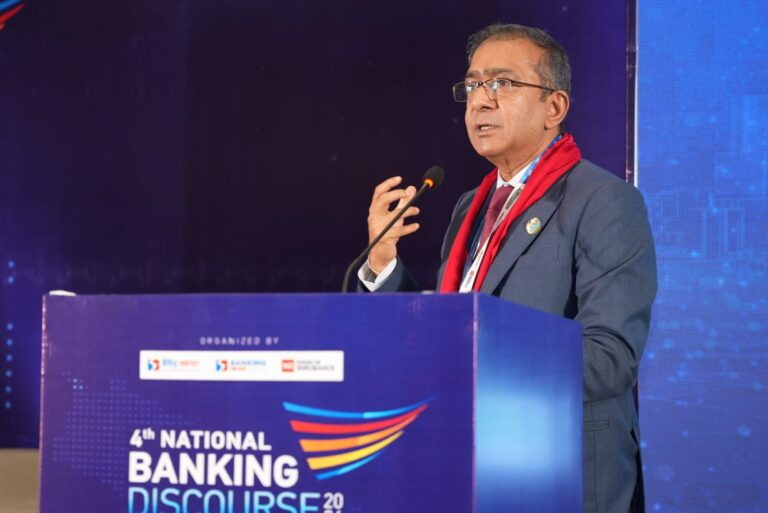
Speaking at the fourth edition of the Banking Discourse, the executive said the event comes at a crucial time as Nepal discusses its fiscal policy and prepares its upcoming monetary policy. Bringing together policymakers, the Nepal Rastra Bank, bankers, and other stakeholders reflects a shared commitment to ensuring a stable, resilient, and self-reliant economy.
Banking Sector Facing Multiple Challenges
The speaker acknowledged that Nepal’s banking industry is currently navigating a difficult period marked by excess liquidity, sluggish economic activity, rising non-performing loans, declining returns on equity, and challenges in human resource management.
Despite these issues, he stressed that significant opportunities remain, particularly with the formation of a new government that has pledged to improve governance and strengthen the country’s economic direction.
He also noted that the lingering effects of the COVID-19 pandemic, the Indian border blockade, and the 2015 earthquake continue to influence the economy, but said these challenges should now be viewed as opportunities for transformation.
Technology Will Shape the Next Era of Banking
According to the speaker, rapid advances in artificial intelligence (AI), data analytics, cybersecurity, open banking, and fintech innovation are reshaping the financial industry worldwide.
“The future of banking will not be defined by branch expansion alone,” he said. “It will be defined by technology, trust, innovation, and the ability to solve customers’ needs quickly.”
He added that banks must evolve beyond their traditional role as financial intermediaries and become promoters of entrepreneurship, drivers of digital transformation, and partners in Nepal’s economic development.
Balanced Regulation Is Essential
While emphasizing the importance of financial discipline and the rule of law, the speaker warned that excessive regulatory uncertainty could discourage businesses from borrowing and investing.

He expressed concern over recent court rulings that have treated minor procedural or technical errors on par with serious banking and financial crimes, creating uncertainty within the banking sector.
According to him, failing to distinguish between deliberate financial misconduct and unintentional procedural mistakes risks undermining confidence among banking professionals.
Retaining Skilled Professionals
The executive also raised concerns about the increasing outflow of skilled professionals seeking higher education and employment abroad.
He warned that creating an environment that discourages experienced banking professionals could have long-term consequences for Nepal’s financial sector.
“The banking industry needs competent, experienced, and ethical leadership,” he said, urging policymakers to strike a balance between maintaining financial stability and ensuring professional security when formulating new regulations.
Need to Change Public Perception of Borrowing
The speaker also called for greater public awareness about the role of credit in economic development.
He noted that public discussions often focus on the country’s debt burden or debt per capita without adequately explaining that borrowing itself is not inherently negative.
According to him, many successful businesses have grown through responsible borrowing, and governments can also use debt productively when it finances investment and economic growth.
However, he cautioned that if businesses become reluctant to borrow even for productive sectors because of fear or uncertainty, it could slow economic expansion.
The speaker further pointed out that many of today’s non-performing loans originated from previously mandated directed lending programs. When banks later attempt to recover those loans, they often face public criticism, creating negative perceptions about the banking industry.
He urged the government to help address such misconceptions while creating a more supportive environment for responsible lending and investment.

 About Us
Comment