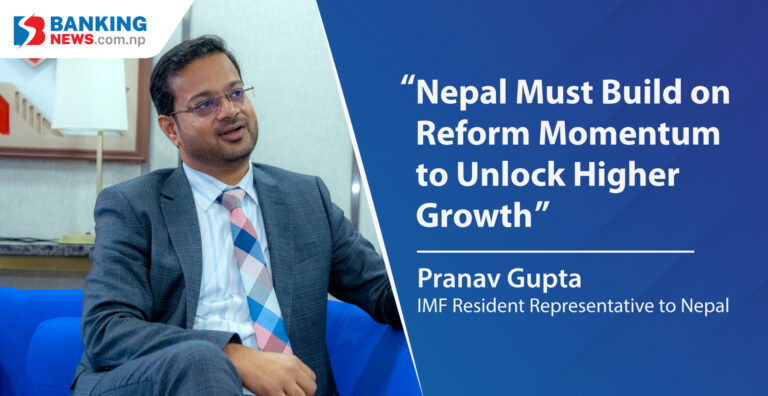

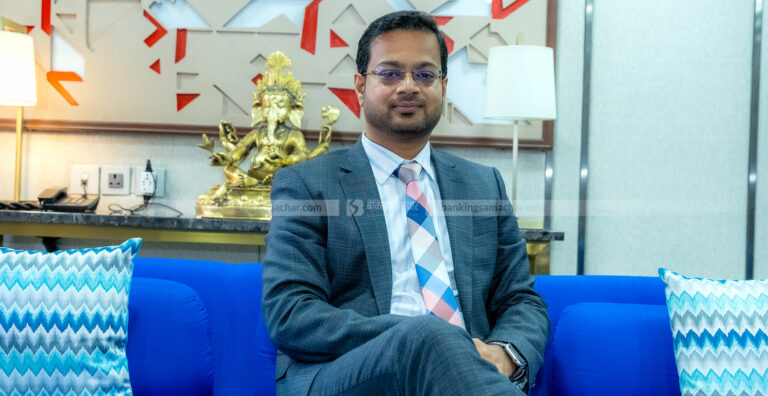
As Nepal and the International Monetary Fund (IMF) mark 65 years of partnership since Nepal joined the IMF on September 6, 1961, we spoke with the IMF’s Resident Representative to Nepal, Mr. Pranav Kumar Gupta, about the country’s economic outlook, reform priorities, and emerging challenges.
Mr. Gupta brings more than 15 years of experience at the IMF, with extensive expertise in macroeconomic policy, IMF lending programs, and capacity development. Over the course of his career, he has worked on a wide range of countries, including Armenia, India, Malawi, Mongolia, Rwanda, and Zambia. An accomplished economist and researcher, he has published widely on international economics and macroeconomic issues in leading academic journals.
In this wide-ranging conversation, he reflects on his experience living and working in Nepal, shares his assessment of the recent floods, and discusses the IMF’s perspectives on governance reforms, financial sector resilience, digital finance, fiscal policy, and the future of the Fund’s engagement following the successful completion of Extended Credit Facility (ECF) program. The interview offers valuable insights into both the challenges and opportunities facing Nepal as it strives to achieve stronger, more inclusive, and sustainable economic growth.
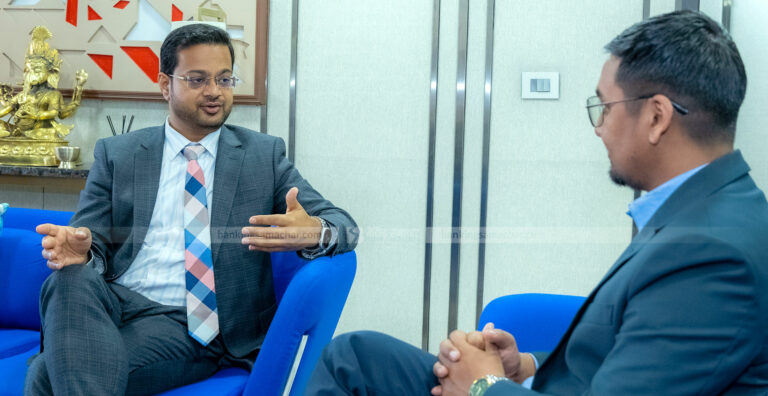
How have your experience been so far in Nepal and what do you like the most about your role as the IMF Resident Representative to Nepal.
I moved to Nepal from Washington, DC, in December 2024 to serve as the IMF Resident Representative, and the experience has been incredibly rewarding. Professionally, Nepal is a fascinating country because it is pursuing important reforms while also navigating a unique set of opportunities and challenges. What I enjoy most about my role is the opportunity to engage in candid discussions with a wide range of stakeholders, whether from the government, private sector, academia, think tanks, or civil society organizations. These interactions have helped me better understand the country and gain deeper insights into Nepal’s policy challenges and opportunities.
Outside of work, Nepal’s scenic beauty never ceases to mesmerize me. I have been fortunate to travel to different parts of the country and go on several hikes around Kathmandu Valley. Most recently, my wife and I hiked to Jamacho Gumba and were amazed by the natural beauty and the breathtaking views of the valley from the top. We are now planning a trek to Annapurna Base Camp in the coming months and are very excited about it. Overall, it has been a true privilege and a pleasure to live and work in Nepal.
How have the recent floods impacted the Nepali economy, and what support is Fund providing to the authorities as they respond to the disaster?
First, I would like to express my sincere condolences to the people of Nepal for the tragic loss of life and livelihoods caused by the devastating floods few days back. Beyond the profound human cost, the floods have caused significant damage to infrastructure, homes, agricultural land, and economic activity in affected areas. The macroeconomic impact of the flash flood could be substantial given the scale of infrastructure damage and we stand ready to support the authorities as they respond to this disaster. At this stage, our focus remains on understanding the impact of the disaster and supporting the authorities’ assessment efforts.
We will continue to work closely with the government and other development partners to support Nepal’s recovery from these devastating floodings. Should the need arise, Nepal has access to the IMF’s Rapid Credit Facility (RCF), which can provide concessional financial assistance to help address urgent balance of payments needs arising from natural disasters and other shocks. Financing under the RCF currently carries a zero percent interest rate, a grace period of 5½ years, and a final maturity of 10 years.
People hoped for a stable economy when the new government took over. Instead, businesses are complaining that the government is harassing them under the guise of good governance. What should the government do to revive an economy that has been slow for years?
We do not comment on ongoing legal cases, but we believe that strong governance is essential for fostering private sector-led and inclusive growth. Despite progress in some areas, weaknesses in governance, anti-corruption frameworks, and public service delivery remain a persistent structural constraint on Nepal’s development. Therefore, strengthening governance through greater transparency, more predictable and rules-based administration, stronger institutions, and effective enforcement can help reduce uncertainty and improve policy credibility. In fact, our recent empirical analysis suggests that implementing governance reforms to raise public investment efficiency, strengthen VAT collection, and reducing distortions for private investment could boost real GDP by 13 percent over ten years. This is quite significant.

So, what can be done? The government has rightly identified governance reform as a key priority. At the authorities’ request, the IMF is undertaking a Governance and Corruption Diagnostic for Nepal, and we expect to submit the report to the government soon. The assessment focuses on four key state functions: fiscal governance, the rule of law, financial sector oversight, and AML/CFT, as well as the effectiveness of the broader anti-corruption framework. It will provide concrete and prioritized recommendations to strengthen governance, improve the business environment, and support Nepal’s long-term growth prospects.
Ultimately, sustainable growth requires both strong governance and a vibrant private sector. The goal is to build institutions that are transparent, fair, and predictable so that businesses have the confidence to invest, create jobs, and contribute to Nepal’s long-term development.
How is the IMF evaluating the rules, conditions, and actual benefits of the Extended Credit Facility (ECF) that Nepal is currently using?
The IMF’s ECF is one of the lending facilities under the Poverty Reduction and Growth Trust, which is our primary vehicle for providing concessional financial support to low-income countries. The purpose of this facility is to assist eligible countries with a protracted balance of payments problem to implement economic programs that make significant progress toward a stable and sustainable macroeconomic position consistent with strong and durable poverty reduction and growth. The financing is highly concessional. For low income countries such as Nepal, ECF loans currently carry a zero percent interest rate, with a grace period of five and a half years and a final maturity of ten years. We also do periodic reviews and reform our lending facilities to ensure they remain effective and responsive to the evolving needs of member countries.
An official loan portfolio review of the major commercial banks has just been completed. What did it reveal about bad loans ? Was the IMF wrong to suspect that banks were just evergreening bad loans to hide them ?
When we recommended conducting the LPR for an in-depth analysis of the banking sector, we did not have a preconceived notion of what the analysis would find. So, I would not characterize the IMF’s concerns as being right or wrong. Rather, LPR has provided valuable evidence that supports the need for closer scrutiny of loan classification, provisioning, and credit practices. The recently published NRB Bank Supervision Report also talks about loan rollover practices and limited post disbursement monitoring, which indicates concerning practices in the banking sector. The purpose of raising these issues has never been to criticize the banks, but to ensure that risks are identified and addressed early. Transparent recognition of problem loans, adequate provisioning, and strong supervision are essential for maintaining confidence in the banking system and safeguarding financial stability.
Going forward, the focus should be on implementing the post-LPR roadmap prepared by the NRB, ensuring the timely recognition of losses where needed, strengthening supervisory practices, and addressing weaknesses in credit underwriting and loan monitoring. This process will ultimately help create a stronger, more resilient, and more trustworthy banking system.
Does Nepal really need to set up a special company to manage bad banking assets? Right now, the amount of unsold, non-banking property held by banks hasn’t even hit double digits. For comparison, India waited until their numbers reached double digits before starting an AMC.
As you may have seen, the NPL ratio rose to 5.6 percent in July 2026, up from 4.6 percent a year earlier, while non-banking assets increased to about NPR 57 billion. In addition, the recent loan portfolio review identified a number of underlying weaknesses in asset quality. This suggests that the financial system remains under stress with significant asset quality concerns.
In this context, the authorities are preparing a legal framework for an AMC which should proceed with extreme caution and incorporate international best practices. Only if properly designed, can an AMC contribute to stabilizing the banking sector by removing NPLs from bank balance sheets, restoring banks’ lending capacity, and maintaining confidence in the financial system. We need to understand that an AMC is not a silver bullet and there should be realistic expectations regarding its effectiveness. Decisions should be based on prudent assumptions about asset valuations, economic recovery prospects, and the financial resources required to support its operations. Furthermore, to make an AMC effective, there is a need to first improve the debt recovery framework, including insolvency and bankruptcy laws, and the functioning of the real estate market to dispose of repossessed collateral. The AMC framework should also require timely loss recognition by the banks, establish a sufficiently discounted acquisition price, give precedence to cash recoveries, and designate a clear sunset clause to incentivize loan workouts and timely resolution of distressed assets.
Nepal is adopting digital banking, preparing to launch Neo Banks, and looking into creating its own Central Bank Digital Currency (CBDC). What are the real opportunities and risks here?
The world of finance is changing rapidly. We are seeing major developments in digital payments, central bank digital currencies (CBDCs), stablecoins, the tokenization of financial assets, and many other innovations. These developments have the potential to significantly transform the financial sector, but they also bring new risks and challenges. Given the pace of these developments, the IMF has been actively engaged at a global level in analyzing both the opportunities and the risks. We have published numerous papers, fintech notes, and a Virtual CBDC Handbook to help policymakers navigate this rapidly evolving landscape.
For Nepal, the rapid growth of digital payments over the past few years has been remarkable, with widespread adoption by both households and businesses. Regarding CBDCs, our role is not to advocate for or against a CBDC, but rather to help the authorities carefully evaluate the potential benefits, risks, design options, and prerequisites so that any future decisions are well informed and aligned with Nepal’s development and financial stability objectives. The NRB has received technical assistance from our experts in this area.
The government is struggling to collect enough taxes, and most of its budget goes toward everyday administrative costs rather than building roads, airports, or hydropower plants. What fiscal reforms does the IMF suggest to help Nepal collect more revenue and spend it on development projects?
There is certainly scope to further strengthen domestic revenue mobilization in Nepal, which would help create room in the budget for much-needed development spending while supporting medium-term fiscal sustainability. For example, last year, the Ministry of Finance published a Tax Expenditure Report which estimated revenue foregone at about NPR 300 billion in FY2024, or roughly 5 percent of GDP, with VAT exemptions accounting for the largest share. Rationalizing these tax expenditures could raise revenues without increasing tax rates, while also promoting equality and enhancing transparency.
Another important challenge is tax compliance. According to our 2023 Tax Administration Diagnostic Assessment, compliance rates remain relatively low across several major tax categories, indicating significant room to broaden the tax base and improve revenue collection. For example, based on our 2023 TADAT report, compliance stood at about 33 percent for personal income tax and 47 percent for corporate income tax. So, there is a significant room to broaden the tax base. The government remains committed to broadening the tax base by improving tax compliance and tax administration as mentioned in the budget.
Now the Extended Credit Facility arrangement is over, how will IMF’s engagement with Nepal evolve ?
The successful completion of the IMF-supported ECF arrangement marks an important milestone, but it does not mark the end of the IMF’s engagement with Nepal. One immediate priority will be to support the government as they prepare their response to the unfortunate disaster. Our partnership with Nepal remains strong, and we will continue to work closely with the authorities through standard Article IV consultations, the Post-Financing Assessment framework, and a broad program of capacity development and technical assistance.
Beyond that, we are also working on the Governance and Corruption Diagnostic Report, which is expected to be shared with the authorities very soon. The report will provide a comprehensive assessment of governance challenges and help inform future reform efforts. More broadly, the IMF and Nepal have enjoyed a close and constructive partnership for more than six decades since Nepal joined the Fund in 1961. We look forward to building on that strong foundation and continuing to support Nepal’s efforts to strengthen macroeconomic stability, enhance financial sector resilience, and promote higher, more inclusive, and sustainable economic growth.

 About Us
Comment