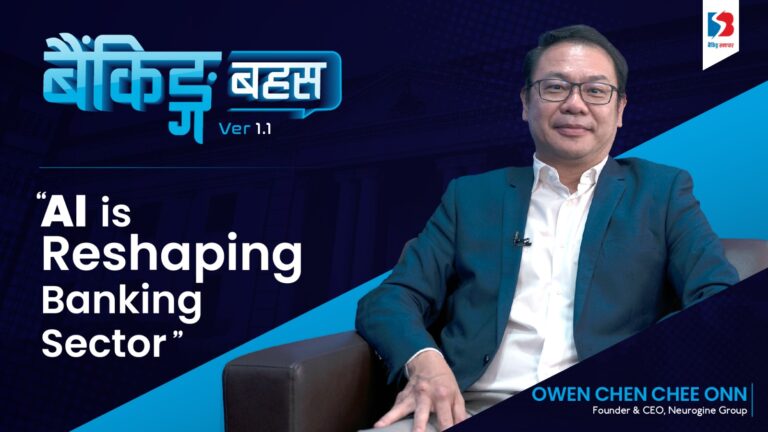

Globally, financial institutions are dumping billions into digital hype, yet consumer fraud is skyrocketing, cross-border payments remain broken, and an incoming quantum threat is about to dismantle standard security in minutes. The harsh reality of 2026? AI isn’t just coming for the banking industry, it’s actively filtering it out.
In this exclusive episode of The Banking Bahas, host Nikesh Khatri sits down with tech pioneer Owen Chen Chen onn, the CEO and Founder of Neurogen Group. Operating across 21 countries, Chen is on a mission to rewrite the fintech playbook. Let’s dive in.
This is your first time visiting Nepal, and you attended our 4th Banking Discourse event. First of all, how was your experience?
Oh, it really impressed me. The event managed to gather a lot of excellent speakers and contributors, and it drew significant attention from many banks. I was genuinely impressed by how the event pulled the right crowd to focus on the national banking agenda.
Thank you for that. Now, Neurogen is a fintech company pushing innovation in tokenization, blockchain, AI, and API technologies. To start off, banking has always adapted to new technologies. Why is the current shift to AI and digital payments a much bigger deal than past technological shifts?
Well, today, banking faces a completely new challenger and pusher, the fintech sector. You see many fintech players coming up trying to deliver services that are highly competitive, user friendly, and seamless for the customer. Banking has to step up because these non banking fintech players are entering their markets. If the consumer feels a fintech company serves them better, makes them happier, and is cheaper, the user will instantly swing to whoever serves them best. Banking can no longer operate the way it did in the past; banks today must be far more adaptive toward their customers.
If you compare the Nepalese and Malaysian banking sectors, what are the primary differences in terms of fintech innovation?
First of all, Malaysia has generally been a bit ahead with technology in Southeast Asia. The major difference is that Malaysian fintech companies have scaled outside of Malaysia, they are no longer just serving the local market. Many of us go abroad to compete, and along the way, we learn continuously from international competitors. I think the core difference is that Nepal needs more of this external exposure. With that exposure, Nepalese institutions can become equally competitive.
In this competitive race of fintech and innovation over the next decade, who do you think will win by 2030? Will it be traditional consumer banks, specialized fintech companies, or the big tech firms?
That is very subjective. The ultimate winner will simply be whoever figures out how to best serve the customer in terms of protecting them, making transactions completely convenient, keeping costs affordable, and ensuring the service is incredibly easy to use. Whichever sector addresses those core needs effectively will likely emerge as the winner globally.
Globally, we see the banking sector investing billions into new technologies, yet consumers still frequently feel frustrated. Why does so much of this financial investment feel wasted?
Generally, particularly in South Asia, most tech companies you encounter are actually just ‘technology brokers.’ They do not spend money on or emphasize true R&D (Research and Development). Instead, they dump funds into heavy marketing, studying consumer behaviors, and adjusting price models, all while using someone else’s underlying technology.
If you continue to be a tech broker, you are heavily limited in how cost-effective or flexible your pricing model can be. To make a solution truly affordable for your own local citizens, you have to start investing in building the core technology yourself rather than renting it. Alternatively, you can work closely with a primary principal company like Neurogen, where we blend what we have into your specific ecosystem, and over a few years, that technology transitions to belong to you. The more tech dependency a bank has, the higher the cost to the consumer. Less dependency equals lower costs for your users.
Nikesh Khatri: Let’s imagine that you were suddenly appointed the CEO of a traditional bank. What are the three core strategies you would adopt to make your consumers happy?
At first, I will Clean Up and Leverage In-House Data. I would make sure our own data and internal knowledge can be scaled, sustained, and enhanced. You must use your data to convert raw inputs into actionable information that helps you make decisions whether you are utilizing AI or not. Once your data state is ready, you can scale using a partial partnership model to begin innovating safely.
& Talent Retention and Enhancement. Success is entirely built on people. If your workforce isn’t successful, the company will never be successful. Talent isn’t just born; it has to be trained. You have to commit real resources to training, industry exposure, and continuous hands on experiments.
& finally Patient, Clear Market Adoption. People must actually understand what you are offering. Sometimes, when a bank gets too blindly enthusiastic about the technology itself, a massive disconnect forms between the bank and the user’s practical understanding of how to use the service. I would emphasize these three areas to completely turn a bank around.
Despite years of massive innovation and endless fintech hype, why is sending money cross border still such a broken, frustrating process?
It circles back to what I just mentioned: people spend millions collecting data, but if that data cannot be transformed into structural knowledge to guide decisions, you remain stuck in a vicious cycle. You can’t find clear answers.
To fix this, institutions have to be incredibly patient, highly focused, and very objective about their end goal. If a bank keeps changing its goals every few months without giving the team or the strategy enough time to mature, you end up with a “half-cooked” or “half-baked” rollout. Then, you spend all your time frantically reacting to the failures of a half-cooked system, which wastes an unjustifiable amount of time and capital.
Nikesh Khatri: Looking ahead, what is the single biggest change coming to global payment systems?
Payments themselves have actually become very mature. In the past, we only had checks, cash, fixed deposits, and savings accounts. Then came Visa, Mastercard, Amex, drafts, bank guarantees, and Swift codes. Today, we have e-wallets and customized QR codes unique to various countries. Payment mechanisms are incredibly mature, but these services are highly siloed; they don’t natively integrate well with one another. The next step we are seeing is national QR codes that can seamlessly clear cross border.
However, because payment systems are so mature, the absolute next focus must be: How secure is your QR code or mobile money transfer? Financial fraud is growing exponentially today because everything has moved online, and users blindly assume that they are magically protected by their bank. If banks do not proactively upgrade and enhance their existing security standards, they will find that simply playing catch-up to basic ISO standards is a very losing, expensive approach.
Furthermore, quantum breakthroughs are coming within the next 3 years, if not earlier. Quantum computing will easily break any standard cryptographic security or current soft tokens we use today within a single minute. Don’t just worry about standard QR code safety; quantum computing changes the entire paradigm. Banks have to look at this immediately to protect their consumers.
Let’s dive deeper into AI. Neurogen relies heavily on AI innovation. Right now, AI is disrupting every industry, including fintech. How exactly will AI reshape the banking sector moving forward?
Let’s learn from large countries like China and Russia, and even parts of Europe that are waking up to the critical need for data independence. When you freely share your data, you are actively giving away the collective intelligence of your people to foreign corporations.
For example, when an entire population heavily uses a platform like Facebook, Facebook becomes exponentially smarter because they understand your localized culture and behavior inside out. If you want to keep your strategic edge just like a top chef keeping a secret family recipe your data recipe must stay strictly intact within your own house.
If you retain and train your consumer data locally, your market competitiveness remains incredibly unique. You understand your exact localization requirements far better than an outside entity ever could. People use AI casually, but they don’t realize their data is being shipped out of the country to train foreign models. The first rule of AI in banking is ensuring data is trained locally.
Banks are using AI to secure their data, but on the flip side, malicious hackers are also using AI to crack into banks. Who is going to win this AI arms race the security companies or the hackers?
Hackers always exploit two primary vectors: weak security layers or a consumer’s lack of awareness, which leads them straight into scams. If your behavioral data doesn’t leak out publicly, scammers have almost nothing to work with. They can’t read your mind unless you broadcast your habits across WhatsApp, Telegram, or Facebook. By sharing your life online, you allow them to map your behavior. Keeping that information protected and localized is step one.
Step two relates to how modern fraud operates. Fraud is a 24/7 machine; it doesn’t care about holidays, weekends, or whether you are fast asleep. Combined with modern internet speeds and AI, attacks are fast. Relying on rigid, old-school, documentation-based “if-then-else” rules is too slow to stop an attacking AI.
Security must rely on adaptive learning AI. For example, an adaptive system notes your lifestyle patterns: it learns you receive your salary on the 28th, you pay your rent on the 1st, and you always execute that rental transaction in Kathmandu. If an automated payment suddenly attempts to pay rent in Bangkok, the AI instantly detects that the behavioral pattern has shifted. It can safely halt the transaction and learn whether you are simply on holiday or if it’s a legitimate breach. True AI is about rapid, real-time pattern recognition processed instantly via high-speed hardware it’s the fastest defense we have in technology history to stop scams.
What about employment? Is AI going to massively take over the jobs of traditional bankers?
Based on my experience, AI actually creates more job opportunities. The reality is quite simple: those who refuse to adopt AI will be replaced. Those who actively adopt, use, and understand AI will create more value and secure more opportunities.
I have a friend who is a traditional carpenter. He used to rely entirely on middle men to find clients for him. When he learned to use AI, he transformed himself into an interior designer who could interface directly with clients. He upskilled. He used AI as an auxiliary tool to rapidly visualize a customer’s ideas based on his deep, practical knowledge of carpentry. The exact same rule applies to banking. If a banker uses AI to automate tedious, back end paperwork, they spend less time on manual processing and far more face to face time deeply serving the client. If you don’t adapt to AI, you will be replaced by someone who does.
Let’s shift focus to tokenization. Your company, Neurogen, is heavily promoting tokenization globally. For our audience, what exactly is tokenization?
At its core, tokenization is about completely protecting transactions. While traditional tokens were highly restricted to a single entity, modern tokenization must securely operate cross-entity.
When you pair modern tokenization with the FIDO2 standard, you achieve a level of protection that is inherently quantum-proof. It enables a strict “what you see is what you sign” environment. Historically, old token paths were split, meaning what you saw on your screen wasn’t necessarily what was happening in the background code. FIDO2 merges this into the core operating system and device hardware using platform attestations tethered directly to networks like Google or Apple iOS.
Historically, tokenization was incredibly expensive, so banks only deployed it to protect high-net-worth accounts, leaving smaller accounts vulnerable. Additionally, most vendors push a cloud-based model that traps banks in an aggressive “vendor lock-in.” Neurogen completely rejects this approach. We build and deploy the entire tokenization engine directly within the bank’s own local data center. This eliminates vendor lock-in, ensures complete data sovereignty, and makes top-tier security highly affordable for the entire customer base. FIDO2 tokenization is utilized by global giants like Visa, Mastercard, Cloudflare, Google, and Microsoft. Our job is to bring that exact same caliber of local data engine directly to regional banks.
Can developing countries like Nepal easily afford this caliber of tokenization technology?
Absolutely. We have active clients across massive regions like Indonesia and Myanmar who use it affordably. The key is avoiding the traditional industry pitfalls: the vendor lock-in model and forcing everything onto an external cloud. If you avoid those, it becomes entirely sustainable.
At last, Neurogen is actively promoting a technology called ‘SoftPOS.’ How can this technology gain widespread merchant acceptance in a country like Nepal?
There are two distinct ways to look at SoftPOS. In its simplest form, it allows a merchant to turn an ordinary, open smartphone into a secure payment receiver. A plumber or a small restaurant owner can accept payments directly on their personal phone. However, some consumers feel slightly uneasy tapping their cards onto a merchant’s private personal phone.
To solve this, Neurogen developed dedicated mobile terminal hardware that retains an open standard operating system. Traditional credit card terminals are completely locked; they can process a payment and do absolutely nothing else. An open-standard SoftPOS terminal, however, handles payments while simultaneously running a merchant’s Point-of-Sale (POS) software, managing inventory, dispensing vending machine items, or printing logistics, bus, and stadium tickets all from one single device.

 About Us
Comment