
Banking News – The hills and slopes of the country’s mid-hill region are considered suitable for coffee farming. Especially in hilly districts with suitable climate and soil for Arabica coffee production, its commercial farming has been found expanding. Coffee farming has been making the rural economy dynamic while increasing the possibilities of farmers’ income, employment, and foreign exchange earnings through exports. In terms of coffee farming expansion and production, Kavrepalanchok has established itself as the country’s leading district. According to the National Tea and Coffee Development Board, coffee is being farmed on 5,501.05 hectares in the country, with processed green bean coffee production reaching 641.90 metric tons. Coffee farming has expanded to more than 43 hilly districts of the country. In Kavrepalanchok, coffee is being farmed on 497 hectares, with green bean coffee production reaching 121 metric tons. Kavre is the country’s leading district in terms of area and green bean production.
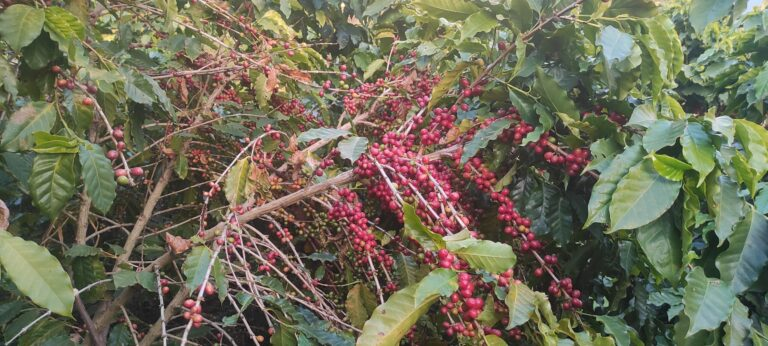
Coffee farming has expanded to all wards of Mahabharat Rural Municipality in Kavrepalanchok. According to the rural municipality, 219.83 metric tons of coffee cherries are produced here annually. This is raw coffee before processing. The rural municipality has been operating various incentive programs to develop coffee as an important foundation of the local economy and connect farmers to production. According to Kancha Lal Jimba, Chairperson of Mahabharat Rural Municipality, more than 5 lakh 66 thousand 500 improved coffee saplings have been distributed to farmers from fiscal year 2077/78 to date. He says the rural municipality has been working continuously to increase production along with coffee farming expansion, make farmers commercial, and create an environment for marketing at the local level.
The rural municipality has launched the campaign “Whoever plants a coffee tree gets a twenty-rupee note.” An arrangement has been made to provide incentive amounts to farmers at the rate of Rs 20 per tree by counting living coffee trees through cooperatives. Jimba stated that this has further encouraged farmers to plant new saplings and protect old gardens. Shankha Lal Thokar, a farmer from Mahabharat, has been farming coffee on 19 ropanis of land. According to him, up to two thousand kilograms of coffee is produced annually from the garden. His experience is that although coffee farming takes effort and time, good income can be earned from it once the market becomes assured.
Another farmer Krishna Bahadur Moktan has also been commercially farming coffee. He stated that he produces 500 kilograms of coffee annually. He says that along with coffee farming expansion, production, processing, market, and price certainty need to be further strengthened. Khanikhola Rural Municipality of Kavre has also moved forward by connecting coffee farming with farmers’ income generation. The rural municipality has started encouraging farmers based on production, adopting the policy “Whoever produces gets the subsidy.”
The rural municipality has distributed saplings worth Rs 10 lakh for coffee farming expansion and provided eight pulper machines to eight farmer groups. According to the rural municipality, 81 metric tons of coffee cherries have been collected from here recently. The rural municipality’s Agriculture Section has stated that farmers are being provided a production incentive of Rs 35 per kilogram based on the quantity of coffee produced. According to Bikas Tamang, Chief of the Agriculture Section, production-based subsidies have further attracted farmers to coffee farming. Rural Municipality Chairperson Indra Bahadur Tamang stated that a policy has been adopted to develop coffee not just as a local product but as a long-term source of income. Along with production, processing and marketing are equally important aspects for coffee-producing farmers. Tulsiram Dhital, Central Member of the Central Coffee Producers Cooperative Federation, emphasized that although Nepal has high potential for coffee, much more work needs to be done to provide farmers with fair prices, regular markets, and necessary technology.
He says there is a need to strengthen cooperatives, expand collection centers, increase access to pulpers and processing machines, maintain quality, and prioritize organic certification to increase coffee production. He says that if processing centers can be established in the production areas themselves, farmers can receive fair prices for their produce and maintain coffee quality. Coffee farming expansion in Nepal has been gradually increasing in recent years. In fiscal year 2071/72, coffee was being farmed on 2,381 hectares, with production of 463.58 metric tons. In fiscal year 2075/76, production reached 530 metric tons. In fiscal year 2076/77, production decreased to 296.50 metric tons.
Production was affected by climate and weather-related problems, diseases, and the outbreak of white stem borer, among other reasons. After that, however, the area and production appear to be gradually increasing. In fiscal year 2080/81, 501.30 metric tons of green bean coffee was produced on 4,309 hectares, while in fiscal year 2081/82, the area increased to 5,501.05 hectares and production reached 641.90 metric tons. In just one year, the coffee farming area increased by 1,192 hectares, and production increased by 140.6 metric tons.
Coffee farming expansion is also remarkable at the provincial level. According to the Central Coffee Producers Federation, 292.45 metric tons was produced on 1,578 hectares in Bagmati Province, 156 metric tons on 1,451 hectares in Gandaki Province, 128.55 metric tons on 1,734.95 hectares in Koshi Province, 62.09 metric tons on 681.20 hectares in Lumbini Province, 2.70 metric tons on 44.30 hectares in Karnali Province, and 0.09 metric tons on 11.60 hectares in Sudurpashchim Province. District-wise, Kavrepalanchok is in the leading position with 121 metric tons of green bean production. After that, 90.50 metric tons in Nuwakot, 83 metric tons in Ilam, 33-33 metric tons in Syangja and Lamjung, 30 metric tons in Gulmi, 24 metric tons in Kaski, 20.70 metric tons in Dhading, and 20-20 metric tons of green bean coffee was produced in Palpa and Gorkha.
Along with increased production, the international market for Nepali coffee has also been expanding. In fiscal year 2081/82, approximately 63,997.55 kilograms of coffee was exported from Nepal. Its export value was Rs 1 crore 14 lakh 36 thousand 972. Among the exporting countries, Germany has emerged as a major market for Nepali coffee. 27,981.7 kilograms of coffee was exported to Germany, with a value of Rs 54 lakh 25 thousand 600. Germany’s share in total exports is approximately 47.4 percent.
17,648.9 kilograms was exported to Japan, 3,878 kilograms to the United Kingdom, 5,373 kilograms to the Netherlands, 2,932 kilograms to Switzerland, and 2,001 kilograms to Italy. Nepali coffee has reached more than 22 countries. Compared to exports, there is still a large gap between domestic demand and supply of coffee in Nepal. In fiscal year 2080/81, Nepal imported 443 metric tons of coffee. Its import value was equivalent to Rs 41 crore 98 lakh. In fiscal year 2081/82, the import quantity decreased to 203.3 metric tons, and the import value is equivalent to Rs 14 crore 41 lakh. A large share of imported coffee comes from India.
Prices of coffee have also improved in recent years. In fiscal year 2081/82, the price of fresh coffee cherry ‘A’ grade was set at Rs 105 per kilogram and ‘B’ grade at Rs 95. In parchment coffee, ‘A’ grade was set at Rs 535 and ‘B’ grade at Rs 482, while in dry cherry, ‘A’ grade was set at Rs 280 and ‘B’ grade at Rs 242. The increase in coffee prices has also increased farmers’ attraction. In fiscal year 2077, the price of dry cherry ‘A’ grade was Rs 148 per kilogram, which increased to Rs 280 in fiscal year 2081/82. If a balance can be maintained between production cost, quality, market, and price, coffee farming appears capable of becoming a reliable means of long-term income for hill farmers.
The programs put forward by local levels of Kavrepalanchok are creating a new foundation for connecting coffee farming with the local economy. Programs ranging from tree-based incentives in Mahabharat to production-based subsidies in Khanikhola have attempted to connect farmers with production. If such programs can be linked with quality, processing, and market, there is potential to increase both local income and employment through coffee farming.
Nepal’s coffee sector is no longer limited to traditional agricultural production alone. This is a sector increasingly connecting with the rural economy, employment, local enterprise, cooperatives, tourism, and exports. Since a single coffee tree planted on a hill slope can provide income to a farmer for years, it can be developed as a long-term agricultural investment. The identity Kavrepalanchok has built in coffee production has also given other hilly districts an opportunity to learn. Tulsiram Dhital, Central Member of the Central Coffee Producers Federation, says that if local level investment, farmers’ labor, the role of cooperatives, and market access can be integrated, Kavre’s experience can be expanded to other districts as well. At a time when coffee farming is being carried out in more than 43 hilly districts, the challenge for the coming days is not just expanding the production area but making the quality of production and farmers’ income sustainable.

 About Us
Comment