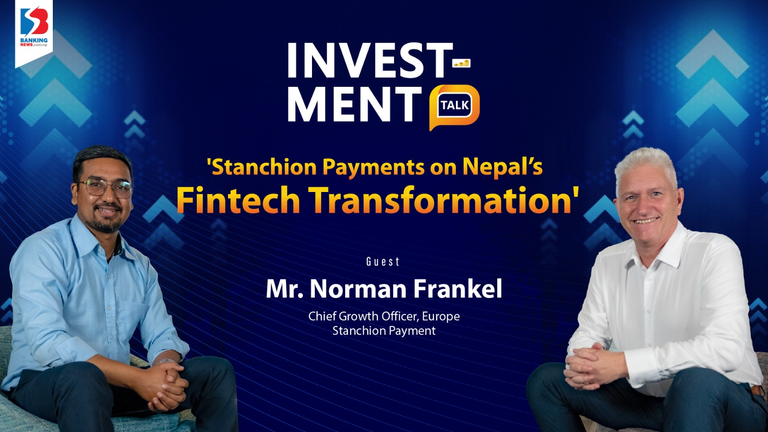

Banking News – In the latest episode of Investment Talk, presented by Banking Samachar and Banking News, Nikesh Khatri, News Chief at Banking Samachar, sat down with Mr. Norman Frankel, Chief Growth Officer (Europe) at Stanchion Payments, to discuss the massive wave of fintech transformation sweeping across Nepal and how global payment solutions are shaping the future of digital banking and investment in the region.
Frankel, who was in Nepal to attend the Fintech Expo 2026 organized by the Nepal Fintech Alliance, shared his observations from his first visit to the country. He noted that Nepal is at the early stages of its fintech journey, similar to markets he recently visited like Kenya and Bangladesh. He stated that he was overwhelmed by the welcome, the vibrancy of Kathmandu, and the general entrepreneurial spirit, but observed a gap in having a strong vision and execution plan for digitalization. He suggested that the local market needs more guidance from international players, fintechs, and major card schemes like Visa, Mastercard, and Union Pay.
Observations from Fintech Expo 2026
Frankel, whose company was a silver sponsor at the expo, categorized the offerings he saw into three areas: infrastructure plays such as cybersecurity and data centers, loan providers offering buy now pay later and embedded finance, and mobile wallet providers. He was particularly fascinated by the virtual card issuance by domestic organizations like Fonepay, which is tightly linked to a leader in the QR space.
He mentioned that over his five-day visit, he attended more than a dozen meetings with major banks, switches, Fonepay, and card schemes. He was impressed by an organization called MBank, a wallet offering a full-service proposition, though he felt they needed to focus more on growing their customer base and usage.
Assessment of Nepal’s Fintech Ecosystem
Assessing Nepal’s fintech ecosystem, Frankel stated that it is in its early days. He expressed that banks are not necessarily doing enough to help fintechs, partly because the banks themselves are not clear on how to connect the dots and put together a value proposition suitable for Gen Z. He also noted a lack of conversation around affluent or wealth niche propositions, which are typically expected when kickstarting a digitalization program.
Opportunities and Gaps
Frankel identified two cornerstones of opportunity for Nepal. First, virtual card issuance aimed at Gen Z and affluent female professional workers, using international card schemes, along with a stronger proposition around tokenizing the virtual card for tap-and-pay use abroad. Second, he emphasized the need for banks to have more faith in issuer tokenization readiness. He cited the example of the Philippines, where after the central bank gave Google Pay the regulatory green light, nine organizations went live within months, followed by Apple Wallet, accelerating seamless payment experiences.
Stanchion Payments’ Evolution and Solutions
Frankel explained that Stanchion Payments was formed 25 years ago in Cape Town, South Africa, and has since grown globally, working with more than 60 banks, issuer processors, and acquirers. Five years ago, the company developed its own intellectual property in the card issuing space, creating a payment fabric that allows banks to keep their existing systems while adding a digital overlay to deliver next-generation card issuing.
He described the company’s three core offerings: the payment fabric for agile digital journeys, Switch Care providing 24/7 technical support around the ACI Postilion platform, and the payment ecosystem offering best-of-breed solutions. He likened Nepal’s current card payment stage to a team that has reached the Olympics but lacks the right equipment, nutrition, and coaching to win a medal.
Growth Strategy and Focus on Cards
Frankel stated that Stanchion’s priority is the card industry, believing that if executed correctly and digitally, it offers a superior experience with substantially lower fraud than QR. He noted that the cost base for cards in Nepal is not yet at the right point to compete with QR but that with the right metrics reset, cards have a future and can provide a great economic growth platform.
He explained that the company models markets based on GDP growth, card growth, digital growth, and smartphone penetration to identify where global players like Google and Apple might prioritize, and that their global partnerships with Mastercard and Visa give them the green light to enter new markets.
Recommendations for Nepal
Frankel suggested that Nepal needs more segmentation and the offering of appropriate solutions to segments before introducing virtual card issuance and tokenization. He also emphasized the need for solutions on the acquiring side and infrastructure to accept those cards. He noted that the foundation for API integration already exists in Nepal, citing an organization called OnePoint, which has already taken on the API integration layer for about 18 banks locally, allowing fintechs to hook into their environments quickly.
Cybersecurity and Fraud
On cybersecurity, Frankel stated that it is a real threat requiring better monitoring and automated response solutions, and that a layered approach is needed. Given the cost consciousness of the Nepalese market, he suggested organizations work with specialized managed security service providers. However, he noted that the bigger losses may not come from cybersecurity but from the developing fraud on QR, which seems to be growing fast and should concern the banking industry.
Regulatory and Commercial Conditions
Frankel stated that markets where fintechs have done well are those where the central bank has a progressive digital agenda and introduces deregulation. He mentioned that he has not met with the central bank yet but would welcome the opportunity on a next visit. He suggested that the central bank look into dynamic currency conversion, noting that 7% of Nepal’s GDP comes from tourists who spend at least $40 a night and cannot pay in their local currency, which would be a genuine money earner, quick to implement for both banks and merchants. He also observed that the visa-on-arrival process at the airport could be improved by allowing it to be completed online prior to arrival.
Collaboration and International Trade Programs
Frankel shared that Stanchion Payments has the support of the Australian government through a trade program called Austrade, which helps cover export sales trips. He suggested that if Nepal wants its fintech ecosystem to expand internationally, it could look at similar systems and collaborative ties between governments, citing trade missions between Vietnam and Australia, and from the Philippines and Indonesia to Australia.
In conclusion, Frankel emphasized that at the end of the day, where ecosystems work well, it is always about collaboration. When asked about his preference between cards and QR, he reiterated his choice for the card system.

 About Us
Comment